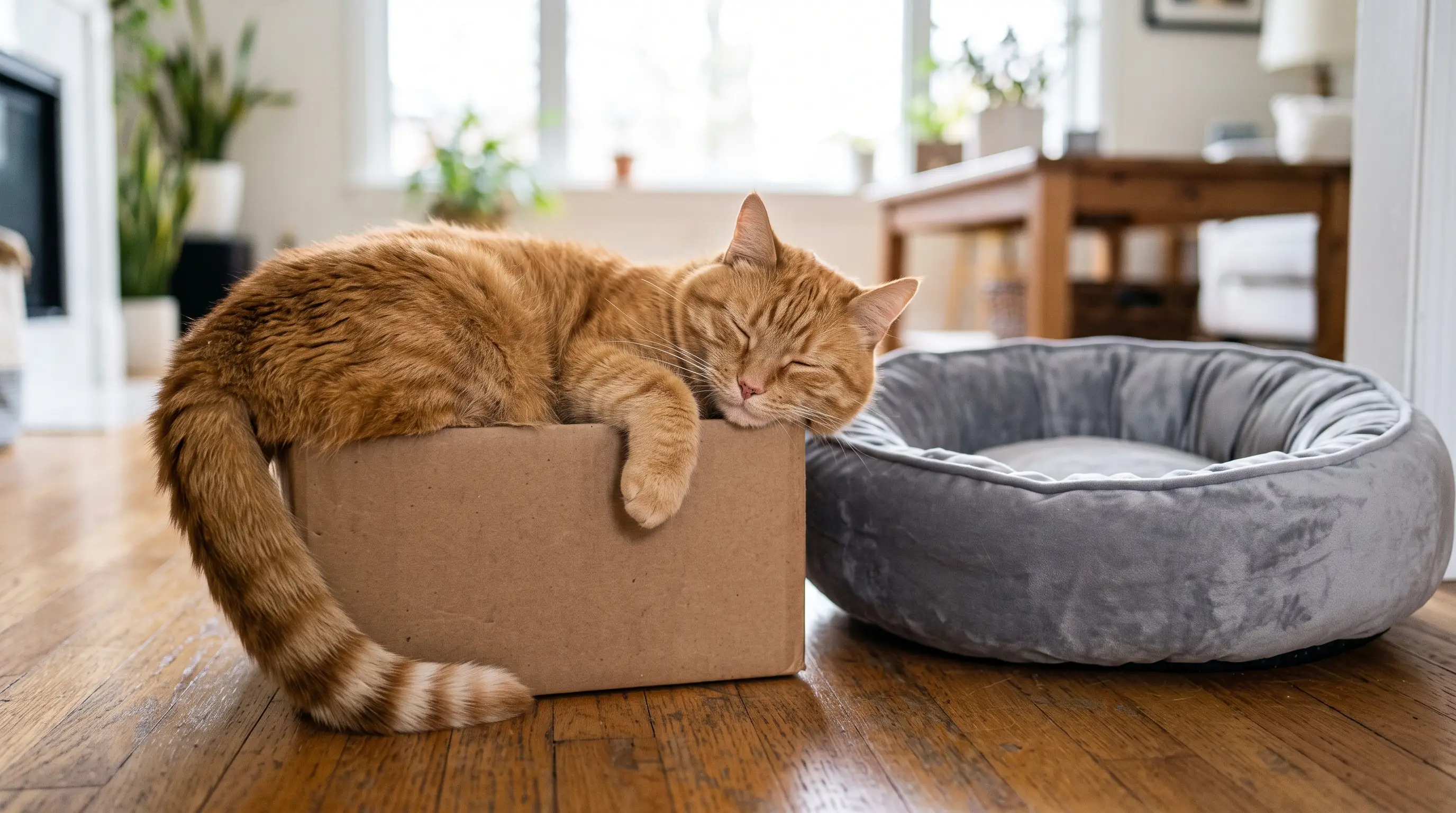
If it fits: why cats sit in boxes
Buy a cat a bed and it sleeps in the packaging: the joke is old because the behaviour is universal. It's also one of the few cat quirks science has tested properly — with shelter studies, thermal physiology, and one gloriously silly citizen-science experiment involving squares that didn't exist. The short answer: a box presses back, a box is warm, a box is a fortress with one entrance, and a cat's brain is so tuned to enclosed spaces that even the *idea* of a box will do. Here's the evidence, and what it means for your flat.
The box presses back
Start with touch. A cat wedged into a snug box has contact on several sides at once, and that whole-body pressure appears to be genuinely calming — the same principle behind swaddling infants, anxiety wraps for dogs, and the squeeze machine Temple Grandin famously built for herself. The behavioural term is thigmotaxis: the drive to be in contact with surfaces. Cats are strongly thigmotaxic, which is why the box beats the open bed, the too-small box beats the right-sized one, and the loaf posture — legs folded, everything tucked — turns the cat itself into its own snug container.
Pressure also explains the absurd end of the spectrum: the cat overflowing a shoebox, sitting in a salad bowl, or cramming itself into the bathroom sink. It isn't miscalculating its size. It's buying contact, and paying in dignity.
A fortress with one entrance
The second driver is security, and here the evidence is unusually clean. In a Dutch study at Utrecht University, newly arrived shelter cats were split into two groups: half got a hiding box in their cage, half didn't. The box cats' stress scores dropped significantly within days, while the boxless cats took much longer to settle. For an animal that is both predator and prey, an enclosed space with walls at its back and one watchable entrance is the safest seat in the house — ambush cover in one direction, defence in the other.
That's also why the box habit intensifies in stressful weeks — a move, a new pet, fireworks season. A cat spending more time in boxes isn't necessarily anxious, but a cat that lives in one while eating less and hiding from the household is telling you something, and the stress signs owners miss covers how to read it. The practical lesson from the shelter data is cheap and generous: every cat, and especially every new or nervous cat, should have a hiding place it owns — a box on its side in a quiet corner outranks most of the pet-shop catalogue. It's the same principle our guide for shy rescue cats is built on.
Thirty degrees, please
Driver three is heat. A cat's thermoneutral zone — the temperature band where its body idles without spending energy on warming or cooling — sits roughly between 30 and 38°C, far above the 20-or-so degrees most of us keep our homes. Your comfortable living room is, to your cat, mildly and permanently chilly. Corrugated cardboard is an excellent insulator, and a small box traps a cat-sized pocket of body heat: the cardboard box is, in thermal terms, a cheap personal sauna.
The same arithmetic explains the sunbeam patrol, the laptop occupation, the radiator hammock, and the August cat baking on hot paving that would make you flinch. None of it is odd. The animal is simply built for warmer weather than your thermostat believes in — one of several desert inheritances, along with the kidney efficiencies covered in how cats and dogs drink.
The square that wasn't there
Now the beautiful part. In 2021, researchers ran a citizen-science experiment — thousands of owners, cameras at home — testing whether cats would sit in a mere square of tape on the floor. They did. Then the researchers went further, using the Kanizsa illusion: four Pac-Man shapes arranged so a human brain perceives a square that is not actually drawn. The cats sat in the illusory squares too, at rates comparable to the taped ones — and ignored the same shapes when rotated so no square appears.
Read that again: a cat's visual system completes the contour, decides "enclosure", and the cat sits in a box made of nothing. The comfort of the box runs so deep in feline wiring that the merest suggestion of boundaries triggers it. The experiment survived every owner's phone camera and a pandemic, and it remains the best proof that the box isn't about cardboard at all. It's about edges — and a cat's brain supplies its own.
Engineering the flat accordingly
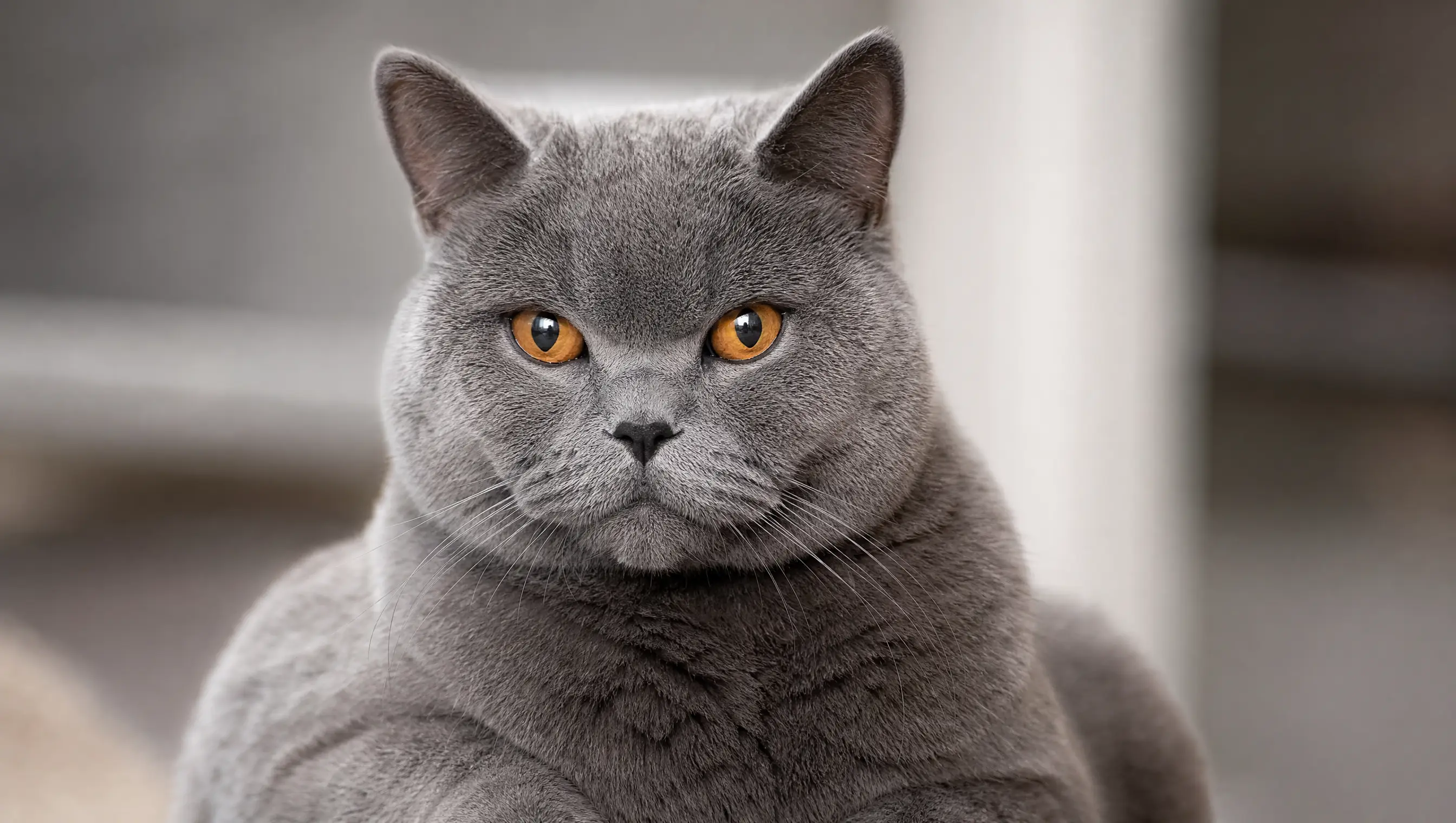
The applications write themselves, and they're free. Keep a box or two in rotation — swap them when they collapse or go stale, and put one wherever the household pressure is highest: a new flat, a spare room during renovations, the quiet corner when guests descend. Give it a blanket in winter and site it off the cold floor. For multi-cat homes, one refuge per cat, in different rooms, prevents the fortress itself becoming contested territory. Solid, compact breeds like the British Shorthair are champion loafers, but the box rule is universal — even the wildcats in zoos get enrichment boxes, and use them the same way.
Two cautions close the file. Watch the box-plus-everything-else pattern: a box habit plus withdrawal, appetite loss or tray changes is stress or illness wearing a cardboard coat. And mind the recycling: check boxes before flattening them, because the universe's sense of humour guarantees the one you crush is the one that's occupied. Otherwise, let the cheap fortress stand. Forty euros of memory foam will lose to it every time, and now you know it's not ingratitude. It's physics, fortress logic and a brain that sees squares where there are none.
Common questions
Why do cats like boxes so much?
Three tested reasons: whole-body contact pressure is calming (cats are strongly thigmotaxic), an enclosed space with one entrance is the safest spot for an animal that is both predator and prey, and cardboard traps heat — a cat's thermal comfort zone starts around 30°C, so your normal room is chilly to it. A box answers all three at once.
Why do cats sit in squares on the floor?
Because the attraction is to enclosure itself, not cardboard. In a 2021 citizen-science study, cats sat inside squares of tape — and inside Kanizsa illusory squares, outlines their brains completed from four corner shapes. Even the suggestion of boundaries reads as 'box' to a cat's visual system.
Do boxes reduce stress in cats?
Yes, measurably. In a Utrecht University shelter study, newly arrived cats given a hiding box showed significantly lower stress scores within days than cats without one. A hiding place a cat owns is one of the cheapest welfare upgrades there is — especially for new, shy or nervous cats.
Why does my cat sit in boxes that are too small?
It's buying pressure, not misjudging its size. Snug contact on several sides is the calming part — the same principle as swaddling — so the too-small box often beats the right-sized one. The overflow is the point.
Why does my cat ignore its expensive bed?
The bed answers one need (softness); the box answers three (pressure, security, warmth). An open bed offers no walls, no ambush cover and no heat trap. Put a blanket inside a box, or choose enclosed, cave-style beds, and the economics improve.
What does the cat loaf position mean?
The loaf — legs folded under, tail wrapped — is a relaxed, warmth-conserving posture: the cat turns itself into its own snug container. It usually signals a comfortable cat at rest. A hunched version with tense muscles, half-closed eyes and reluctance to move can indicate pain instead; the difference is in the looseness.
More in Cats
Why does my cat lick me? Grooming, love and salt
A cat's lick is mostly a compliment: you've been adopted into the grooming circle. What the sandpaper tongue is doing, why some cats overdo it, and when to gently opt out.
Why does my cat follow me everywhere, even the bathroom?
The supposedly aloof animal trailing you from room to room is behaving exactly as the attachment science predicts. Why cats shadow their person, the bathroom mystery, and the one change that needs a vet.
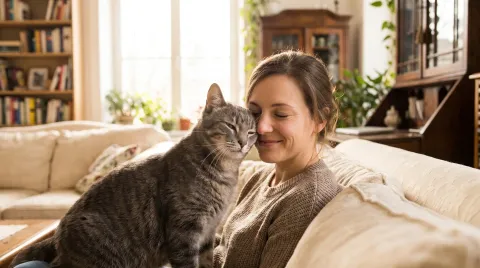
Do cats love their owners? The kidnap experiment says yes
Science ran the same attachment test on cats that it runs on human infants, and 64% passed. What the secure-base test found, why one earlier study disagreed, and how a cat actually says it.
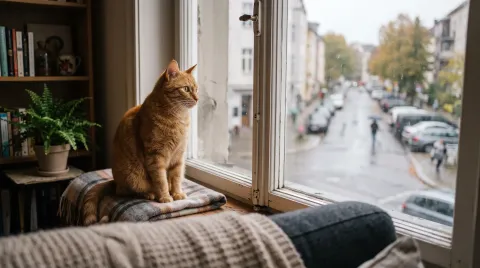
Do cats miss their owners? They even track the clock
Cats greet you harder after four hours away than after thirty minutes — they know how long you were gone. What missing looks like in a cat, when it tips into separation anxiety, and how to leave well.
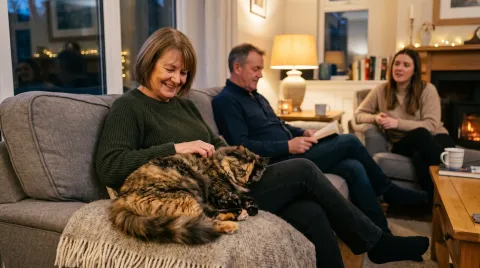
How cats choose their favourite person
It isn't whoever fills the bowl. The Swiss living-room study found one habit that predicts a cat's favourite better than food ever did — and the person who ignores cats has it by accident.
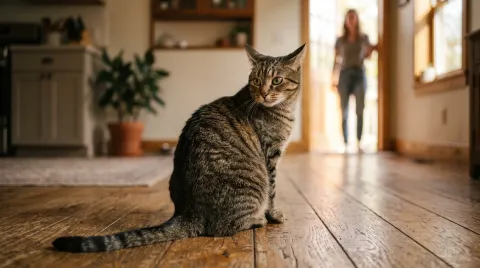
Cats know their names. They've decided not to answer
A Tokyo lab proved cats pick their own name out of a string of similar words — even from a stranger's mouth. What cats actually understand of what you say, and why the response is optional.