Why does my cat lick me? Grooming, love and salt
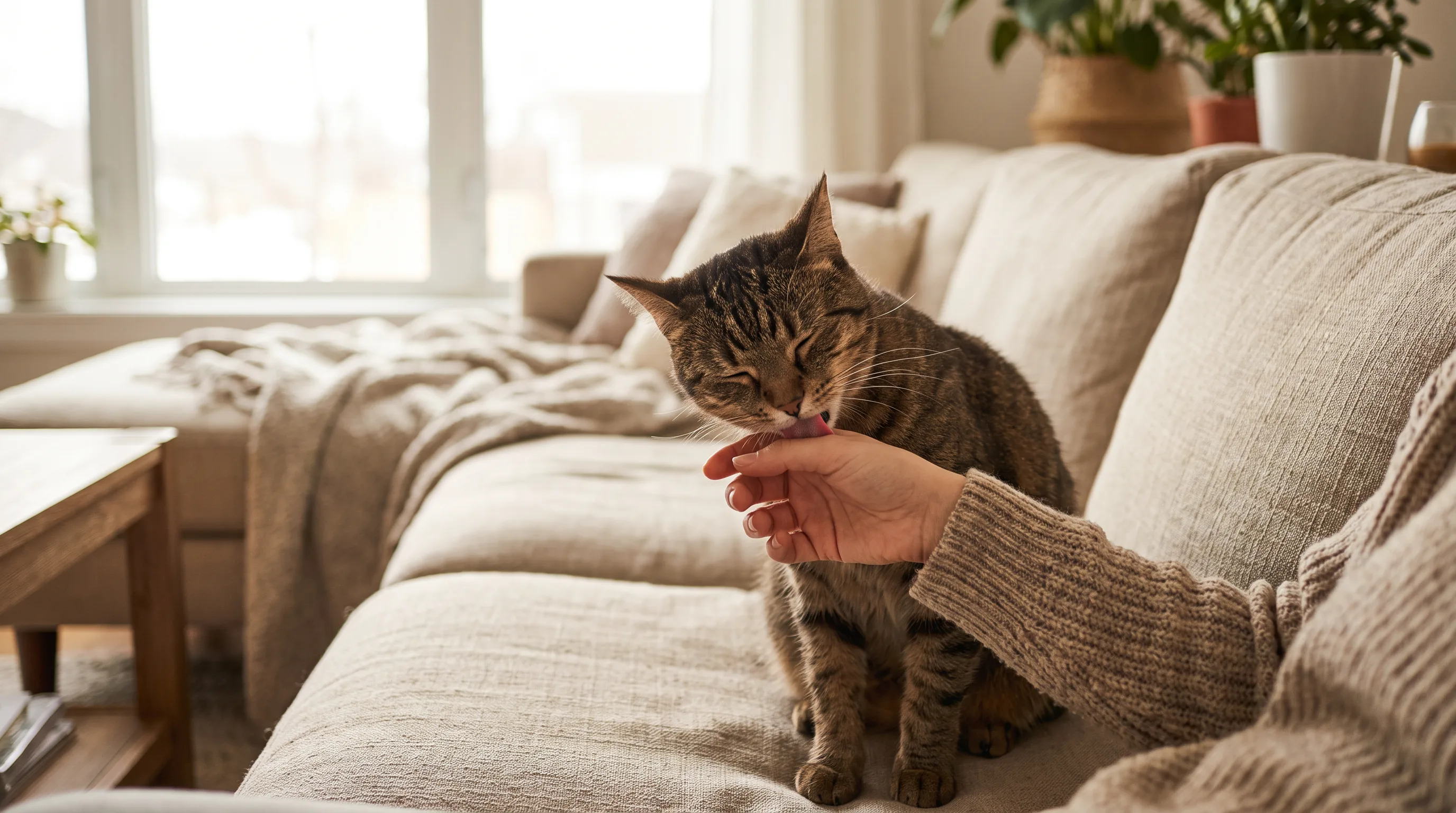
When your cat licks you, it is usually doing to you what cats in the same social group do to each other: grooming you, mixing scents, and filing you under family. There are smaller reasons in the mix — your skin tastes of salt, licking gets your attention, and a few cats lick because something is wrong — but the headline is friendly. Here is what that rasping tongue is actually saying, and what to do when the affection starts to hurt.
You've joined the grooming circle
Cats that like each other groom each other. Behaviourists call it allogrooming, and in a feline household it runs along affiliation lines: cats lick the cats they rest with, and they concentrate on the head and neck, the spots a cat can't reach on itself. It starts at birth — a mother licks her kittens to clean them, stimulate them and mark them as hers — and among adults it doubles as social glue, smoothing tensions and blending the group's scent into one shared signature.
A cat that licks your hand or your arm is extending that system to you. You're being groomed as a member of the group, and lightly scent-marked as part of the furniture of its life. As compliments from a cat go, only the slow blink and the exposed belly sit in the same league, and our guide to cat body language covers both.
The smaller reasons: salt, attention, comfort
Not every lick is a love letter. Human skin is lightly salted, and some cats simply like the taste — licks that cluster after your workout are about electrolytes, not emotion. Licking is also a reliable attention lever: if a lick makes you look up, talk, or hand over breakfast, your cat files that away and uses it, which is why so much licking happens near feeding time.
Some cats also lick for comfort, the way they knead — both are behaviours carried forward from kittenhood, and cats weaned very young tend to do more of both, sometimes graduating to sucking on blankets or sleeves. The occasional comfort-licker is fine. A cat that spends long stretches sucking fabric is soothing itself, and it's worth asking what in the household needs the soothing; cat stress signs walks through the usual suspects. The kneading half of the story has its own page.
Why the tongue feels like sandpaper
A cat's tongue is covered in hundreds of backward-facing hooks of keratin — the same material as claws — called papillae. They're hollow-tipped and they wick saliva down to the skin, which is how a cat deep-cleans a coat it can't see into; the backward angle is also why anything a cat starts swallowing tends to finish the journey, hair included — which is where hairballs come from.
On your bare arm, those hooks are why affection arrives as fine-grade sandpaper. A few licks are harmless. A dedicated groomer working the same patch of your skin can genuinely redden it, which is one of several polite reasons to redirect a committed licker — and the only reason you ever need to give.
When licking means something is wrong
The licking that deserves attention is the kind that changes. A cat that suddenly licks you far more than its own normal is often asking for something — food, play, reassurance after an upheaval — and sometimes transferring nervous energy: over-grooming is one of the classic feline stress outlets. Check the basics first: has the routine changed, is there a new animal, a new baby, a house move in the mix?
Watch the cat's own coat too. A cat that over-grooms you often over-grooms itself, and thinning fur on the belly, flanks or forelegs is a flag for stress, skin irritation or pain that belongs at the vet rather than in a training plan. And a lick-lick-bite sequence during a stroking session isn't betrayal — it's the overstimulation threshold arriving, covered in petting aggression: the licks were the countdown, and the bite was the announcement that time was up.
How to opt out without offending anyone
You're allowed to not enjoy it. The way out is redirection, not punishment: when the licking starts, stand up or withdraw the arm calmly and offer something better — a wand toy, a food puzzle, a stroke along the cheeks. Done consistently, the cat learns that licking ends the interaction and play continues it. Never scold or push the cat off sharply; to the cat, it was mid-compliment, and punishment just adds confusion to affection.
Two practical cautions. Keep freshly creamed or medicated skin away from a licker — anything on your skin ends up in the cat, and some human topicals (think pain-relief gels and certain lotions) are genuinely dangerous to them. And if you've just handled food a cat shouldn't have — onion, garlic, anything in toxic foods for cats — wash before you offer the arm back.
Common questions
Why does my cat lick me?
Mostly as social grooming: cats lick the individuals they consider part of their group, mixing scents and maintaining the bond, exactly as they do with cats they like. Salt on your skin, learned attention-seeking and comfort behaviour carried over from kittenhood make up most of the rest.
Why does my cat lick me then bite me?
That sequence is usually overstimulation: the licking was part of a stroking session that went past the cat's tolerance threshold, and the nip announces that time is up. Watch for the earlier warnings — a twitching tail tip, skin rippling, ears rotating back — and end sessions before the countdown runs out.
Is it safe to let my cat lick me?
On intact skin, yes, for healthy adults. Don't allow licking on broken skin, and keep a licking cat away from skin carrying creams or medication — topicals end up in the cat, and some human products are toxic to them. Wash your hands after handling foods cats shouldn't eat.
Why does my cat lick my hair?
Head and neck are exactly where cats groom each other, so a cat working on your hair is treating you as a well-liked, slightly oversized cat. It can also simply like the texture or the smell of your shampoo. It's harmless unless you mind it.
Why does my cat lick me more than anyone else in the house?
Cats groom along relationship lines: the person who feeds, plays with and sleeps near a cat typically gets the licks. It's one of the clearer signs of who a cat regards as its person — a theme our guide to a cat's favourite person takes further.
When is licking a problem?
When it changes. A sudden increase in licking you, or over-grooming of the cat's own coat — thinning fur on the belly, flanks or legs — points at stress, skin trouble or pain and is worth a vet conversation. Steady, moderate licking from a relaxed cat is just affection.
More in Cats
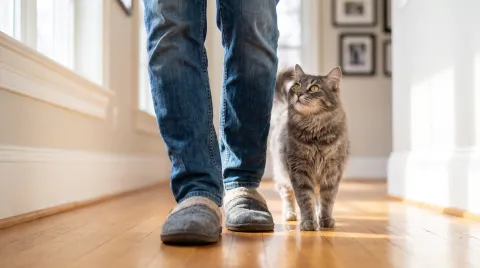
Why does my cat follow me everywhere, even the bathroom?
The supposedly aloof animal trailing you from room to room is behaving exactly as the attachment science predicts. Why cats shadow their person, the bathroom mystery, and the one change that needs a vet.
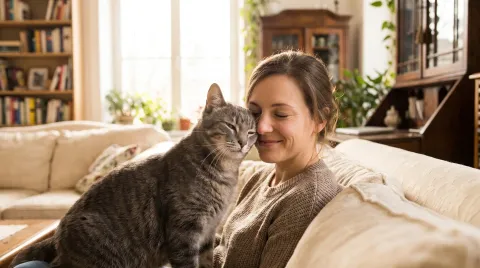
Do cats love their owners? The kidnap experiment says yes
Science ran the same attachment test on cats that it runs on human infants, and 64% passed. What the secure-base test found, why one earlier study disagreed, and how a cat actually says it.
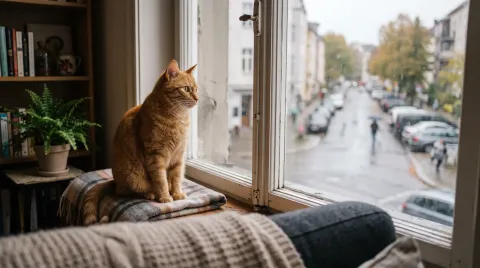
Do cats miss their owners? They even track the clock
Cats greet you harder after four hours away than after thirty minutes — they know how long you were gone. What missing looks like in a cat, when it tips into separation anxiety, and how to leave well.

How cats choose their favourite person
It isn't whoever fills the bowl. The Swiss living-room study found one habit that predicts a cat's favourite better than food ever did — and the person who ignores cats has it by accident.
Cats know their names. They've decided not to answer
A Tokyo lab proved cats pick their own name out of a string of similar words — even from a stranger's mouth. What cats actually understand of what you say, and why the response is optional.
Zoomies: why your cat sprints through the house at 3am
The wall-of-death lap around the living room has a name, a mechanism, and a fix for the 3am edition. Why a predator that sleeps sixteen hours a day sometimes has to spend the surplus all at once.