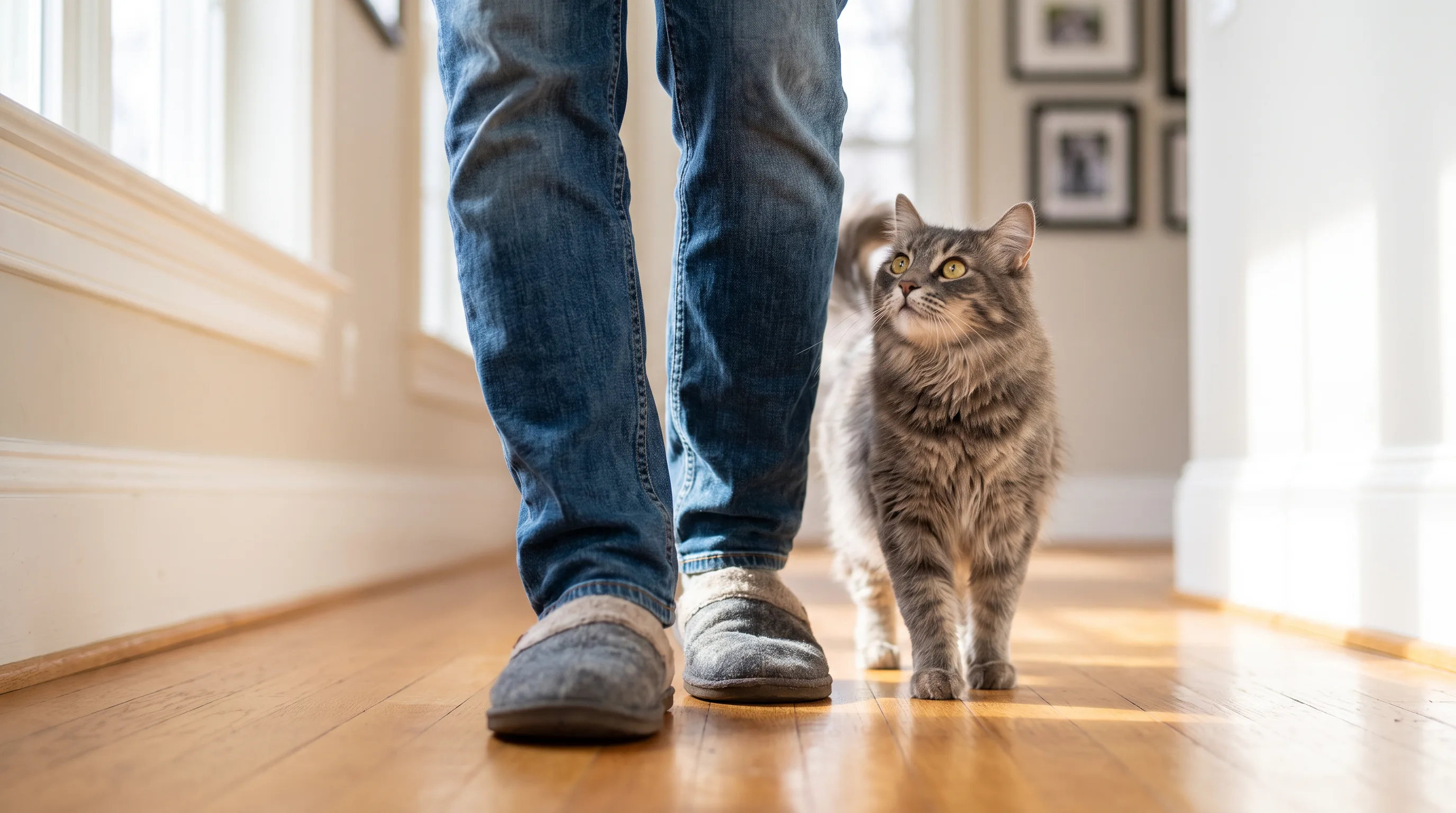
Why does my cat follow me everywhere, even the bathroom?
A cat that follows you everywhere isn't broken, needy or plotting. Cats form real attachments to their people — in controlled tests, most cats treat their person as a safe base the way infants and dogs do — and following is what that attachment looks like with legs. Add curiosity, meal-time arithmetic and the strange magnetism of a closed bathroom door, and the shadow at your heel is fully explained. Here's the breakdown, and the one version of it that belongs at the vet.
Attachment, with legs
The aloof-cat stereotype has been tested and it lost. When researchers at Oregon State University ran cats through the same “strange situation” protocol used on human infants and dogs, about 65% of cats showed secure attachment to their owner — returning to them as a safe base after a brief separation, at almost exactly the rate human babies do. A securely attached animal keeps track of where its person is. In a house, that's called following you around.
Following is also information-gathering. You are the most interesting thing that moves in your cat's territory: you open doors, operate taps, produce food and rearrange objects. A cat trailing you on your route through the flat is part companion, part site inspector. The broader science of what cats feel about us is in do cats love their owners.
The meal-time economist
Some shadowing is simply arithmetic. Cats are formidable readers of routine: they learn the sequence of events that precedes food — alarm, kettle, fridge door — and insert themselves into it early. A cat that materialises at your ankles every day at five isn't psychic, it's been running the schedule in its head, and escorting you toward the kitchen is its way of keeping the process on track.
The same logic covers the escort to the food cupboard, the supervision of tin-opening and the figure-of-eight through your legs — that last one doubles as scent-marking, wrapping you in the household smell. If the following is strongly clustered around meals, you've been adopted as infrastructure. It's still affection; it's just affection with an agenda.
The bathroom mystery, solved
The bathroom escort is so universal it deserves its own section. Several things converge there. You sit still, at cat height, with empty hands — from a cat's point of view, the single best audience you offer all day. The room itself is interesting: cool tiles, a sink that sometimes drips, towels to sit on, and your undivided attention trapped in one place.
Then there's the door. Cats dislike closed doors on principle — a shut door removes part of their territory and cuts off their line of sight to their person, and a territorial animal objects to both. Many cats that ignore you all evening will cry at a closed bathroom door, not because the bathroom matters but because the exclusion does. Letting them in usually produces a cat that sniffs the bath, sits on the mat, and does nothing at all. That was the point: access, not activity.
The breeds that shadow professionally
Any cat can be a shadow, but some breeds ship with the behaviour. The Siamese and its relatives follow and narrate; the Ragdoll pads after its people from room to room and settles wherever they stop; the Maine Coon supervises like a site foreman; the Burmese treats separate rooms as an administrative error.
If you chose one of these, the following is a feature you ordered. The flip side is real: people-oriented breeds dislike empty houses, and a professional shadow with nobody home all day is a candidate for boredom and stress. For long work days, a bonded pair — or a less velcro breed — is the honest setup. Which cat in the household gets shadowed also says something; how cats choose their favourite person covers the selection criteria.
When following changes: the vet flag
The version that matters medically is new clinginess in a cat that didn't use to be clingy. Cats hide illness, and for some the hiding takes the form of staying close. Sudden shadowing plus louder, more urgent vocalising — especially in a cat past ten — puts hyperthyroidism, high blood pressure and failing senses on the list. A senior that follows you because it's losing hearing or sight startles when you appear, calls more at night, and tracks you with unusual intensity; feline cognitive decline adds disorientation and reversed sleep to the picture. The full senior checklist is in senior cat care.
New clinginess after an upheaval — a move, a new pet, a schedule change — reads differently: that's a cat seeking its safe base more often because the territory feels less safe, and it settles as the routine does. Make the distinction on the trend: a cause you can name plus a cat that relaxes within a couple of weeks is adjustment; following that escalates with no obvious trigger, or arrives with weight loss, appetite change or night yowling, is a vet appointment, not a personality quirk.
Common questions
Why does my cat follow me everywhere?
Because it's attached to you, and following is what attachment looks like: in tests, about 65% of cats treat their owner as a safe base, the same rate as human infants. Routine-reading around meals, curiosity about everything you do, and breed temperament make up the rest.
Why does my cat follow me to the bathroom?
You're seated, still, at cat height, with free hands — the best audience of the day — in an interesting room with cool tiles and a captive occupant. Add the feline objection to closed doors cutting off territory and line of sight, and the escort is fully explained.
Is it bad that my cat follows me everywhere?
Usually it's a compliment and nothing more. It's worth attention when it's new: a previously independent cat that turns clingy — especially a senior, and especially with more vocalising, weight change or night-time restlessness — should see a vet to rule out hyperthyroidism and other age conditions.
Do cats get separation anxiety?
Some do, particularly people-oriented breeds and cats in single-cat homes that are empty all day. Signs include vocalising at departures, over-grooming, and litter-box lapses clustered around your absences. More play, foraging toys, and in some homes a second cat all help; persistent cases merit a vet-and-behaviourist conversation.
Why does my cat follow me and no one else?
Cats pick their person along practical lines: who feeds, who plays, who moves predictably and reads their signals. The household member who does those things usually acquires the shadow. It can change hands when routines change.
Should I ignore my cat when it follows me?
No need — it isn't misbehaviour. Enjoy it, and invest the attention where it pays: a real play session and a feeding routine give the cat something better to organise its day around than your ankles. Only sudden, anxious shadowing needs more than that.
See also
More in Cats
Why does my cat lick me? Grooming, love and salt
A cat's lick is mostly a compliment: you've been adopted into the grooming circle. What the sandpaper tongue is doing, why some cats overdo it, and when to gently opt out.
Do cats love their owners? The kidnap experiment says yes
Science ran the same attachment test on cats that it runs on human infants, and 64% passed. What the secure-base test found, why one earlier study disagreed, and how a cat actually says it.
Do cats miss their owners? They even track the clock
Cats greet you harder after four hours away than after thirty minutes — they know how long you were gone. What missing looks like in a cat, when it tips into separation anxiety, and how to leave well.
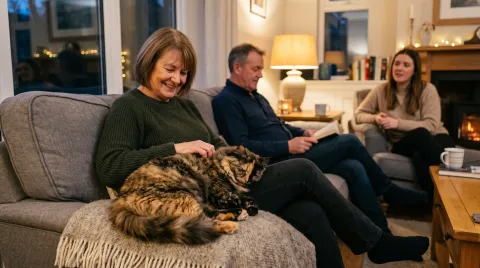
How cats choose their favourite person
It isn't whoever fills the bowl. The Swiss living-room study found one habit that predicts a cat's favourite better than food ever did — and the person who ignores cats has it by accident.
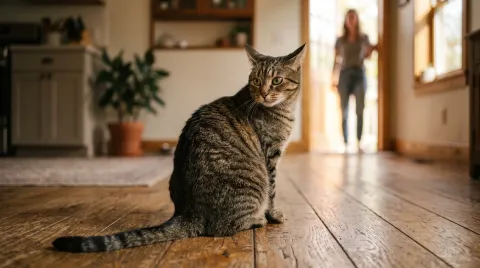
Cats know their names. They've decided not to answer
A Tokyo lab proved cats pick their own name out of a string of similar words — even from a stranger's mouth. What cats actually understand of what you say, and why the response is optional.
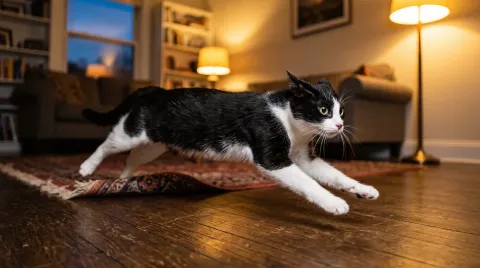
Zoomies: why your cat sprints through the house at 3am
The wall-of-death lap around the living room has a name, a mechanism, and a fix for the 3am edition. Why a predator that sleeps sixteen hours a day sometimes has to spend the surplus all at once.