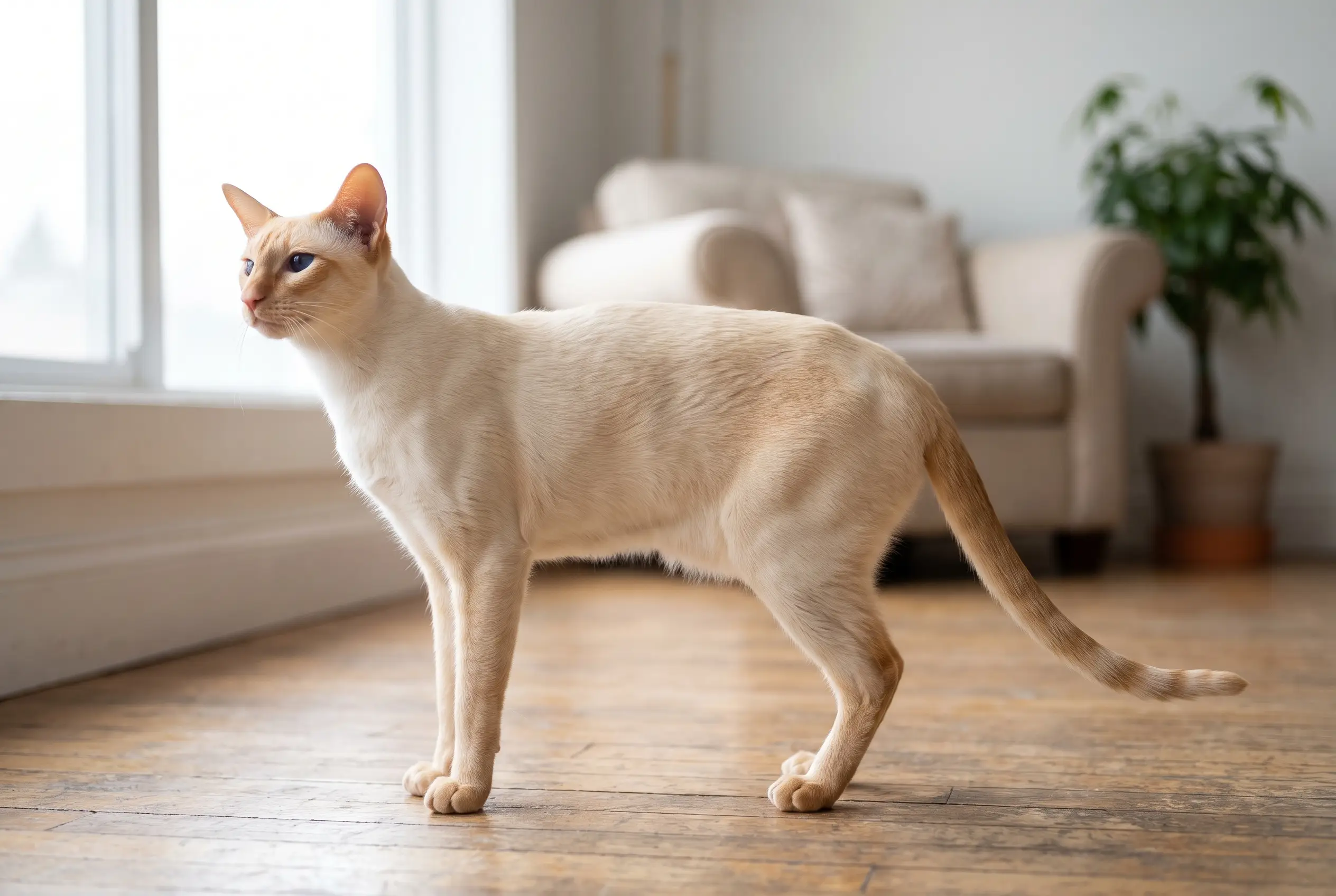
Colorpoint Shorthair
A Siamese in every way that shows, except the four colours the Siamese standard allows.
Vital stats
| Size | Medium · long, tubular, fine-boned |
| Weight | 2.7–5.4 kg · males heavier |
| Life expectancy | 12–16 years — breed literature, not a CFA-published figure |
| Energy | High — busy, vocal and people-focused |
| Shedding | Low · short single coat |
| Coat | Short, fine, pointed; 16 recognised point colours |
| Group | Shorthair |
| Origin | United States |
Breed traits
Friendliness
Care
Mind
The Colorpoint Shorthair by the numbers
The Colorpoint Shorthair facts owners search for most — price, lifespan, weight, shedding and colours, in one place.
Less common, so expect a waitlist and some travel to a reputable breeder — which pushes the price up. Ongoing costs stay modest — it eats little and routine vet care sits at the lower end.
We don't quote a single figure: the real price swings with breeder, region, bloodline and health testing — and a rescue costs a fraction of a breeder's litter. Adopting is almost always the cheapest route.
Temperament
Take everything true of a Siamese and it holds here too: constant contact, a loud running commentary on the household, quick learning, and real trouble with being left alone. There is nothing in the standard or the breed history that changes the wiring, because the wiring is Siamese wiring with a different coat colour riding on top. What buyers actually notice as different is cosmetic — a red point looks warmer and brighter than a seal point, a lynx point carries faint tabby striping through the mask and legs — and none of it changes how the cat behaves in a house. If you want the Siamese temperament without the traditional four colours, this is that cat; if you want a genuinely different personality, look elsewhere in the family.
Habits & quirks
Patterned points, not just coloured ones
Lynx points carry visible tabby striping through the mask, legs and tail, and tortie points come mottled rather than solid — a look no traditional seal, chocolate, blue or lilac point Siamese is allowed to have.
Red and cream run warm
Where a seal or blue point reads cool and dark, a red or cream point reads warm and bright, and young kittens with red points can look almost solidly ginger before the contrast settles in.
Born pale, coloured in over weeks
Kittens arrive nearly white; the same heat-sensitive pigment gene that colours a Siamese darkens the cooler extremities first, so the final point colour takes several weeks to show.
A pedigree that keeps changing shape
Breeders have spent seven decades breeding these cats back toward Siamese type after every colour outcross, which is why a modern Colorpoint Shorthair is, structurally, not distinguishable from a Siamese by eye.
Care
| Grooming | The short single coat needs almost nothing — a weekly wipe with a damp hand or rubber brush, and shedding is light year-round. |
| Health screening | Carries the same risks as the Siamese line it comes from: progressive retinal atrophy (ask for the rdAc DNA test), systemic amyloidosis affecting the liver (no test exists, ask what older cats in the line died of), a tendency toward asthma, and early dental disease. Start brushing teeth as a kitten. |
| Company | The same non-negotiable as any Siamese-type cat: it does badly left alone all day. Plan on a second cat or a household where someone is usually around. |
| Buying one | Ask the breeder which registry they show in before you fall for a kitten. A CFA breeder's paperwork will say Colorpoint Shorthair; a TICA or European breeder's will say Siamese. Neither one is wrong, and neither changes the cat you're bringing home. |
Life expectancy
This breed has a typical life expectancy of 12–16 years — breed literature, not a CFA-published figure.
Similar breeds
Breeds with a similar build and background — worth a look if this one isn't quite the fit.
Common questions
Is the Colorpoint Shorthair a real breed or just a Siamese?
Depends who you ask, and both answers are correct. CFA and the Canadian Cat Association give it full breed status because it carries point colours (red, cream, tortie, lynx) the Siamese standard never admitted. TICA and most European registries disagree and register the identical cat as a Siamese. It's a registry decision, not a biological one — there's no genetic line you could draw between the two.
Why did my Colorpoint Shorthair's papers come back saying Siamese?
Because whoever registered the litter used a registry that treats point colour as a variation within the Siamese breed rather than a separate one — TICA and the European federations mostly work this way. The cat is the same animal a CFA breeder would call a Colorpoint Shorthair; only the paperwork differs.
What colours can a Colorpoint Shorthair have that a Siamese can't?
Red, cream, tortoiseshell and tabby-striped (lynx) points, and the combinations of those with the four traditional Siamese colours — sixteen recognised point colours in CFA's system. A Siamese is restricted to seal, chocolate, blue and lilac points only.
Does the Colorpoint Shorthair shed a lot?
Not much. The Colorpoint Shorthair is a low-shedding breed, so loose hair around the home stays minimal. It still needs regular grooming, but you won't be fighting drifts of fur.
Are Colorpoint Shorthair cats hypoallergenic?
No cat breed is truly hypoallergenic. The trigger is Fel d 1, a protein in a cat's saliva and skin that transfers to the coat during grooming and then travels on loose hair and dander — so a cat that sheds less, like the Colorpoint Shorthair, spreads less of it around the house, but still produces it. If someone at home reacts to cats, spend real time with this breed before deciding, and no breeder should promise you an allergy-free cat.
Are Colorpoint Shorthair cats good with children?
Usually yes. The Colorpoint Shorthair is a sociable cat that tends to tolerate the noise and handling of family life better than most, which is why it comes up so often for homes with kids. It still needs somewhere high and quiet to retreat to, and children need teaching that a cat walking away is allowed to.
How much grooming does a Colorpoint Shorthair need?
Very little. The Colorpoint Shorthair handles its own coat and a comb once a week or so is plenty — mostly to catch loose hair before the cat swallows it. Claws, teeth and ears still want the usual checks, which is the part people skip on an easy-coated cat.