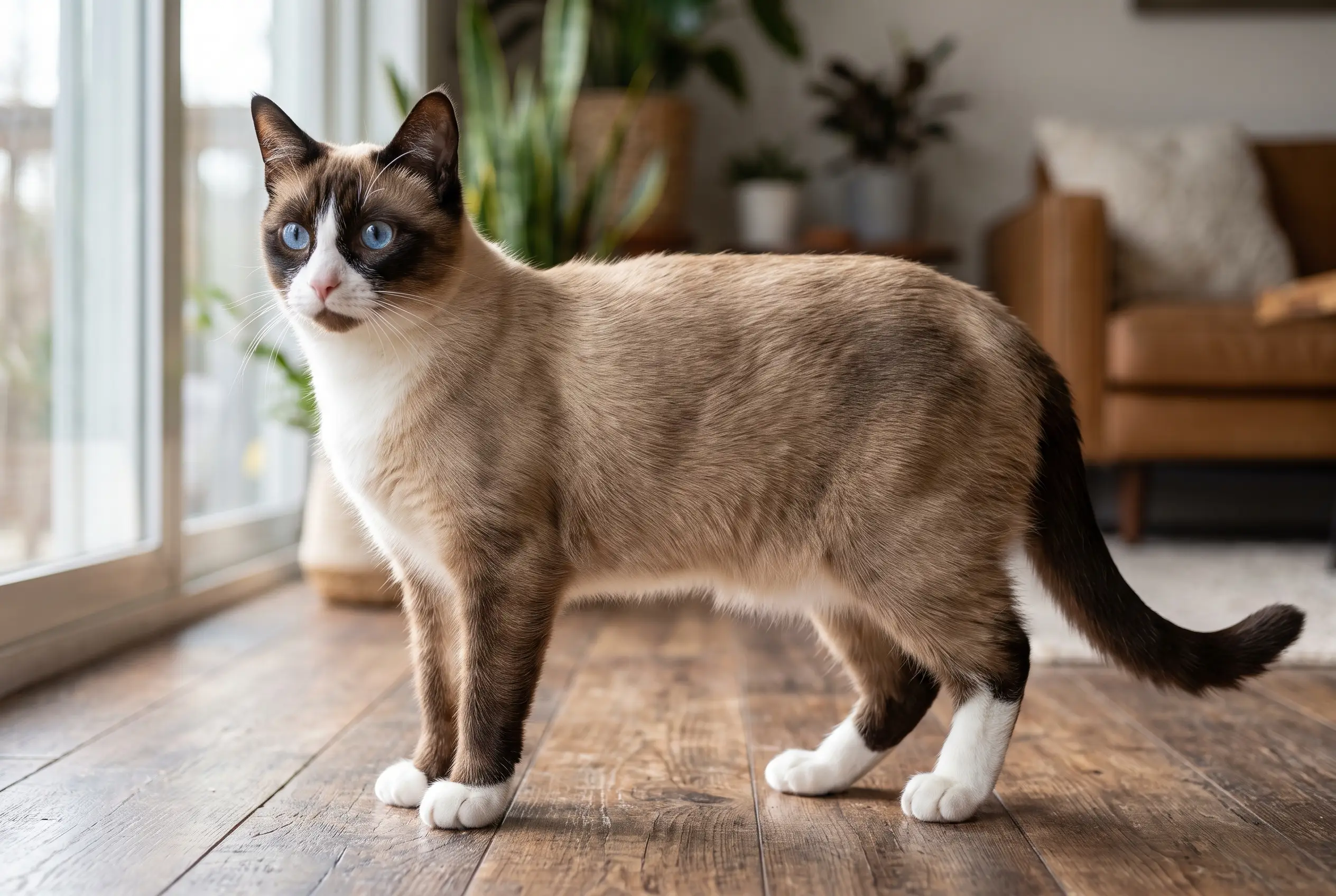
Snowshoe
A point cat with four white boots — and a coat so hard to get right that most Snowshoes are pets, not show cats.
Vital stats
| Size | Medium · sturdier and rounder than a Siamese |
| Weight | 2.7–5.5 kg · males heavier — breed literature, not a registry figure |
| Life expectancy | 14–19 years — breed literature, not a registry figure |
| Energy | Moderate — playful and social, not driven |
| Shedding | Low · short coat, minimal undercoat |
| Coat | Short, dense, glossy; colour-pointed with white |
| Group | Shorthair |
| Origin | United States |
Breed traits
Friendliness
Care
Mind
The Snowshoe by the numbers
The Snowshoe facts owners search for most — price, lifespan, weight, shedding and colours, in one place.
Less common, so expect a waitlist and some travel to a reputable breeder — which pushes the price up. Ongoing costs stay modest — it eats little and routine vet care sits at the lower end.
We don't quote a single figure: the real price swings with breeder, region, bloodline and health testing — and a rescue costs a fraction of a breeder's litter. Adopting is almost always the cheapest route.
Temperament
Snowshoes keep the Siamese habit of following their household from room to room, minus most of the volume. They talk, in soft chirps and short comments rather than a yowl, usually to complain about a closed door or an empty food bowl. Sociable to the point of shameless, they greet visitors at the door, ride along on errands around the house, and don't take well to being shut out of a room. Many are drawn to water — a dripping tap or a half-full sink counts as a toy — and some work out how to press a lever door handle or fetch a ball without being shown twice. A Snowshoe left alone from nine to six gets bored rather than destructive, but it notices, and it wants a person in the house most of the day.
Habits & quirks
Marked by two genes fighting each other
The white boots come from a piebald spotting gene; the points come from the separate gene that makes a cat Siamese-patterned. The two don't cooperate — even a mating between two well-marked Snowshoes routinely produces kittens with too much white, too little, or boots that don't match left to right.
Born white
Kittens arrive without a trace of colour. The points darken over the first couple of weeks, and the boots and facial V keep changing shape for months after that, so nobody can call a kitten's markings finished before it's half-grown.
Talks, quietly
It inherited the Siamese voice but not the volume — soft chirps and short comments rather than a yowl, usually aimed at whoever just left the room.
Runs the taps
Many Snowshoes are drawn to moving water: a dripping tap, a filling bath, a fish tank. Don't leave a glass unattended.
Care
| Grooming | The short coat has almost no undercoat and sheds lightly — a weekly rub with a rubber brush or a damp hand is enough most of the year. |
| Health screening | Snowshoes carry Siamese ancestry and its risks: ask for a DNA result for progressive retinal atrophy, ask about systemic amyloidosis in the line (a protein disease that damages the liver and kidneys, with no simple test), and know the breed turns up disproportionately in studies of urate bladder stones — get a vet to check urine if a cat strains to urinate. |
| Company | A Snowshoe left alone all day gets bored and vocal rather than aggressive, but it notices. Plan on a second pet, or a real greeting and a play session at both ends of the day. |
| Teeth | Dental disease is common in Siamese-descended cats generally. Start brushing while the cat is young and have the gums checked at every annual visit rather than waiting for a smell. |
Life expectancy
This breed has a typical life expectancy of 14–19 years — breed literature, not a registry figure.
Similar breeds
Breeds with a similar build and background — worth a look if this one isn't quite the fit.
Common questions
Is a Snowshoe just a Siamese with white feet?
Genetically it's more mixed than that. The breed started from a Siamese litter that carried an unplanned cross to a bicolour American Shorthair, then was bred back into Siamese lines to fix the pointed pattern — so the body is sturdier than a Siamese's, not the same cat with boots added. The registries that accept it (TICA, ACFA, CFF, and FIFe since 2004) all treat it as its own breed; CFA still doesn't recognise it at all.
How do I tell a Snowshoe apart from a Siamese, a Birman or a Ragdoll?
Start with coat length: Siamese and Snowshoe are shorthairs, Birman and Ragdoll are longhairs. Then size and build: the Ragdoll is the giant of the four (up to 9 kg) with a floppy, docile temperament; the Siamese is the smallest and finest-boned, all wedge head and tube body; the Snowshoe sits in between, sturdier than a Siamese on an American-Shorthair-influenced frame. Last, the white: a Siamese has none, a Ragdoll's colour points come with no set white pattern, a Birman wears rounded 'gloves' that stop at the wrist with a pointed lace running up the back of the hock, and a Snowshoe wears taller 'boots' that run higher up all four legs plus a white inverted V up the face that none of the other three carry.
Why are Snowshoes so hard to find?
Mostly because the markings won't cooperate. The white boots come from a piebald spotting gene and the points from the separate Siamese gene, and pairing two textbook-marked parents still produces litters where only a few kittens get the symmetrical boots and clean facial V the standard wants. The rest are just as healthy and just as affectionate, only ineligible for the show ring. That scarcity, plus a population too small for CFA to recognise the breed at all, is why a correctly marked Snowshoe costs what it does, and a slightly-off one is often the better deal for a home that just wants the cat.
Does the Snowshoe shed a lot?
Not much. The Snowshoe is a low-shedding breed, so loose hair around the home stays minimal. It still needs regular grooming, but you won't be fighting drifts of fur.
Are Snowshoe cats hypoallergenic?
No cat breed is truly hypoallergenic. The trigger is Fel d 1, a protein in a cat's saliva and skin that transfers to the coat during grooming and then travels on loose hair and dander — so a cat that sheds less, like the Snowshoe, spreads less of it around the house, but still produces it. If someone at home reacts to cats, spend real time with this breed before deciding, and no breeder should promise you an allergy-free cat.
Are Snowshoe cats good with children?
Usually yes. The Snowshoe is a sociable cat that tends to tolerate the noise and handling of family life better than most, which is why it comes up so often for homes with kids. It still needs somewhere high and quiet to retreat to, and children need teaching that a cat walking away is allowed to.
How much grooming does a Snowshoe need?
Very little. The Snowshoe handles its own coat and a comb once a week or so is plenty — mostly to catch loose hair before the cat swallows it. Claws, teeth and ears still want the usual checks, which is the part people skip on an easy-coated cat.