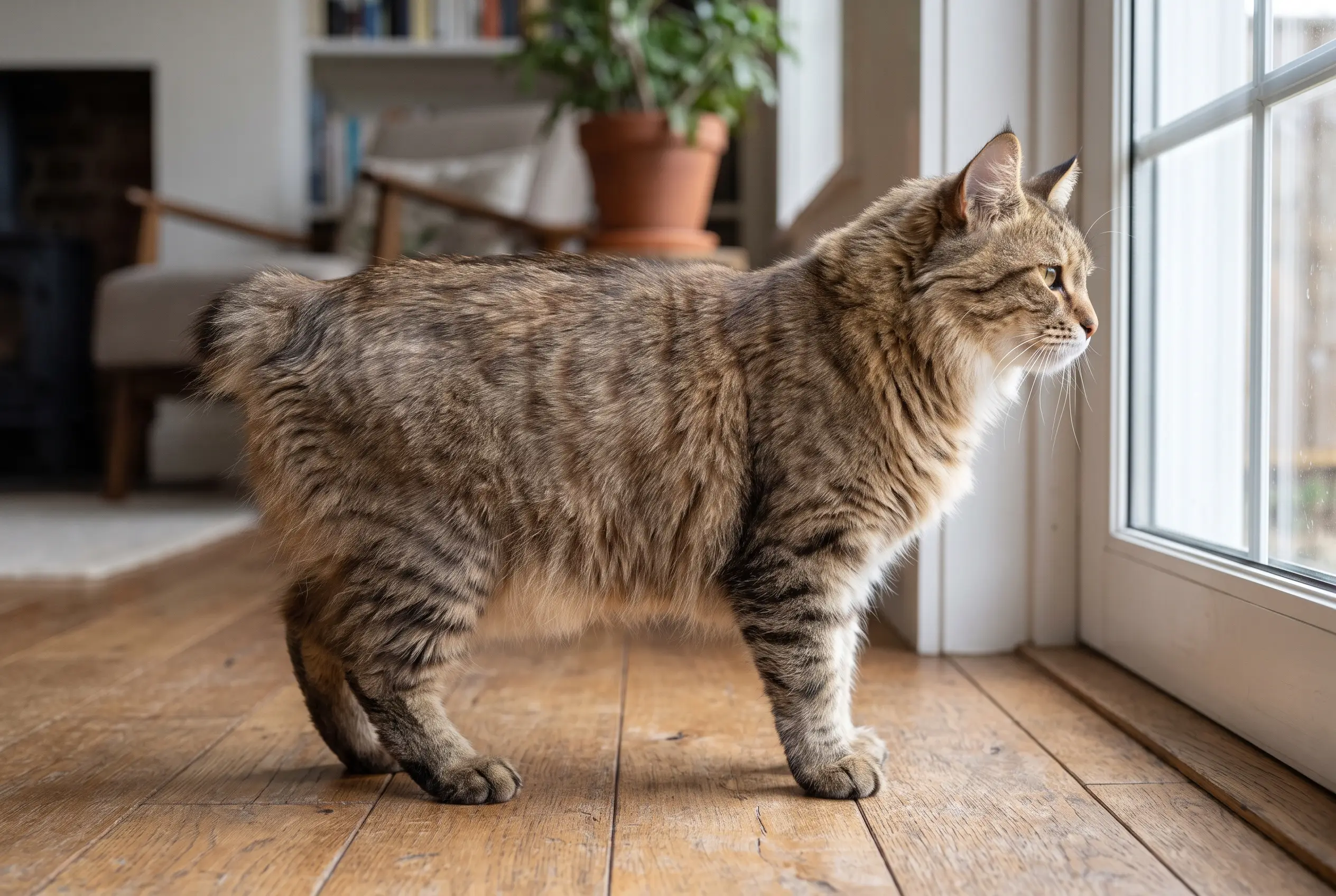
Pixie-Bob
Built to look like a bobcat, up to seven toes a paw, and no bobcat blood at all.
Vital stats
| Size | Medium to large · stocky, rangy build |
| Weight | 3.5–8 kg · males noticeably heavier — breed-club figures, the standard sets none |
| Life expectancy | 13–16 years — breed literature, not survey data |
| Energy | Moderate to high — playful and people-focused, not frantic |
| Shedding | Moderate — plush double coat, worst at the seasonal change |
| Coat | Short, wooly, weather-resistant (longhair Pixiebob registered separately) |
| Group | Shorthair |
| Origin | United States |
Breed traits
Friendliness
Care
Mind
The Pixie-Bob by the numbers
The Pixie-Bob facts owners search for most — price, lifespan, weight, shedding and colours, in one place.
Less common, so expect a waitlist and some travel to a reputable breeder — which pushes the price up. Ongoing costs stay modest — it eats little and routine vet care sits at the lower end.
We don't quote a single figure: the real price swings with breeder, region, bloodline and health testing — and a rescue costs a fraction of a breeder's litter. Adopting is almost always the cheapest route.
Temperament
Pixie-Bobs are built like a small bobcat and behave like a golden retriever. They rarely meow in the ordinary sense — chirps, chatters and a low growl do most of the talking — and they use it to keep up a running commentary while trailing a person from room to room. Many take to a harness and lead, fetch a thrown toy with little training, and greet visitors rather than hide from them, which surprises people expecting something aloof to match the coat. They mature slowly, taking up to four years to reach full size and staying playful well past kittenhood. They're steady with children, generally easy with a cat-tolerant dog, and they don't do well parked alone for long stretches — the same sociability that makes them easy houseguests makes boredom a real problem.
Habits & quirks
Talks without meowing
Chirps, chatters and a low growl do the work a meow would elsewhere; a proper meow is rare enough that owners often mention its absence unprompted.
Keeps growing for years
Full size isn't reached until three or four years old, well past the one year most cats take, so a Pixie-Bob spends a long stretch looking like an oversized kitten.
Uses the extra toes like thumbs
A polydactyl Pixie-Bob's wider, fleshier paw works more like a hand than a cat's usually does — pulling open a half-latched door or working a toy out of a gap other cats can't reach.
Greets like a dog
Head-butts, tags along room to room, and will often meet a stranger at the door rather than vanish under the bed — the trait most owners mention before the coat.
Care
| Trim the extra claws | A Pixie-Bob can carry up to seven toes per paw under the TICA standard — one of the only breed standards in the cat fancy that permits it rather than penalising it. The extra toes' claws don't touch the ground the way the others do, so they don't wear down naturally; check every paw monthly and clip what the cat can't file down itself, or an unused claw can curl back into the pad. |
| Health screening | Ask a breeder for hypertrophic cardiomyopathy (HCM) screening by echocardiogram on the parents — it's the heart condition most often flagged in the breed. Because the gene pool was deliberately kept wide with outcross 'Legend Cats' early on, also ask directly about any dystocia (birth difficulty) or undescended-testicle cases in the line; both are tracked by conscientious breeders. |
| Coat | The plush, wooly double coat combs clean most weeks and needs more attention during the spring and autumn shed; the longhair Pixiebob wants the same routine done more often. Check the belly hair, which the standard calls out as longer, for tangles. |
| Exercise & structure | This is a cat that wants a job: a harness and lead, a fetch session, a trained routine of some kind. Skip it and a smart, physically large cat will find its own entertainment, usually somewhere you didn't intend. |
Life expectancy
This breed has a typical life expectancy of 13–16 years — breed literature, not survey data.
Similar breeds
Breeds with a similar build and background — worth a look if this one isn't quite the fit.
Common questions
Is the Pixie-Bob really part bobcat?
That's the breed's own founding story — Carol Ann Brewer's account of a bobcat-sired tom and a run of 'Legend Cats' she believed were wild-domestic crosses from Washington's Cascade Range in the 1980s. Genetic testing has never found a bobcat marker in the breed; every registry treats it as fully domestic Felis catus, and the resemblance comes from selecting for a spotted coat, a bobbed tail and a big-boned build, not any actual wildcat ancestry.
Is the Pixie-Bob's short tail the same gene as the Manx's?
Related, but not identical in effect. Both sit in the same T (TBXT / Brachyury) gene, and a 2013 genetics study found Pixie-Bobs and American Bobtails sharing one of the same mutant alleles documented in Manx cats. Where the breeds part ways is the standard: Manx breeders select for complete taillessness, the 'rumpy' end of the spectrum where the documented spinal defect — sacrocaudal dysgenesis, sometimes with spina bifida — concentrates. The TICA Pixiebob standard disqualifies a tail that short (under 2 cm) as well as a full-length one, holding breeders to a 5 cm-to-hock middle ground instead. No published case series of Manx-syndrome-style spinal defects exists for the Pixie-Bob specifically, though the population is small enough that an absence of reports isn't a guarantee — ask a breeder what they screen for.
How is a Pixie-Bob different from a Maine Coon?
Convergent, not related. Both run large and both can be polydactyl, but a Maine Coon comes in dozens of colours and patterns and carries a full tail; the TICA Pixiebob standard permits only brown spotted tabby and disqualifies anything but a bobbed one. The voice differs too — a Maine Coon's chirp is closer to a soft trill, while a Pixie-Bob adds a distinct low growl and chatter, and rarely produces an ordinary meow at all.
Does the Pixie-Bob shed a lot?
Moderately. The Pixie-Bob sheds a fair amount, steadily through the year with heavier seasonal patches. A weekly brush keeps most of the loose hair off your floors and clothes.
Are Pixie-Bob cats hypoallergenic?
No cat breed is truly hypoallergenic, and the Pixie-Bob isn't one of the easier ones. The trigger is Fel d 1, a protein in a cat's saliva and skin that ends up on the coat during grooming and then spreads on loose hair and dander — and this breed sheds enough to move plenty of it around. If someone at home is allergic to cats, this is a hard breed to live with; spend real time around one first.
Are Pixie-Bob cats good with children?
Usually yes. The Pixie-Bob is a sociable cat that tends to tolerate the noise and handling of family life better than most, which is why it comes up so often for homes with kids. It still needs somewhere high and quiet to retreat to, and children need teaching that a cat walking away is allowed to.
How much grooming does a Pixie-Bob need?
A weekly comb is usually enough for the Pixie-Bob, with a second pass during a seasonal moult. That keeps loose hair off your furniture and cuts down on hairballs, since everything the cat doesn't shed onto the sofa it swallows while washing.