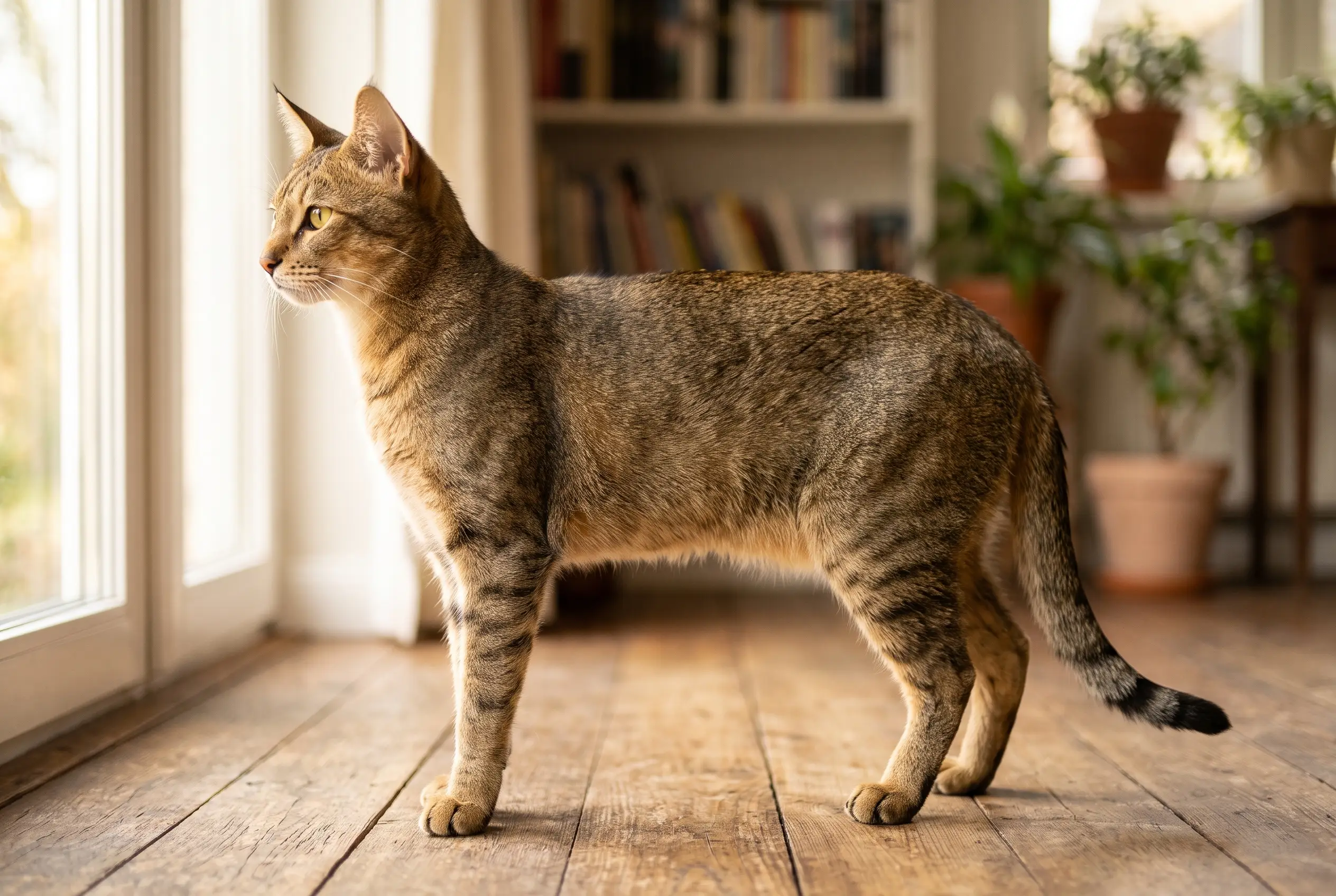
Chausie
A jungle cat bred back down to house-cat size, and nobody told it to slow down.
Vital stats
| Size | Medium-large · long-legged, ectomorphic build |
| Weight | 3.5–8 kg · males heavier — breed literature; TICA's own standard sets no numeric weight |
| Life expectancy | 12–15 years — breed literature, not survey data |
| Energy | Very high — bred to move, not to sit |
| Shedding | Low to moderate, little undercoat to mat |
| Coat | Short to medium, soft dense undercoat under a coarser topcoat; ticked or grizzled |
| Group | Shorthair |
| Origin | United States |
Breed traits
Friendliness
Care
Mind
The Chausie by the numbers
The Chausie facts owners search for most — price, lifespan, weight, shedding and colours, in one place.
Less common, so expect a waitlist and some travel to a reputable breeder — which pushes the price up. Ongoing costs stay modest — it eats little and routine vet care sits at the lower end.
We don't quote a single figure: the real price swings with breeder, region, bloodline and health testing — and a rescue costs a fraction of a breeder's litter. Adopting is almost always the cheapest route.
Temperament
Chausies get called dogs in cat suits often enough that it's worth taking seriously. They play fetch, many walk calmly on a harness and leash, and they track a household's routine — dinner time, walk time, bedtime — with real attentiveness. The intelligence cuts both ways: left alone too long, a Chausie opens cupboards, works door handles, and investigates anything it hasn't already solved. The jungle cat ancestry shows up as a serious prey drive rather than aggression toward people, which makes this a poor match for homes with birds, rodents, or other small pets, but not a difficult cat around its own family. Loyal to a favourite person, generally fine with cat-savvy dogs, and rarely still long enough to be called aloof.
Habits & quirks
Clears six feet standing
The deep chest that gives a Chausie its stamina also gives it lift — a flat-footed jump onto a wardrobe or the top of the fridge is routine, not a party trick.
Fetches and takes a leash
Unusual for a cat: TICA's own breed material notes that Chausies play fetch and take to a harness readily, and plenty of owners walk them like a small, opinionated dog.
Hunts, doesn't just play
The prey drive inherited from Felis chaus is a genuine hunting instinct, not roughhousing, which is why breed advice steers households with birds or small pets away from the Chausie.
Wears bands, never spots
The coat's trick is ticking: each hair carries two or three dark bands over a lighter base, or in the rarer grizzled variant, a near pepper-and-salt effect. Neither pattern looks anything like a Savannah's leopard-style spots.
Care
| Grooming | Low-maintenance despite the size. A weekly comb through the dense undercoat and coarser topcoat covers most of the year, stepping up during the twice-yearly shed; there's too little undercoat to mat badly. |
| Health screening | Ask for the DNA test for pyruvate kinase deficiency, an inherited anaemia found in Abyssinian bloodlines — most Chausie pedigrees carry Abyssinian ancestry. A pre-breeding echocardiogram is sensible too; the breed is too small and too recent to have its own inherited-disease census yet. |
| Diet | Cats close to the wild side of the pedigree (F1–F3) can have a shorter gut inherited from the jungle cat and struggle to digest plant-heavy kibble, developing loose stools or food sensitivities on grain- or legume-heavy formulas. A high-meat, low-filler diet is the safer default across the whole breed, not just its wilder end. |
| Exercise & company | Not a cat for an empty flat. Vertical space, daily interactive play, and puzzle feeders are the minimum; Chausies do badly left alone for long stretches and do better with a second active pet or a housemate who's around. |
Life expectancy
This breed has a typical life expectancy of 12–15 years — breed literature, not survey data.
Similar breeds
Breeds with a similar build and background — worth a look if this one isn't quite the fit.
Common questions
Is a Chausie the same as a Savannah cat?
No, and the wild parent is the giveaway: a Savannah comes from the African serval, a Chausie from the jungle cat, Felis chaus. The build differs too — a Savannah can be extreme in leg length and height, while the Chausie is tall and long-bodied but stops well short of that. Coat is the fastest tell: Savannahs are spotted, Chausies are ticked or grizzled, never spotted. Legality also runs on the specific wild species named in the statute, so a law restricting serval hybrids doesn't automatically restrict jungle cat hybrids, or the other way round — check the actual wording, not the breed name.
Is it legal to own a Chausie?
In most of the United States, yes, especially from the fourth generation on, which is fully domestic in temperament and usually fertile. Earlier generations (F1–F3) run into more restrictions state by state, because many exotic-pet laws are written around any wild-cat ancestry within a set number of generations rather than around the Chausie by name. Some countries go further still — the Netherlands and Belgium ban ownership of jungle cat hybrids through the fourth generation. Check your own state or country's exotic-pet law before buying, and get the cat's generation from the breeder in writing.
Do Chausies need a special diet?
Often, yes, and more so the closer the cat sits to the wild side of its pedigree. Early-generation cats can have a shorter digestive tract that struggles with grain- or legume-heavy kibble, showing up as loose stools or food sensitivities. A high-meat, low-filler diet works better across the breed generally, and a cat that's visibly reacting to its food is worth a vet visit rather than a shrug.
Does the Chausie shed a lot?
Moderately. The Chausie sheds a fair amount, steadily through the year with heavier seasonal patches. A weekly brush keeps most of the loose hair off your floors and clothes.
Are Chausie cats hypoallergenic?
No cat breed is truly hypoallergenic, and the Chausie isn't one of the easier ones. The trigger is Fel d 1, a protein in a cat's saliva and skin that ends up on the coat during grooming and then spreads on loose hair and dander — and this breed sheds enough to move plenty of it around. If someone at home is allergic to cats, this is a hard breed to live with; spend real time around one first.
Are Chausie cats good with children?
Often, in the right home. The Chausie is reasonably sociable and can settle well with children who already know how to handle a cat gently. Give it high perches and a room the kids don't own, and introductions go far better.
How much grooming does a Chausie need?
Very little. The Chausie handles its own coat and a comb once a week or so is plenty — mostly to catch loose hair before the cat swallows it. Claws, teeth and ears still want the usual checks, which is the part people skip on an easy-coated cat.
Stories featuring this breed
All stories →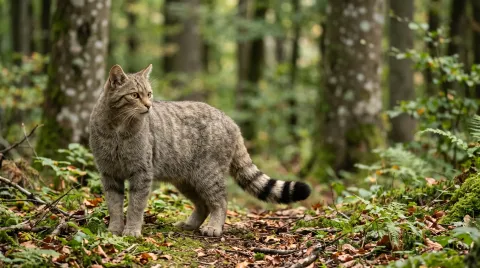
European wildcat: the cat Europe cannot count
Felis silvestris was only assessed as a species in its own right in 2022, and its official population trend is one word: unknown.
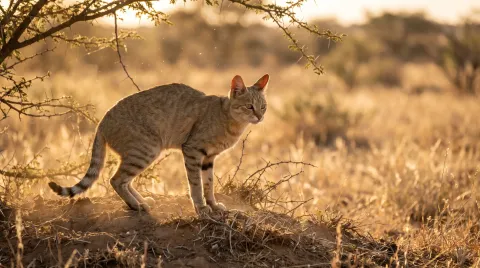
African wildcat: the real ancestor of your cat
Your cat descends from Felis lybica, a North African animal most people cannot name. In November 2025 the standard account of how it reached Europe broke.