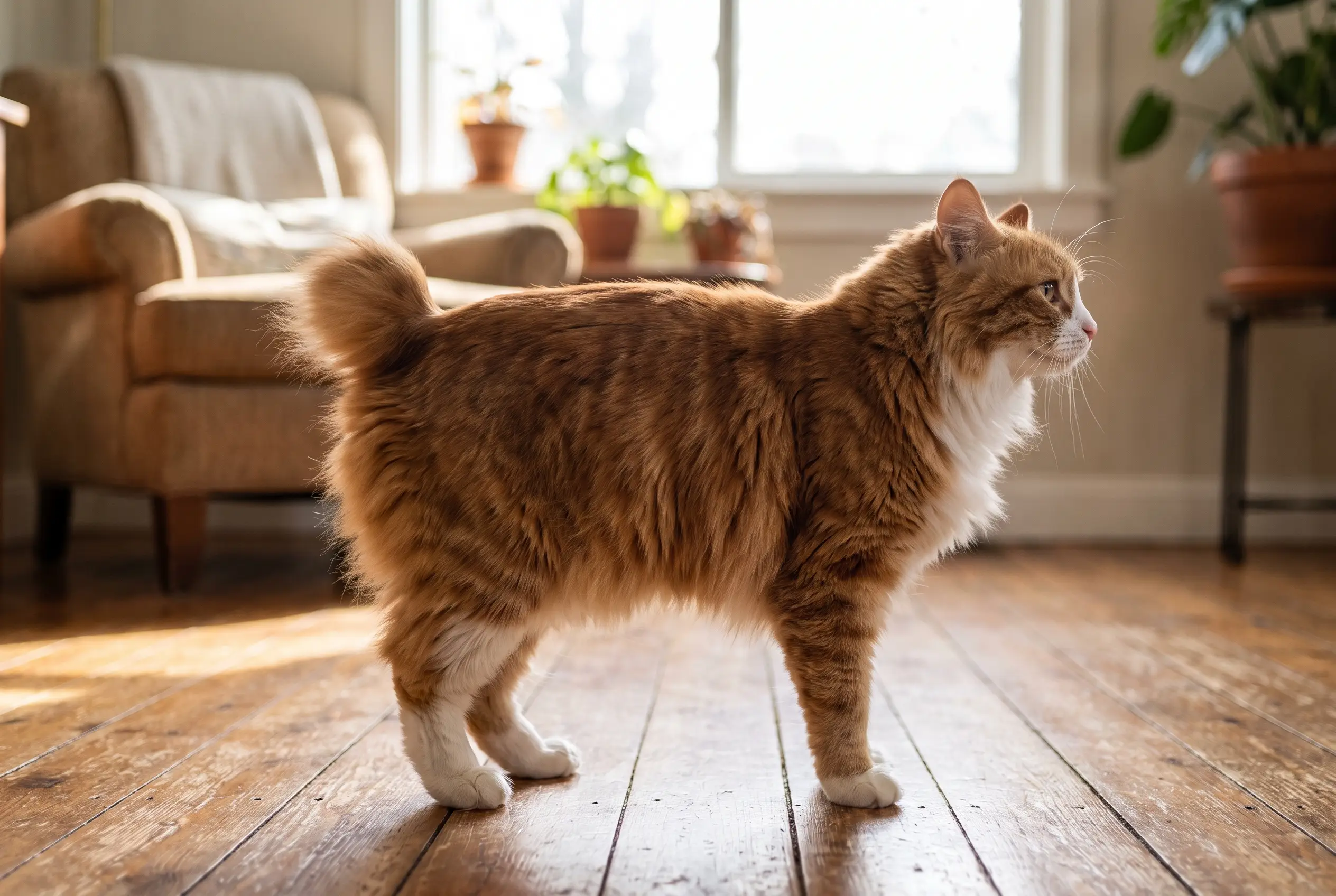
Kurilian Bobtail
A short, powerful island cat that fishes, swims, and still wants to sleep against your feet.
Vital stats
| Size | Medium to large · muscular, semi-cobby |
| Weight | 4–7 kg · males heavier |
| Life expectancy | 15–18 years — breed literature, not survey data |
| Energy | High — built to hunt and fish |
| Shedding | Moderate, heavier at the seasonal coat change |
| Coat | Short or semi-long, dense, water-shedding double coat |
| Group | Shorthair |
| Origin | Russia |
Breed traits
Friendliness
Care
Mind
The Kurilian Bobtail by the numbers
The Kurilian Bobtail facts owners search for most — price, lifespan, weight, shedding and colours, in one place.
Less common, so expect a waitlist and some travel to a reputable breeder — which pushes the price up. Ongoing costs stay modest — it eats little and routine vet care sits at the lower end.
We don't quote a single figure: the real price swings with breeder, region, bloodline and health testing — and a rescue costs a fraction of a breeder's litter. Adopting is almost always the cheapest route.
Temperament
Kurilian Bobtails are built for company. TICA's own standard says outright that the breed must be kept with its people, and owners back that up: this is a cat that meets you at the door, moves from room to room after you, and settles near you rather than on a windowsill across the house. It's physical rather than lapdog-soft — a strong jumper, confident around dogs and older children, slow to spook. The hunting instinct sits close to the surface. Leave a Kurilian Bobtail near an unlidded fish tank, a hamster cage or an unattended plate and it will treat the situation as a job. Give it something to chase, climb or fish out of a bowl instead, and the same energy turns into one of the more even-tempered cats you can own.
Habits & quirks
Fishes for real
In its home range the Kurilian Bobtail is documented catching fish from shallow water, sometimes ones close to its own size. Pet cats keep the instinct at a smaller scale: expect paw-fishing in water bowls and sinks, and keep a lid on any aquarium.
Swims without being asked
The double coat resists soaking rather than absorbing it, and plenty of Kurilian Bobtails will wade or swim on their own, which is rare enough in a cat that most owners bring it up unprompted.
Follows you, greets guests, tolerates a harness
Room to room, this is a cat that keeps you in sight and meets arrivals at the door rather than hiding from them. Many will walk on a harness without much protest, which is unusual for a breed this physically confident.
Signals mood off a stub
The tail can't wag the way a full one does, but it flicks, puffs and holds a position, and people who live with the breed read its mood off that stub much the way they would a longer tail.
Care
| Grooming | The shorthair needs a comb once a week; the semi-long variety needs the same more often, plus extra during the spring shed when the dense undercoat comes out over a couple of weeks. Neither coat mats the way a full longhair's does. |
| Health screening | There's no DNA test specific to the breed yet, and importantly, no equivalent to the Manx's sacrocaudal risk — the Kurilian Bobtail's tail is a stub of kinked or curved vertebrae, not a shortened spinal column, and it isn't linked in veterinary literature to spina bifida or the incontinence that comes with Manx syndrome. Ask instead for routine cardiac screening (an echocardiogram for hypertrophic cardiomyopathy, as with most breeds) and, given how small and young the population still is outside Russia, ask what the breeder knows about the wider gene pool — the standard bans outcrossing entirely, so there's no fallback if a line narrows. |
| Exercise and enrichment | This is a hunting cat with the drive still switched on. Daily play that involves chasing and catching something, a wand toy dragged through a shallow tray of water is the breed-appropriate version, keeps that energy from landing on your fish tank or the neighbor's guinea pig. |
| Handling the tail | It isn't fragile, just short. No vertebrae protrude and normal handling doesn't hurt the cat. A breeder who knows the breed will tell you which tail type yours is — snag, spiral or whisk — and let you feel it before you decide. |
Life expectancy
This breed has a typical life expectancy of 15–18 years — breed literature, not survey data.
Similar breeds
Breeds with a similar build and background — worth a look if this one isn't quite the fit.
Common questions
What's the difference between the Kurilian Bobtail, the Japanese Bobtail and the American Bobtail?
All three carry a naturally short tail, but not the same one. The Japanese Bobtail's comes from a dominant mutation in the HES7 gene, identified by DNA sequencing in 2016. The Kurilian Bobtail's is a separate mutation that arose independently in its own island population; breed literature describes it as incompletely dominant, but it hasn't been mapped to a specific gene the way the Japanese Bobtail's has. The American Bobtail's traces to one short-tailed stray tomcat found in Arizona in the 1960s and is inherited as a dominant trait, which some breeders link mechanically closer to the Manx than to either Asian breed. Geography makes two of the three look related, since Japan and the Kuril Islands sit close together, but the genetics available so far don't confirm that, and the breed's own standards treat all three as distinct.
Is this the same gene as the Manx's taillessness?
No, and the distinction matters for welfare, not just paperwork. The Manx's dominant mutation can shorten the spine itself, causing sacrocaudal dysgenesis — spina bifida, a hopping gait, bowel or bladder problems — in a real share of that breed. The Kurilian Bobtail's tail is built from kinked or curved vertebrae rather than a shortened spinal column, and it isn't tied to that condition in the veterinary literature. Two different mutations with two different risk profiles.
Do Kurilian Bobtails actually swim and fish, or is that a marketing story?
The fishing claim holds up better than most breed folklore: TICA's own breed standard calls it 'an amazing hunter and fish catcher,' developed in a place where fish was a dependable food source. Voluntary swimming and paw-fishing in a water bowl are reported consistently by owners outside Russia too, more consistently than most 'water-loving cat' claims about other breeds. What is folklore is the specific detail that gets added on top, like the exact size of fish it can land, or physical claims such as webbed toes that don't appear in any breed standard. Take the general trait as real and the embellishments as retellings.
Does the Kurilian Bobtail shed a lot?
Moderately. The Kurilian Bobtail sheds a fair amount, steadily through the year with heavier seasonal patches. A weekly brush keeps most of the loose hair off your floors and clothes.
Are Kurilian Bobtail cats hypoallergenic?
No cat breed is truly hypoallergenic, and the Kurilian Bobtail isn't one of the easier ones. The trigger is Fel d 1, a protein in a cat's saliva and skin that ends up on the coat during grooming and then spreads on loose hair and dander — and this breed sheds enough to move plenty of it around. If someone at home is allergic to cats, this is a hard breed to live with; spend real time around one first.
Are Kurilian Bobtail cats good with children?
Usually yes. The Kurilian Bobtail is a sociable cat that tends to tolerate the noise and handling of family life better than most, which is why it comes up so often for homes with kids. It still needs somewhere high and quiet to retreat to, and children need teaching that a cat walking away is allowed to.
How much grooming does a Kurilian Bobtail need?
A weekly comb is usually enough for the Kurilian Bobtail, with a second pass during a seasonal moult. That keeps loose hair off your furniture and cuts down on hairballs, since everything the cat doesn't shed onto the sofa it swallows while washing.