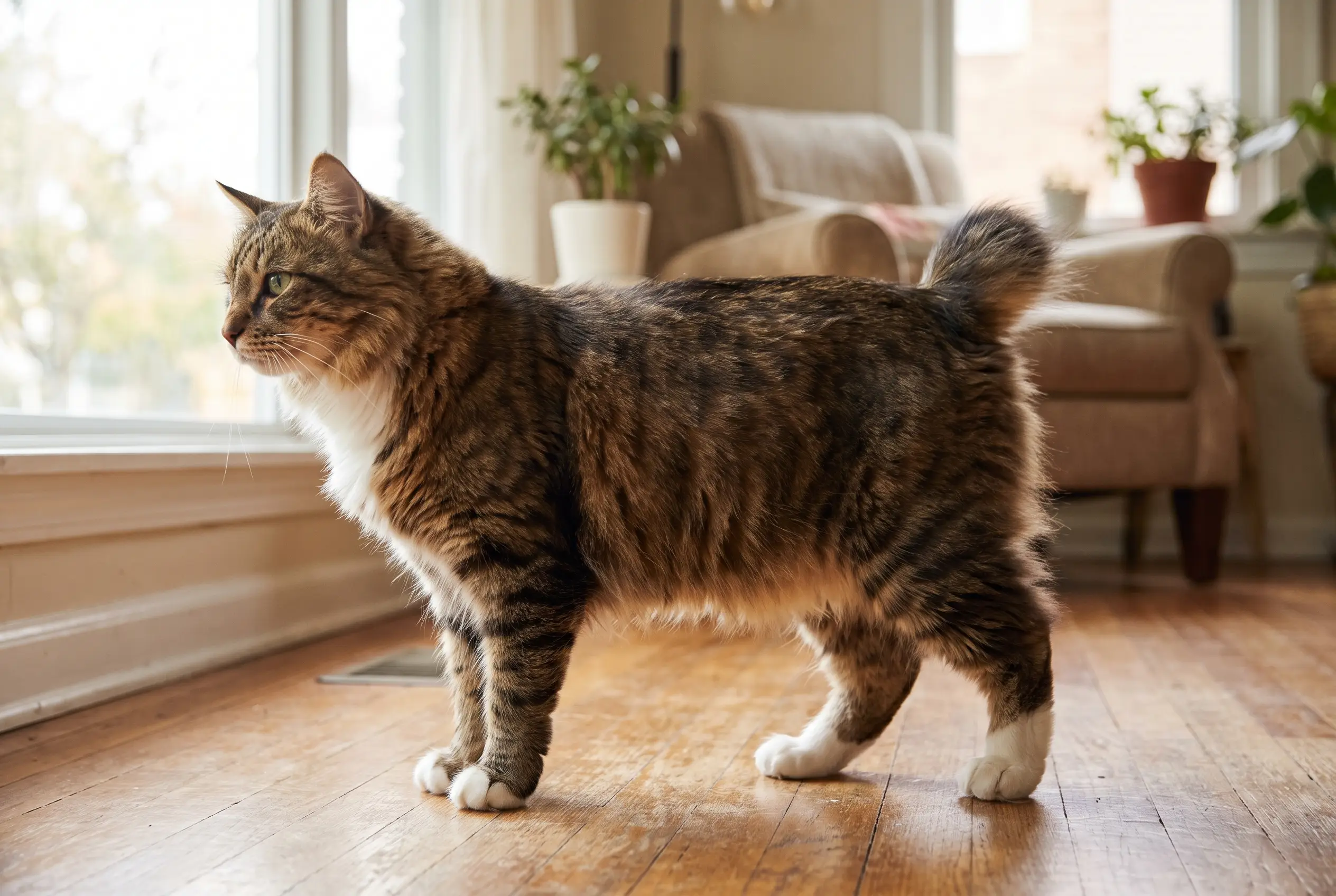
American Bobtail
A short, thick, one-of-a-kind tail from a domestic mutation, on a cat that reads a room before you finish walking into it.
Vital stats
| Size | Medium to large · rectangular body, higher-set hips |
| Weight | 3–8 kg · males heavier |
| Life expectancy | 12–15 years — breed literature, not registry data |
| Energy | Moderate — playful and interactive, not high-strung |
| Shedding | Moderate; heavier from the longhair's double coat |
| Coat | Short or medium-long, shaggy; both divisions recognized |
| Group | Shorthair |
| Origin | United States |
Breed traits
Friendliness
Care
Mind
The American Bobtail by the numbers
The American Bobtail facts owners search for most — price, lifespan, weight, shedding and colours, in one place.
Less common, so expect a waitlist and some travel to a reputable breeder — which pushes the price up. Ongoing costs stay modest — it eats little and routine vet care sits at the lower end.
We don't quote a single figure: the real price swings with breeder, region, bloodline and health testing — and a rescue costs a fraction of a breeder's litter. Adopting is almost always the cheapest route.
Temperament
American Bobtails are close-focus cats — they track the people in a house and adjust to them, which is where the breed's dog-like reputation comes from. CFA's own breed material describes the cat seeking out someone who's upset for a comforting purr rather than hiding from the mood in the room. They lean into laps and shoulders more than they just visit them, take to a harness and leash with little fuss, and tend to get along with children and dog-savvy dogs better than most cats their size. They're playful without being frantic — fetch with a dropped toy is a common trick, not a rare one — and they settle into a role in the household, usually greeter or walking companion, rather than inventing their own entertainment out of boredom.
Habits & quirks
Reads the room
CFA's own breed materials describe American Bobtails seeking out an anxious or upset person for a lean-in and a purr, which is why some end up doing informal visits in special-needs classrooms and with people managing PTSD or anxiety.
Walks on a harness
Leash training tends to take with this breed better than with most cats — CFA lists it as a breed trait rather than a party trick, and plenty of American Bobtails genuinely enjoy a walk.
Takes years to look finished
Both CFA and TICA standards note the breed matures slowly, with full adult type — heavier bone, a filled-out chest — sometimes not settling until two or three years old. A gangly one-year-old is normal, not a badly bred one.
Wears a one-of-a-kind tail
No two American Bobtail tails match: straight, curved, kinked or knuckled along the length, with a fat pad at the tip on the straighter ones. CFA notes that even two bobtailed parents produce fully-tailed kittens about half the time.
Care
| Health screening | There's no DNA test for the tail gene itself — unlike the Japanese Bobtail's HES7 mutation or the Manx's TBX-family deletions, the American Bobtail's specific mutation hasn't been isolated in published genetics literature. What you can ask for: hip X-rays (an OFA hip evaluation), since CFA's own breed material flags a general susceptibility to spine and hip problems tied to the tail gene, and confirmation the breeder never mates two fully tailless cats together — CFA excludes tailless cats from breeding programs for exactly that reason. |
| Grooming | Care depends on which division you have. The shorthair's semi-dense coat wants a weekly comb; the longhair's shaggier double coat mats faster around the ruff and britches and needs two sessions a week, more during a seasonal blowout. |
| The tail itself | Handle it like the working body part it is, not an ornament. It's real, functioning vertebrae, just fewer of them, and the standard specifically penalizes a fragile or overly rigid tail as a fault. Report any sign of pain or reduced mobility to a vet rather than assuming it's just how a bobtail moves. |
| Exercise | This is a physical cat built for a rolling, wildcat-style gait, not a decorative one. A harness walk, a cat tree with real height, and interactive play most days keep the hip and back muscles behind that stance in working order. |
Life expectancy
This breed has a typical life expectancy of 12–15 years — breed literature, not registry data.
Similar breeds
Breeds with a similar build and background — worth a look if this one isn't quite the fit.
Common questions
Is the American Bobtail part bobcat?
No — that's the origin story, not the biology. The founding cat, a stray named Yodie found in Arizona in the 1960s, was assumed to carry bobcat blood because of his short tail, but domestic cats and bobcats are different species with no confirmed crosses between them, and no genetic evidence has ever tied an American Bobtail to a wildcat ancestor. The tail comes from a spontaneous mutation in an ordinary domestic cat, the same kind of event that produced the Manx and the Japanese Bobtail independently, in unrelated cat populations.
How is the American Bobtail different from the Japanese Bobtail and the Kurilian Bobtail?
All three have a short tail and little else in common. The Japanese Bobtail is Japanese, its tail comes from a dominant mutation in the HES7 gene, and it's built slim and fine-boned. The Kurilian Bobtail comes from Russia's Kuril Islands, carries its own separate mutation, and is a stocky, semi-cobby cat. The American Bobtail is American, carries a dominant mutation unrelated to either of the others, and is built bigger and more rectangular than both, with the higher-hipped, wildcat-like stance its own standard calls out by name.
Does the short tail cause the same spinal problems as the Manx's?
Not the same documented condition. The Manx's tailless gene is a well-studied cause of sacrocaudal dysgenesis, a spina-bifida-like malformation with a quantified rate in veterinary literature. The American Bobtail's tail gene hasn't produced a comparable body of research, and its registries build in a safeguard the Manx's don't fully have: a fully tailless American Bobtail is disqualified from showing and excluded from breeding, rather than being the common, accepted outcome it is in Manx litters. CFA's own material still notes a general susceptibility to spine and hip issues tied to the gene, so it isn't risk-free — it's just not the same known syndrome.
Does the American Bobtail shed a lot?
Moderately. The American Bobtail sheds a fair amount, steadily through the year with heavier seasonal patches. A weekly brush keeps most of the loose hair off your floors and clothes.
Are American Bobtail cats hypoallergenic?
No cat breed is truly hypoallergenic, and the American Bobtail isn't one of the easier ones. The trigger is Fel d 1, a protein in a cat's saliva and skin that ends up on the coat during grooming and then spreads on loose hair and dander — and this breed sheds enough to move plenty of it around. If someone at home is allergic to cats, this is a hard breed to live with; spend real time around one first.
Are American Bobtail cats good with children?
Usually yes. The American Bobtail is a sociable cat that tends to tolerate the noise and handling of family life better than most, which is why it comes up so often for homes with kids. It still needs somewhere high and quiet to retreat to, and children need teaching that a cat walking away is allowed to.
How much grooming does a American Bobtail need?
A weekly comb is usually enough for the American Bobtail, with a second pass during a seasonal moult. That keeps loose hair off your furniture and cuts down on hairballs, since everything the cat doesn't shed onto the sofa it swallows while washing.