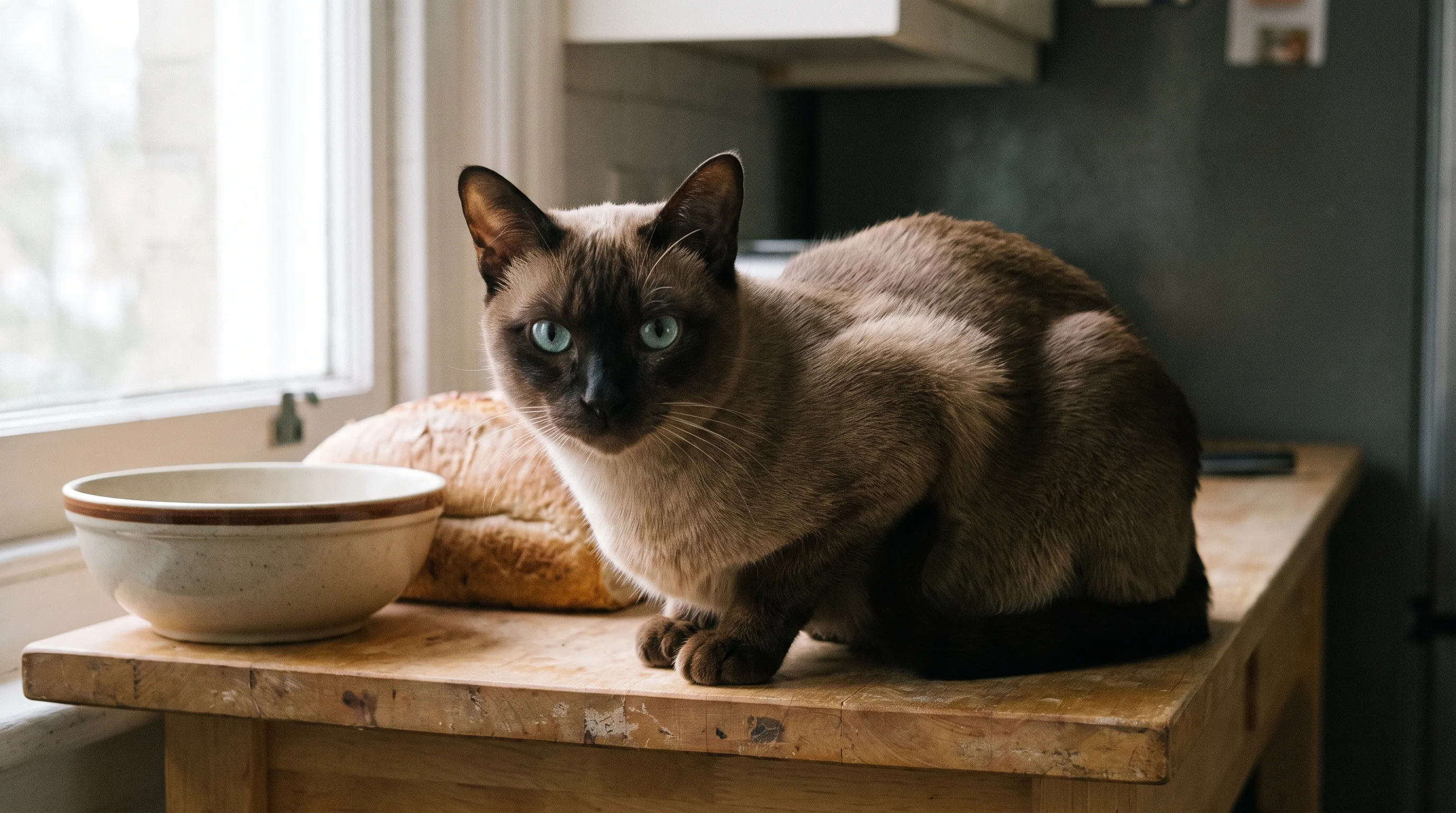
Tonkinese
Half Siamese, half Burmese, and twice as involved in your day as either.
Vital stats
| Size | Small to medium · muscular, surprisingly heavy |
| Weight | 2.5–5.5 kg · males heavier |
| Life expectancy | 14–16 years |
| Energy | Very high — plays like a kitten for years |
| Shedding | Very low, short close coat |
| Coat | Short, soft, close-lying; pointed, mink or solid |
| Group | Shorthair |
| Origin | United States |
Breed traits
Friendliness
Care
Mind
The Tonkinese by the numbers
The Tonkinese facts owners search for most — price, lifespan, weight, shedding and colours, in one place.
Widely bred, so you can usually find a litter from a registered breeder without a long wait. Ongoing costs stay modest — it eats little and routine vet care sits at the lower end.
We don't quote a single figure: the real price swings with breeder, region, bloodline and health testing — and a rescue costs a fraction of a breeder's litter. Adopting is almost always the cheapest route.
Temperament
A Tonkinese takes the Siamese need to be involved and the Burmese need to be held and runs both at once. They meet you at the door, sit on the paper you are reading, ride a shoulder around the kitchen and talk through the whole thing — a chattier voice than a Burmese, softer than a Siamese. They are clever enough to make trouble: door handles, drawers, and the bin all fall eventually, and most learn fetch without instruction. With children, dogs and other cats they are usually delighted rather than nervous. The catch is the same as their parent breeds: this is not a cat that copes with an empty house, and a lonely Tonkinese gets loud, then destructive.
Habits & quirks
Talks through everything
A running commentary, pitched between the Burmese mutter and the Siamese complaint. Tonks answer questions, and they expect an answer back.
Rides on shoulders
Climbing a leg and settling across the shoulders is standard equipment. So is joining you at the sink to see what's happening.
Learns fetch on its own
Bottle caps, hair ties, crumpled paper. Throw it and it comes back — usually with an editorial comment about the throw.
Changes colour with warmth
Mink and pointed coats darken in cooler homes and lighten in warm ones, and every Tonkinese darkens gradually with age.
Care
| Grooming | Barely a task. A weekly rub with a rubber mitt or a damp hand lifts the little that comes loose. Put the time into teeth instead — the Siamese side of the family brings early gingivitis. |
| Health screening | The breed inherits from both parents: ask for a cardiologist's echo for hypertrophic cardiomyopathy, and about amyloidosis and early dental disease in the line. Burmese lines also bring the hypokalaemia gene, which has a DNA test worth requesting. |
| Company | The real requirement. A Tonkinese alone from morning to evening will overgroom, shout and rearrange your shelves. Two cats is the standard answer, and Tonks pair well with other active breeds. |
| Climbing and play | Tall cat trees, secured shelves, puzzle feeders and two proper play sessions a day. Their intelligence needs an outlet or it goes into your cupboards. |
Life expectancy
This breed has a typical life expectancy of 14–16 years.
Similar breeds
Breeds with a similar build and background — worth a look if this one isn't quite the fit.
Common questions
What are mink, pointed and solid Tonkinese?
Three coat patterns from the same two genes. A kitten with two Siamese colour genes is pointed with blue eyes; two Burmese genes make a solid (sepia) coat with green-gold eyes; one of each gives the mink — a medium-toned body with softer points and the aqua eyes the breed is known for. All three can turn up in the same litter, and registries differ on which may be shown.
Are Tonkinese good with children?
Very. They're sturdy, they don't sulk, and they actively want to be part of whatever is going on. The usual rules apply — a cat needs somewhere to leave to — but this is one of the easier breeds to have around a busy family.
Are they as loud as a Siamese?
Quieter, but not quiet. The voice is softer and less penetrating than a modern Siamese, and used more often than a Burmese uses its own. If silence matters in your household, this is not the breed.
Does the Tonkinese shed a lot?
Not much. The Tonkinese is a low-shedding breed, so loose hair around the home stays minimal. It still needs regular grooming, but you won't be fighting drifts of fur.
Are Tonkinese cats hypoallergenic?
No cat breed is truly hypoallergenic. The trigger is Fel d 1, a protein in a cat's saliva and skin that transfers to the coat during grooming and then travels on loose hair and dander — so a cat that sheds less, like the Tonkinese, spreads less of it around the house, but still produces it. If someone at home reacts to cats, spend real time with this breed before deciding, and no breeder should promise you an allergy-free cat.
How much grooming does a Tonkinese need?
Very little. The Tonkinese handles its own coat and a comb once a week or so is plenty — mostly to catch loose hair before the cat swallows it. Claws, teeth and ears still want the usual checks, which is the part people skip on an easy-coated cat.