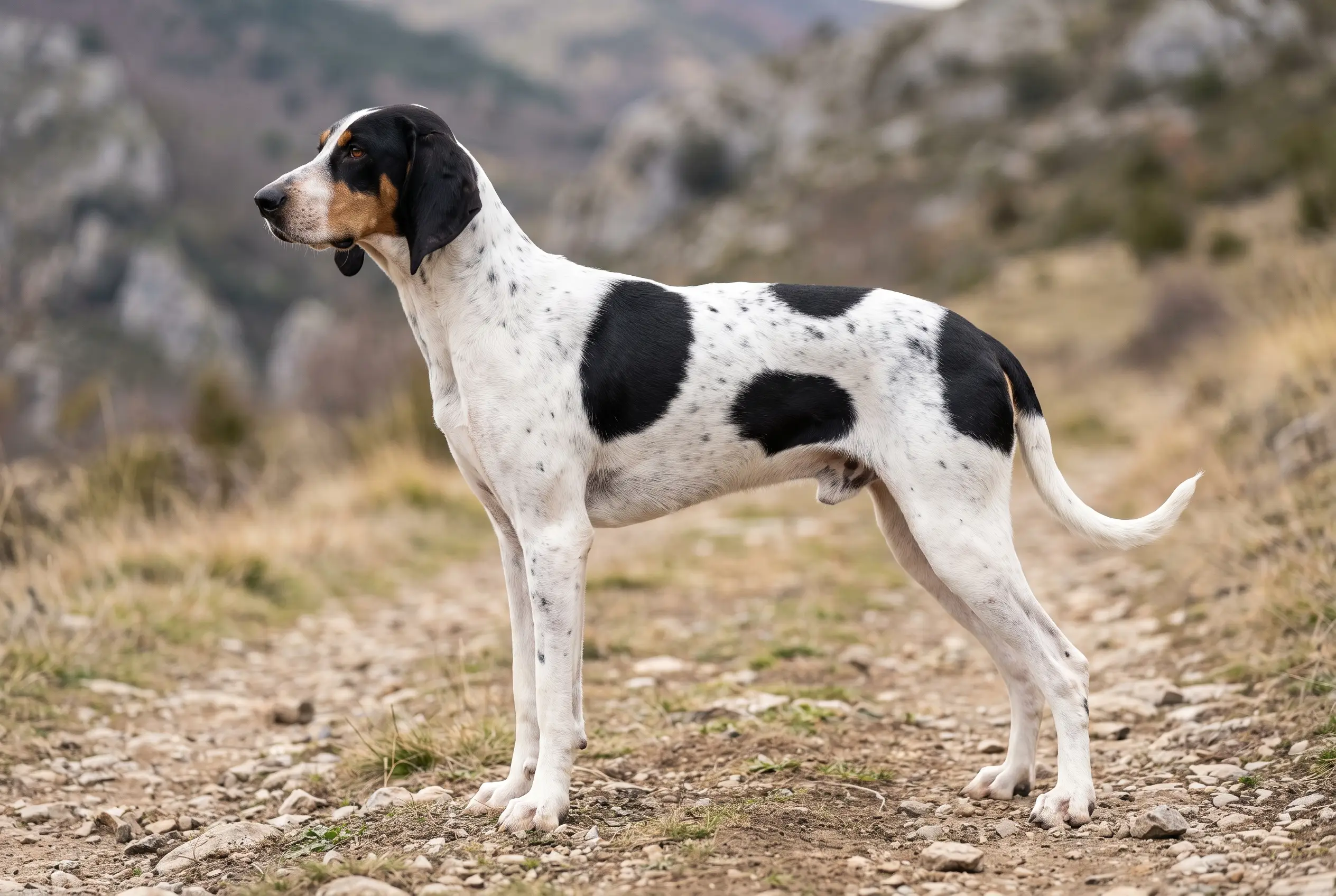
Ariégeois
Built lighter than the Gascon pack hounds behind it, on purpose, to run hare over ground too rough for them.
Vital stats
| Size | Medium · 52–58 cm (males), 50–56 cm (females) |
| Weight | 25–30 kg — breed literature; the standard sets none |
| Life expectancy | 10–13 years — breed literature, not survey data |
| Energy | High — built to drive game over rough ground all day |
| Shedding | Low — short, dense coat |
| Coat | Short, fine, dense · white with well-defined black patches, sometimes mottled, pale tan on cheeks and above the eyes |
| Group | Hound · Medium-sized Scenthound (FCI №20, Group 6) |
| Origin | Ariège, southwestern France |
| FCI group | 6 — Scent hounds and related breeds · FCI 20 |
Breed traits
Friendliness
Care
Mind
The Ariégeois by the numbers
The Ariégeois facts owners search for most — price, lifespan, weight, shedding and colours, in one place.
Less common, so expect a waitlist and some travel to a reputable breeder — which pushes the price up. Ongoing costs run high — more food, bigger doses at the vet, and pricier insurance.
We don't quote a single figure: the real price swings with breeder, region, bloodline and health testing — and a rescue costs a fraction of a breeder's litter. Adopting is almost always the cheapest route.
Temperament
The standard's own behaviour clause reads: "From his origins he is [a] hardworking dog being at the same time very good at driving game to the waiting guns and showing proof of much initiative and enterprise. He has a resounding voice and is quick in his plotting." Its character clause follows in the same short register: "Happy and sociable; easy to train." Read together, that is a hound built to work on its own initiative — driving game toward a stationary gun takes more independent judgment than a pack hound waiting on the huntsman's horn — while staying easy, cheerful company once the work is done. "Quick in his plotting" is an awkward line even in the FCI's own English translation, but the sense of it is a dog that recasts fast after losing a scent rather than working a cold trail slowly. Breed literature adds a note the standard doesn't: this is a sensitive hound that shuts down under a heavy hand and does better with patience than correction.
Habits & quirks
A cross the standard won't fully commit to
The standard names the breed's origin as a cross between a Briquet and a "chien d'ordre" — a pack scenthound — and hedges on which one: "which could have been the Bleu de Gascogne or the Gascon Saintongeois." Both are separate FCI breeds still bred today, No. 22 and No. 21, and both are heavier, more imposing dogs than the lighter hound their cross produced.
A coat with a rulebook
The colour clause is exact, not decorative: white with jet black markings with well-defined outlines, sometimes mottled, with quite pale tan on the cheeks and above the eyes. Blurred edges on the black patches, or black straying outside those clean limits, work against a dog in the ring as much as the wrong pattern would.
Ears built to stop short of the nose
Its heavier Gascon ancestors are judged on ears that reach past the tip of the nose. The Ariégeois standard asks for close to the opposite: fine, narrow ear leather, curled in, that must be able to reach the onset of the nose without going beyond its extremity. It's a small, exact measurement standing in for the whole idea of the breed — everything about it is scaled down and lightened from the pack hounds behind it.
Recognised in 1912, still rare
France gave the Ariégeois its own breed standard in 1912; the FCI followed with definitive recognition in 1954. Both dates are recent as French scenthounds go, and the numbers never caught up to match — it's bred and hunted almost entirely within a handful of packs in the south of France, and a litter from outside that circle isn't something to expect quickly.
Health
The standard says nothing about health, and there's no breed-wide survey behind the life-expectancy figures usually quoted, so read them as a guide rather than a promise. Breed literature reports nothing beyond the ear infections that come with low, folded leathers, so make ear checks routine, especially after a day in cover. Given how small and regional the population still is, ask a breeder directly about hip screening and the depth of the pedigree rather than assuming a documented health scheme, and treat sound working parents as the best evidence you'll get.
Nutrition
| Exercise | Bred to drive game across difficult Pyrenean ground for a full day, alone or with a pack — not a dog satisfied with a lead-walk loop around the block. Give it long, real distance with scent work, tracking or hunting itself folded in; a bored Ariégeois with an unspent nose will find its own quarry. |
| Grooming | The short, fine, dense coat needs only a weekly brush and sheds lightly. The low-set ears are the actual job: they trap moisture and dirt easily, and breed literature flags ear infections as the one recurring issue in the breed, so check and clean them regularly. |
| Training | The standard calls it happy, sociable and easy to train, and breed literature adds the caveat that matters: it's a sensitive hound, and a heavy hand shuts it down rather than correcting it. Keep training positive and consistent, and start recall early — a hound this driven by scent and voice needs the habit locked in before it meets its first real trail. |
| Health | The standard is silent on health, and there is no breed-wide survey behind the life-expectancy figures usually quoted. Breed literature reports nothing beyond the expected ear infections that come with those low, folded leathers; given how small and regional the population still is, ask breeders about hip screening and pedigree depth rather than assuming a documented health scheme exists. |
This is a scenthound built to drive game over rough ground for a full day, so feed it to the work it actually does and keep it lean and hard — ribs you can feel under the short coat, not a heavy dog. A hound in full hunting condition eats more than one resting between seasons, so let the bowl follow the activity rather than a fixed routine. Weigh the meals, count any treats in the day's total, and keep the light, elegant build the breed is drawn for.
Puppy guide
An Ariégeois puppy is happy and sociable by the standard's own account, and it's also a sensitive one, so the first year is about patience, not pressure. Build recall early and lock it in before the pup meets its first real trail, because a hound this driven by scent and voice will follow a line past a command it hasn't solidly learned. Socialise it broadly, keep every lesson positive, and get it used to having those low ears handled and cleaned from the start — a heavy hand shuts this breed down rather than teaching it anything.
Training
The standard calls the Ariégeois happy, sociable and easy to train, and breed literature adds the caveat that matters: it's a sensitive hound, and a heavy hand shuts it down instead of correcting it. Keep training positive and consistent, and start recall early — a dog built to work on its own initiative and drive game with a resounding voice needs the habit locked in before its first real trail. Give the nose genuine jobs, scent work, tracking, hunting itself, and you're steering a working drive rather than fighting it.
Life expectancy
Ariégeois hounds live 10–13 years — breed literature, not survey data. The life-expectancy figures usually quoted for the Ariégeois come from breed literature, not any survey, so treat them as a guide. What keeps a working scenthound sound is plain enough: lean weight, real daily work for the nose and legs, clean ears, and parents from sound working lines. Give this light, hard-working hound the exercise it was built for and it holds its condition for a long time.
Similar breeds
Breeds with a similar build and background — worth a look if this one isn't quite the fit.
Breeds that look like this
Common questions
Is the Ariégeois descended from the Grand Bleu de Gascogne or the Gascon Saintongeois?
The standard itself won't settle it exactly: it describes the breed as a cross between a Briquet and a "chien d'ordre" — a pack scenthound — "which could have been the Bleu de Gascogne or the Gascon Saintongeois," both separate FCI breeds still bred today, No. 22 and No. 21. What's certain is the shape of the cross, not the exact partner: a lighter, smaller Briquet-type dog bred into one of the big Gascon pack hounds, aimed at producing something quick enough to hunt hare on foot over rough Pyrenean ground rather than heavy enough to run wolf or boar from horseback.
Is the Ariégeois the same dog as the Braque de l'Ariège?
No — same home region, unrelated jobs. The Ariégeois (FCI No. 20) is a scenthound that gives tongue on a trail and drives game to a waiting gun, in the white coat with clean-edged black patches described above. The Braque de l'Ariège (FCI No. 177) is a pointing dog from the same département, built to freeze on point over game rather than chase it by voice, and wears its own white-and-orange coat. They share a name and a corner of France, and nothing else.
Is the Ariégeois a good family pet?
Only for a household ready to give a hunting hound a hunting hound's day. The standard calls it happy, sociable and easy to train, and that holds up at home — but it's built to work on its own initiative, drive game with a resounding voice, and follow a trail for hours across rough ground, and none of that instinct switches off just because there's no hare in front of it. It also remains genuinely rare outside a handful of French packs, so finding a breeder at all is the first obstacle, well before family-dog suitability becomes the real question.
Does the Ariégeois shed a lot?
Not much. The Ariégeois is a low-shedding breed, so loose hair around the home stays minimal. It still needs regular grooming, but you won't be fighting drifts of fur.
Is the Ariégeois hypoallergenic?
No dog is truly hypoallergenic, but the Ariégeois comes closer than most: its low-shedding coat releases less of the dander that triggers allergies. Many allergy sufferers manage well with this breed, but spend time around one before committing.
Is the Ariégeois easy to train?
Reasonably. The Ariégeois is trainable with consistency and rewards, though it isn't the quickest study. Keep sessions short and positive, and be patient with the basics like recall.