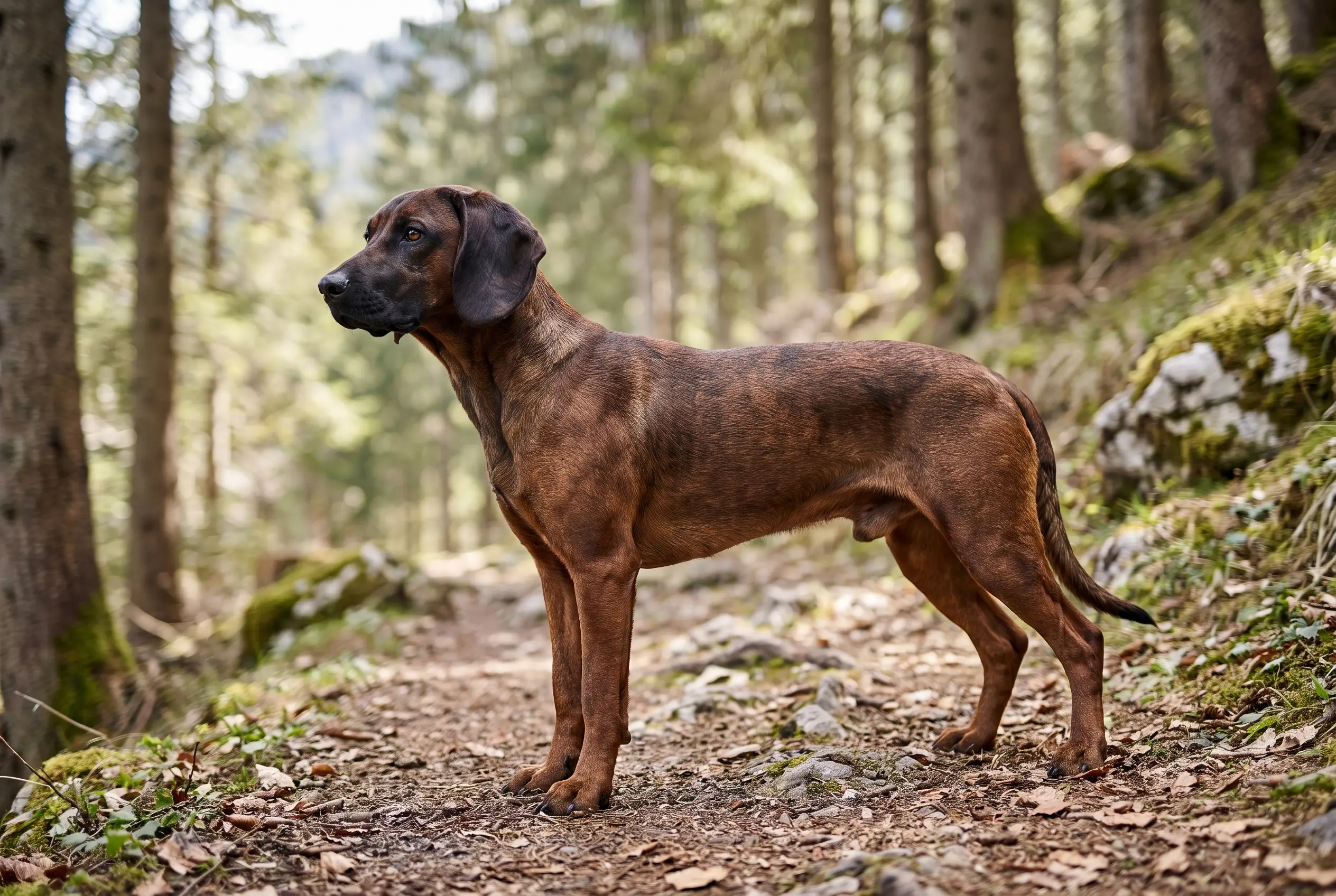
Bayerischer Gebirgsschweisshund
Bred to follow a wounded animal's blood trail for hours, on a leash, so it dies quickly instead of slowly.
Vital stats
| Size | Medium · 44–52 cm (dogs 47–52, bitches 44–48) |
| Weight | 17–30 kg (dogs 20–30, bitches 17–25) — an ideal range given in the standard itself |
| Life expectancy | 10–14 years — breed literature, not survey data; the standard sets none |
| Energy | High — hours of focused leash-tracking, not free galloping |
| Shedding | Low to moderate — short, dense coat, no documented heavy moult |
| Coat | Dense, close-fitting, moderately harsh · deep red to fawn or biscuit, plain or brindled, with a darker mask |
| Group | Hound · Leash (blood-tracking) hound (FCI №217, Group 6) |
| Origin | Bavaria, Germany |
| FCI group | 6 — Scent hounds and related breeds · FCI 217 |
Breed traits
Friendliness
Care
Mind
The Bayerischer Gebirgsschweisshund by the numbers
The Bayerischer Gebirgsschweisshund facts owners search for most — price, lifespan, weight, shedding and colours, in one place.
Less common, so expect a waitlist and some travel to a reputable breeder — which pushes the price up. Plan for steady ongoing costs — mid-range food, routine vet care and insurance.
We don't quote a single figure: the real price swings with breeder, region, bloodline and health testing — and a rescue costs a fraction of a breeder's litter. Adopting is almost always the cheapest route.
Temperament
The standard's own behaviour clause is direct: "Calm and balanced, devoted to his owner, reserved with strangers. Required is a sound, self-assured, unafraid, biddable dog, neither shy nor aggressive." That describes a dog built to sit quietly at a hunter's side for hours and then commit fully once it's put on a cold trail, not one that free-lances. It is a specialist working breed first, and most of the Klub für Bayerische Gebirgsschweißhunde's litters go to licensed hunters and gamekeepers who can give it actual tracking work; that placement pattern is club practice, not a line in the FCI standard, but it shapes who can realistically get one.
Habits & quirks
Worked on the leash, not off it
Section 2 is the whole point: unlike Group 6's free-running, loud-baying pack hounds in Section 1, a Schweisshund like this one stays on a long lead and follows ground scent hours or even days old, in near silence, with the handler right behind it.
The job is finding wounded animals, not chasing healthy ones
A "Schweisshund" tracks blood — Schweiß is old hunting German for blood — after a shot that wounds rather than kills outright. In Germany and Austria, following up (Nachsuche) and dispatching that animal isn't a sport add-on; it's a duty built into hunting law and game-welfare practice, so the animal dies quickly rather than lingering.
Bred lighter than its own parent breed
This breed exists because the heavier Hannoverscher Schweisshund (FCI №213) — 50–55 cm and up to 40 kg — struggled on steep mountain ground. After 1870, Baron Karg-Bebenburg crossed Hanoverian stock with local red mountain scent hounds to build something lighter for the Alps; at 44–52 cm and up to 30 kg, it's noticeably smaller than the breed it came from.
A darker face on a red coat
The standard allows deep red, deer red, reddish brown, tan, fawn to biscuit, and reddish grey, plain or brindled — but the muzzle and ears ("leathers") are meant to run darker than the body, and a small light patch on the chest, the "Bracken Star," is permitted. Slide into an actual black coat with red points, though, and it's rated a serious fault; an unrecognised colour altogether disqualifies.
Health
The standard sets no health list — it describes a sound, self-assured working dog and leaves it there — so the honest guidance here is about temperament and use rather than a screening panel. This is a specialist blood-tracking hound, calm and quiet in the house but built to switch fully on when it's put on a trail, and a dog like that stays healthy in mind only if it gets real work or a serious substitute for it; boredom is this breed's biggest welfare risk. The drop ears want the routine check and clean any hanging ear does. And the tracking drive is a safety matter as much as a pastime: this is a dog that will follow a scent with total focus, so secure ground and a dependable recall matter. Get one from the breed club or a working breeder who tests their dogs and will be honest about whether it suits you at all.
Nutrition
| Exercise | This isn't a dog you tire out with a loose run in the yard. Its work is hours of concentrated nose-down tracking on a lead, so give it real scentwork — training tracks, drag lines, actual hunting duty where legal — rather than just distance. A long walk with nothing to follow leaves the part of it that matters idle. |
| Grooming | The dense, moderately harsh coat needs only an occasional brush and sheds lightly. The heavy, close-hanging ears are the real maintenance item — check and clean them regularly, since they trap moisture after a day working scent close to the ground. |
| Training | The standard asks for a dog that's "sound, self-assured, unafraid, biddable" — calm at home, fully committed once it's on a trail. That combination trains best through real tracking work rather than generic obedience drills; this is a dog built to work a problem alone for hours, and it needs a job that respects that. |
| Health | Neither the FCI standard nor general breed literature documents a widely recognised breed-specific disorder. The long, heavy ears are worth a routine check for infection, and given how small and specialist the breeding population is outside Germany and Austria, ask about pedigree depth wherever a litter turns up. |
Feed the Bavarian Mountain Scent Hound to its actual workload — a dog putting in hours of focused tracking needs real fuel, while one waiting between jobs needs noticeably less, and the two shouldn't eat the same. Keep it lean and muscular, the way the standard describes the breed: a waist you can see, ribs you can feel, and treats counted into the day rather than added on top. A working tracker earns its keep on stamina, and carrying extra weight is the quickest way to blunt it.
Puppy guide
A Bavarian Mountain Scent Hound puppy is a working dog in the making, and it needs raising as one. Socialize him broadly and get him comfortable with handling and new places early, since the adult is reserved with strangers by nature and early exposure keeps that from curdling into wariness. Keep the hard exercise light while the joints are forming, and feed the nose instead — simple tracking and scent games suit this breed far better than repetitive fetch. Above all, be honest before you start about whether you can give the grown dog the tracking work it was built for; the temperament that makes a superb tracker makes a frustrated house ornament.
Training
The standard asks for a biddable dog devoted to its owner, and that's what you train with: a Bavarian Mountain Scent Hound bonds hard to its handler and works willingly for that bond, but it's a focused specialist, not an all-purpose obedience dog. Build a reliable recall and calm manners with reward-based, consistent handling, keep strangers a neutral part of the picture rather than forcing greetings, and channel the tracking drive into the real thing — laid trails, blood-tracking work, scent games — because this is a brain that needs a job and goes sour without one. Trained to track and given the chance to do it, it's a steady, deeply loyal partner.
Life expectancy
Bavarian Mountain Scent Hounds live 10–14 years — breed literature, not survey data; the standard sets none. The Bavarian Mountain Scent Hound is a hardy, purpose-built working hound, and you keep it near the top of that range the same way you keep it settled: a lean, muscular weight, ears kept clean, and above all a real job for that nose — because a tracking dog with nothing to track loses condition in mind long before body.
Similar breeds
Breeds with a similar build and background — worth a look if this one isn't quite the fit.
Breeds that look like this
Common questions
Is the Bayerischer Gebirgsschweisshund the same as the Hannoverscher Schweisshund?
No — parent and offspring, not the same breed. The Hannoverscher Schweisshund is FCI standard No. 213, developed from the old Bracken and Leithund lines by the Hanoverian hunting estate; it's the heavier of the two, 50–55 cm and up to 40 kg. After 1870, breeders crossed it with lighter red mountain scent hounds to make the Bayerischer Gebirgsschweisshund, FCI No. 217, specifically because the Hanoverian was too heavy to work steep Alpine ground. Both are Group 6, Section 2 leash hounds doing the same job — trailing wounded game on a leash — but the Bavarian is the smaller, mountain-built version.
What does a "Schweisshund" actually do, and why does it matter?
It finds animals that a hunter has shot but not killed outright, following the blood trail (Schweiß, in old hunting German) on a long leash, sometimes for hours or across more than a day. That's not a hobby for the dog or the handler: in Germany, Austria and other hunting jurisdictions, tracking down and dispatching wounded game is a legal and ethical obligation on the hunter, and the Schweisshund is the tool that makes it possible. Leave a wounded animal untracked and it can suffer for days before it dies — that's the whole reason this breed, and its Section 2 relatives, exist.
Can I get one as a family pet rather than a hunting dog?
It's difficult, and mostly by design. This is a specialist working breed built for scent work under a handler's close direction, and the Klub für Bayerische Gebirgsschweißhunde — the only club for the breed recognised in Germany — places the large majority of its litters with licensed hunters and gamekeepers as a matter of club practice, not FCI rule. A home without real tracking work to offer is a hard sell to most breeders and a harder life for a dog built to want a trail to follow.
Does the Bayerischer Gebirgsschweisshund shed a lot?
Yes — the Bayerischer Gebirgsschweisshund is a heavy shedder, dropping hair year-round or in big seasonal moults. Brush it several times a week and expect regular vacuuming; it isn't the coat for you if loose fur is a dealbreaker.
Is the Bayerischer Gebirgsschweisshund hypoallergenic?
Not really. No dog is truly hypoallergenic, and the Bayerischer Gebirgsschweisshund's shedding coat releases plenty of the dander that sets off allergies. If someone at home is allergic, this isn't the easiest breed to live with — spend time around one first.
Is the Bayerischer Gebirgsschweisshund easy to train?
Reasonably. The Bayerischer Gebirgsschweisshund is trainable with consistency and rewards, though it isn't the quickest study. Keep sessions short and positive, and be patient with the basics like recall.