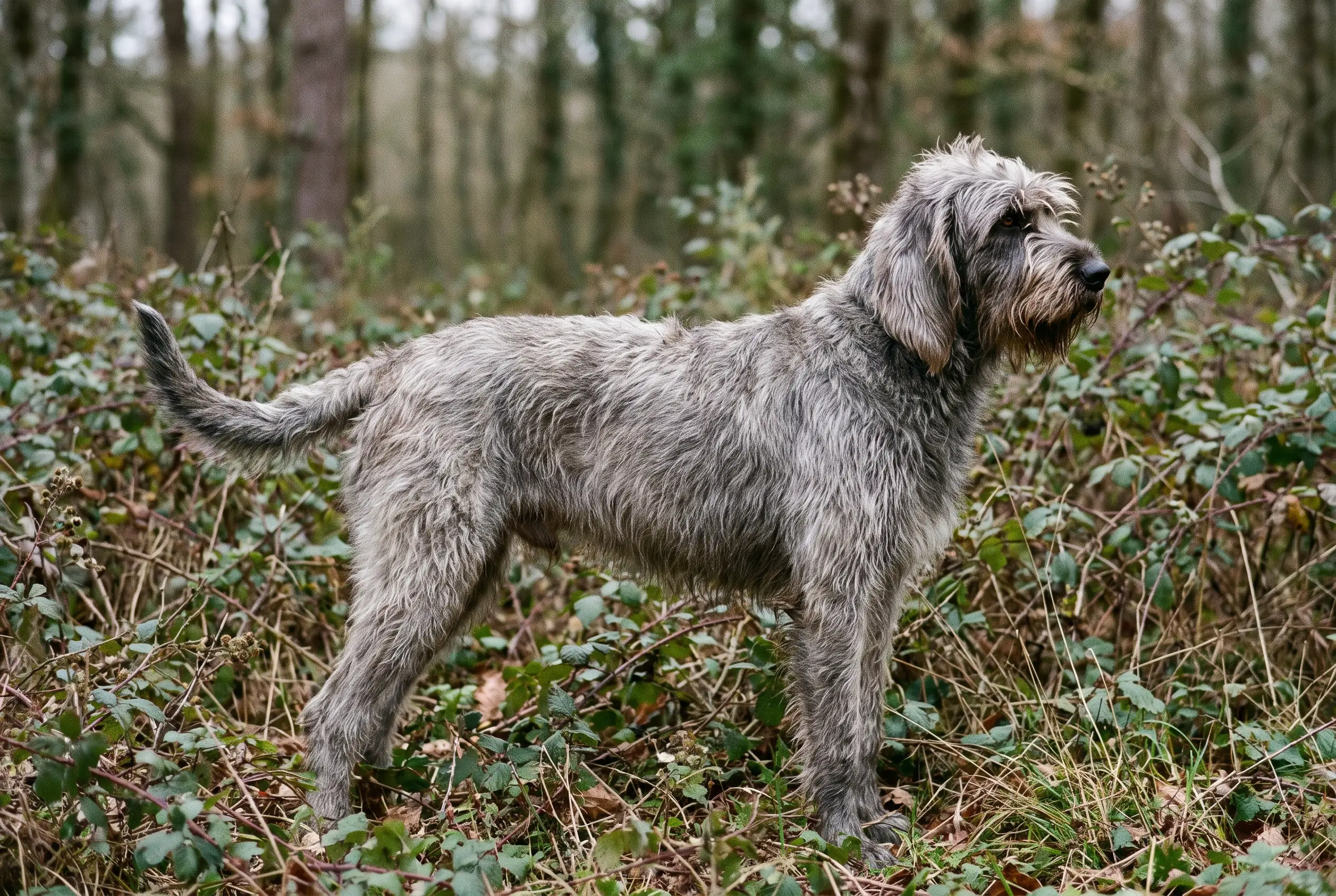
Griffon Nivernais
A hard, tousled coat the standard names barbouillaud, grown to punch through briar after wild boar — not to look shaggy.
Vital stats
| Size | Medium · 55–62 cm (dogs), 53–60 cm (bitches) |
| Weight | 22–25 kg — breed literature; the standard sets none |
| Life expectancy | 10–13 years — breed literature, not survey data |
| Energy | High — bred for full days on rough boar country |
| Shedding | Moderate — long, rough coat, brushed weekly |
| Coat | Long, harsh, shaggy, never woolly or curly · darkened (black-tipped) fawn, hare colour to wild boar grey |
| Group | Scent Hound · Medium-sized Hounds (FCI №17, Group 6) |
| Origin | Nivernais, France |
| FCI group | 6 — Scent hounds and related breeds · FCI 17 |
Breed traits
Friendliness
Care
Mind
The Griffon Nivernais by the numbers
The Griffon Nivernais facts owners search for most — price, lifespan, weight, shedding and colours, in one place.
Less common, so expect a waitlist and some travel to a reputable breeder — which pushes the price up. Plan for steady ongoing costs — mid-range food, routine vet care and insurance.
We don't quote a single figure: the real price swings with breeder, region, bloodline and health testing — and a rescue costs a fraction of a breeder's litter. Adopting is almost always the cheapest route.
Temperament
The standard splits its character in two, and the wild-boar job runs through both halves. Behaviour: "Very good nose, piercing, and particularly enjoying difficult terrains and thickets." Temperament: "Excellent at approaching and very good hunter, it's courageous when holding firm without being reckless. Its courage and initiative allow it to be used successfully in small packs for hunting wild boar. Although it can easily be taught hunting that game, it shows itself occasionally to be obstinate and independent, and its master should know how to make it obey starting at its youngest age." Strip out the hunting language and what's left is a dog built to hold ground against an animal that can kill it, then come home and, per breed literature, greet everyone in the house — "aime tout le monde," loves everyone, is the phrase French sources use. That combination is the point of the breed, not a contradiction in it: a wild-boar hound kept by hunters needs exactly this mix of nerve in the field and biddability at the door, and a home that only wants the second half should look elsewhere.
Habits & quirks
Barbouillaud, in the standard's own word
The standard doesn't just call the coat shaggy — it names it: barbouillaud, French for something close to "daubed" or "smeared." On paper that means hair that is "long, shaggy, and bushy, strong enough and rough," never woolly or curly, thick enough that "the belly and the inside of the thighs shouldn't be hairless." A griffon's coat isn't a look; on this dog it's armour against the thorn and briar of the Nivernais, where the hunting actually happens.
A colour chart written by hunters
Every hair on a Griffon Nivernais is meant to be "always darkened" — tipped darker than its base — over a fawn ground the standard says "can be more or less darkened but never orange." Depending on how far that darkening runs, the standard names the result hare colour, wolf grey or blue grey, and scattered white hair pushes it toward wild boar grey. It's a colour vocabulary built for the men who hunted behind the dog, not for a show ring.
Vanished once, rebuilt twice
The breed's own historical summary is unusually blunt about its own gaps: prized for two centuries until Francis I dropped it from the royal packs for white hounds, kept alive by a handful of Nivernais noblemen, and then "seemed to have disappeared" outright around the French Revolution. What exists today was recreated a century later from the stock those noblemen had preserved, then topped up around 1900 with blood from the Griffon Vendéen, the Fox Hound and the Otterhound. The breed's own club dates only to 1925.
A sad face on a dog that isn't
The standard's own phrase for its expression is "slightly sad in aspect but in no way nervous" — a heavy brow and a serious cast to the face that has nothing to do with its temperament on the ground. Set that next to the standard's behaviour clause and the mismatch is the point: this isn't a mopey dog, it's a hound built to look unbothered while doing genuinely dangerous work.
Health
Neither the standard nor general breed literature pins a breed-specific disease on the Griffon Nivernais, and the consensus is that it's a generally robust hound — but that rests on no breed-wide survey, so treat it as encouragement rather than a guarantee. The recurring watch-points are ear infections, given the long, densely-haired hanging ears that close over the canal, and a reported sensitivity to heat rather than cold. Outside France the population is small, so ask hard questions about pedigree depth, keep the ears clean and dry after a day in cover, and keep the dog lean.
Nutrition
| Exercise | The standard's own job description is hunting wild boar, mostly in a pack but sometimes alone, over the difficult terrain and thickets it says the breed particularly enjoys. A lead walk doesn't touch that; give it real daily distance with something to track, and don't expect a low-key life. |
| Grooming | The coat is built to be harsh and shaggy, and cutting it works against the standard's own description — clipping softens exactly the texture that's meant to survive briar. A weekly brush plus occasional hand-stripping keeps it in order, and the semi-long, hair-covered ears want a regular check, since they fold shut against airflow the way most drop-eared hounds' do. |
| Training | The standard's own warning is direct: it "shows itself occasionally to be obstinate and independent, and its master should know how to make it obey starting at its youngest age." Start early, stay consistent, and don't expect a soft correction to out-compete a hot boar trail — channelling the nose works better than fighting it. |
| Health | Neither the standard nor general breed literature documents an unusual breed-specific condition, and the consensus is that it's generally robust. The recurring watch-points are ear infections, given the long, densely-haired hanging ears, and a reported sensitivity to heat rather than cold; there's no breed-wide health survey behind any of this, and outside France the population is small enough to ask hard questions about pedigree depth. |
Feed a Griffon Nivernais to what it actually does. This is a lean, hard-muscled boar hound built for length of work over rough country, and on a full hunting day it burns far more than on a quiet one — match the ration to the week, not the bag. Weigh the meals, count the training treats in the total, and aim for ribs you can feel under that shaggy coat. A lean, fit dog works longer and carries less strain into its joints.
Puppy guide
A Griffon Nivernais puppy grows into an independent, strong-willed boar hound, and its own standard is blunt that you should teach it to obey 'starting at its youngest age.' Start that early and keep it consistent, socialise him widely, and build recall before the nose takes over. Keep the growing joints to gentle exercise rather than forced miles, get him used to short spells alone, and put the work in now: this is a breed that's much easier to live with when the groundwork went in during the first year than when it didn't.
Training
The standard's own warning is direct: the Griffon Nivernais 'shows itself occasionally to be obstinate and independent,' and asks you to make it obey from puppyhood. Take that at face value. Start early, stay consistent, and don't expect a soft correction to out-compete a hot boar trail — channelling the nose with real, rewarding work does far more than fighting it. It's a bright, driven hound that needs a job; give it one and the stubbornness has somewhere to go.
Life expectancy
Griffon Nivernais live 10–13 years — breed literature, not survey data. The Griffon Nivernais is a hardy, workmanlike hound, and no breed-specific disease hangs over the 10–13 years usually quoted — though no breed-wide survey stands behind that figure either. You keep one sound the way you keep it happy: real daily work for the nose, a lean weight, ears checked and dried after time in cover, and honest questions about pedigree depth given how few there are outside France.
Similar breeds
Breeds with a similar build and background — worth a look if this one isn't quite the fit.
Breeds that look like this
Common questions
What does "griffon" actually mean on a breed name like this one?
It's a coat type, not a decoration: a griffon is a rough, wire-haired hound, bred that way on purpose because a smooth coat gets shredded working thorn and briar country. The Griffon Nivernais's own standard calls its coat "hard and tousled" — barbouillaud in French — and "robust, very hardy and shaggy." The same functional coat, in different colours, defines its griffon relatives: the Griffon Fauve de Bretagne (FCI No. 66), the Grand Griffon Vendéen (FCI No. 282), and the wire coat crossed onto the smooth Bleu de Gascogne base to make the Griffon Bleu de Gascogne (FCI No. 32).
Does the Griffon Nivernais really descend from the medieval Chien Gris de Saint-Louis?
That's the traditional claim, and the FCI's own standard states it as exactly that — a claim, not a documented fact: the breed "may have descended... from the grey Saint Louis dogs," with "may have" doing real work in that sentence. No pedigree connects a living Griffon Nivernais to a 13th-century royal pack. What is documented is that the breed was prized in the French royal kennels for roughly two centuries, dropped by Francis I in favour of white hounds, kept going only by Nivernais noblemen, and appeared to disappear entirely around the French Revolution — before being recreated a century later from what those noblemen had preserved, then reinforced again around 1900 with new blood from the Griffon Vendéen, the Fox Hound and the Otterhound. The dog alive today carries a medieval reputation, not an unbroken medieval bloodline.
How is the Griffon Nivernais related to the other French griffons already in this catalog — the Griffon Bleu de Gascogne, Griffon Fauve de Bretagne and Grand Griffon Vendéen?
Closer to some than others, and not always in the direction you'd guess. The Griffon Bleu de Gascogne's (FCI No. 32) own standard says it comes from crossing a Bleu de Gascogne with "a griffon" without naming which one; breed literature's best guess for that unnamed partner is this breed. The Griffon Fauve de Bretagne (FCI No. 66) and Grand Griffon Vendéen (FCI No. 282) aren't documented ancestors or descendants of this breed — they're cousins in type, sharing the same wiry, weatherproof coat and the same traditional claim of descent from the old grey Saint-Louis hounds. If anything, the traffic with the Vendéen line ran the other way in recent history: this breed's own standard credits its early-20th-century reconstruction with new blood from the Griffon Vendéen, not the reverse.
Does the Griffon Nivernais shed a lot?
Moderately. The Griffon Nivernais sheds a fair amount, steadily through the year with heavier seasonal patches. A weekly brush keeps most of the loose hair off your floors and clothes.
Is the Griffon Nivernais hypoallergenic?
Not really. No dog is truly hypoallergenic, and the Griffon Nivernais's shedding coat releases plenty of the dander that sets off allergies. If someone at home is allergic, this isn't the easiest breed to live with — spend time around one first.
Is the Griffon Nivernais good with children?
They can be. The Griffon Nivernais is reasonably sociable and can be good with children in the right home, especially when socialised early. Supervise around young kids and teach dog and child to respect each other.
Is the Griffon Nivernais easy to train?
They can be a challenge. The Griffon Nivernais is intelligent but independent, and would rather make its own decisions than take orders. Reward-based training and patience work best; expect recall in particular to take time.