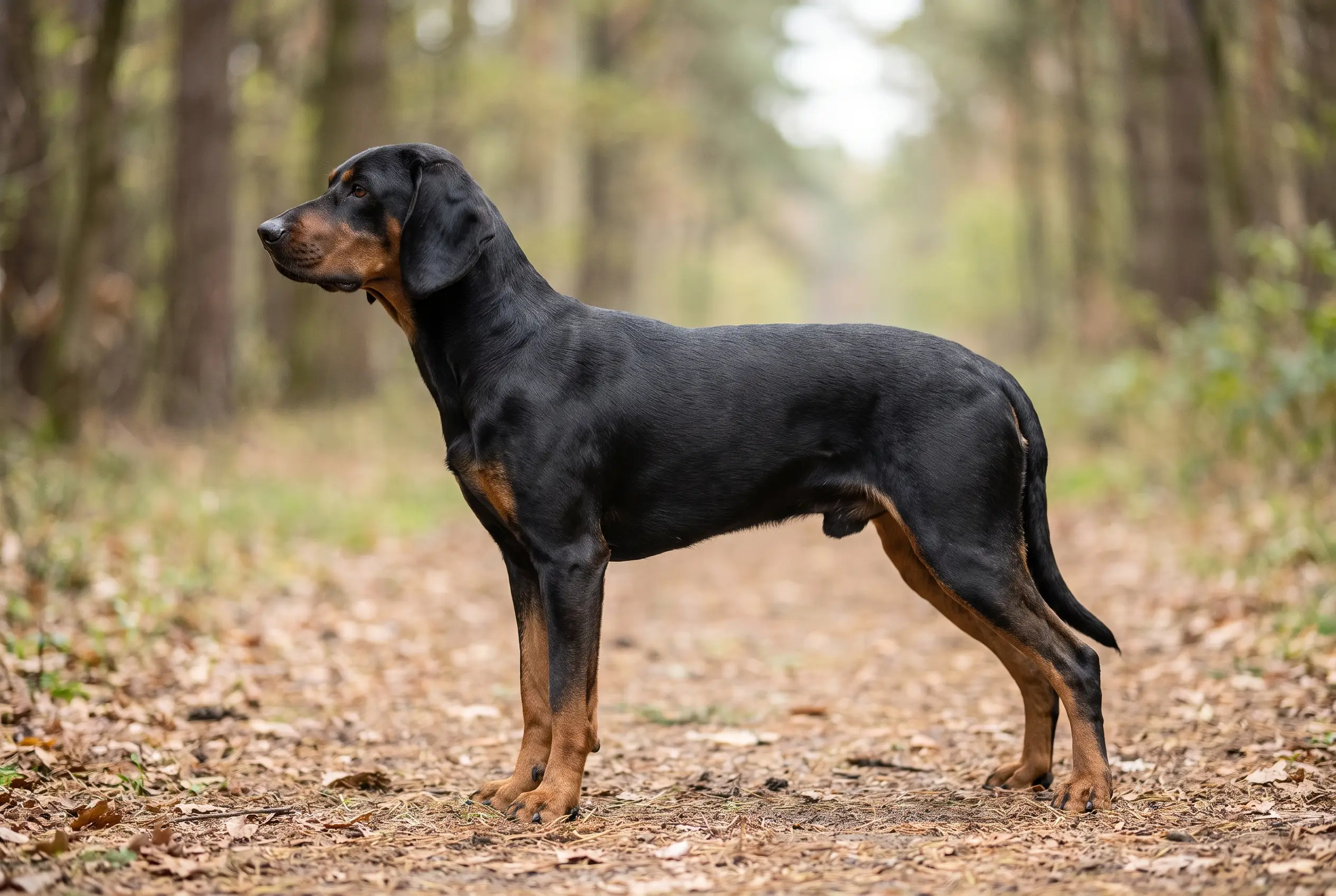
Gończy Polski
Poland's fifth FCI breed, lighter and faster than the Ogar it was once registered as, built for the southern mountains.
Vital stats
| Size | Medium · 55–59 cm (dogs), 50–55 cm (bitches) |
| Weight | 22–26 kg — breed literature; the standard sets no weight |
| Life expectancy | 10–13 years — breed literature, not survey data |
| Energy | High — bred for mobility on difficult mountain ground |
| Shedding | Moderate — abundant undercoat, heavier in winter |
| Coat | Short, harsh, close-lying outer coat with abundant undercoat · black, chocolate or red, all with tan |
| Group | Hound · Medium-sized Scenthound (FCI №354, Group 6) |
| Origin | Poland |
| FCI group | 6 — Scent hounds and related breeds · FCI 354 |
Breed traits
Friendliness
Care
Mind
The Gończy Polski by the numbers
The Gończy Polski facts owners search for most — price, lifespan, weight, shedding and colours, in one place.
Less common, so expect a waitlist and some travel to a reputable breeder — which pushes the price up. Plan for steady ongoing costs — mid-range food, routine vet care and insurance.
We don't quote a single figure: the real price swings with breeder, region, bloodline and health testing — and a rescue costs a fraction of a breeder's litter. Adopting is almost always the cheapest route.
Temperament
The standard's own behaviour section reads: "Stable and gentle. This dog is truly courageous and can even demonstrate proof of bravery. He is intelligent and easy to educate. Not aggressive but remaining wary towards strangers. To his qualities as a hunting dog, must be added those of an excellent guardian. During the hunt he gives voice with a characteristic melody in various intonations; a higher pitch for the females." The voice clause matters as much as the courage clause: Polish hunters work this breed by ear as much as by sight, following the changing pitch of its call through cover where the dog itself can't be seen. Off the hunt, the same paragraph promises a dog that is easy to teach and steady around its own household, with the reserve toward strangers doubling as an unpaid guard job.
Habits & quirks
Three colours, one pattern
The standard allows three coats — black and tan, chocolate (called 'brown') and tan, or red — and lays the tan out in the same places on all three: over the eyes, on the muzzle, down the front of the neck and chest, the lower legs, behind and inside the thighs, around the tail. Small white on the chest or toes is permitted; anything more isn't.
A breed split off from its own name
For years, this breed and the heavier Ogar Polski were both registered under the single name 'Ogar Polski,' before Polish clubs pulled the lighter line apart and eventually renamed it. It's a genuinely contested piece of Polish breed history — sources describe early attempts to cross the two types back together as unsuccessful, which is part of why the split happened at all.
Built 9:10, not square
The standard gives an exact body proportion, 9:10, slightly longer than tall — a tighter, more compact ratio than most scenthounds carry. Combined with bone that's strong but not heavy, it's the shape behind the standard's own claim to 'great aptitude for mobility' on rough ground.
A guard job comes with the hunt
The standard adds guarding to the dog's hunting résumé directly: 'To his qualities as a hunting dog, must be added those of an excellent guardian.' Few scenthound standards make that claim about themselves.
Health
Honestly, the Gończy Polski has no widely recognised breed-specific illness on record — neither the FCI standard nor the available breed literature documents one, which for a working hound is good news. The real thing to ask about is the family tree. The registered population is small (around 1,342 dogs in Poland in 2015, with 432 breeding animals), small enough that Polish breeders themselves flag inbreeding risk, so ask any breeder about pedigree depth and how they keep the lines varied. Otherwise it's straightforward: as a drop-eared hound that works in cover, check and dry the ears, keep him fit and worked, and keep him lean.
Nutrition
| Exercise | This is the more mobile of Poland's two native hounds — its own standard credits the build with 'great aptitude for mobility' on rough, mountainous ground. Daily exercise needs to be real distance with something to track, not a lead-walk around the block; hunting work, tracking trials or long off-lead hikes on varied terrain all suit it. |
| Grooming | The short outer coat lies close to the skin over an undercoat the standard calls abundant, heavier in winter and lighter in summer. A weekly brush handles most of it, with more frequent brushing through the seasonal coat change. |
| Training | The standard calls it 'intelligent and easy to educate,' which tracks with its guard-dog side note — this is a hound that reads a household as well as it reads a trail. Start socialisation early regardless: the same paragraph that calls it stable and gentle also flags it as wary of strangers by design. |
| Health | Neither the standard nor the breed literature available for this profile documents a widely recognised breed-specific disorder. Polish Kennel Club figures put the domestic registered population at 1,342 dogs in 2015, with 432 registered for breeding — a small enough base that Polish sources themselves flag inbreeding risk if the numbers don't grow, so ask about pedigree depth wherever a litter turns up. |
Feed the Gończy Polski to its workload, and for a hound bred to cover mountain ground all day that workload is real. Weigh the meals, count any tracking or training treats into the daily total, and aim for a lean, hard-conditioned dog you can feel the ribs on — a scenthound carrying extra weight is a scenthound working below itself. Adjust up through a hard hunting or hiking season and back down when the work eases off.
Puppy guide
A Gończy Polski puppy is a working scenthound in the making, with a nose and a drive that will want a job long before it's grown. Socialise him early and widely — the standard calls the breed wary of strangers by design, and gentle early exposure keeps that reserve steady rather than sharp — and start calm, consistent training while he's still listening. Keep hard exercise light while the joints form, let the nose work on easy tracking games, and build a recall you can trust before that drive takes him over a hill after a scent.
Training
The standard calls the Gończy Polski intelligent and easy to educate, and owners find a hound that reads a household as well as it reads a trail. Start socialisation early anyway — the same breed description that calls it stable and gentle also flags a built-in wariness of strangers, the flip side of its guarding streak. The challenge isn't willingness, it's the nose: once this dog is following a scent it is genuinely hard to call off, so proof that recall early and keep the interesting work — tracking, trailing, long varied hikes — coming.
Life expectancy
Gończy Polski live 10–13 years — breed literature, not survey data. The Gończy Polski is a fit, working-bred hound with a good working life ahead of it, and you keep it at the top of its range the way you keep any hound sound: lean weight, plenty of real exercise, and a breeder chosen with an eye on pedigree depth given how small the breed's population still is.
Similar breeds
Breeds with a similar build and background — worth a look if this one isn't quite the fit.
Breeds that look like this
Common questions
How is the Gończy Polski different from the Ogar Polski?
They were the same registered breed for decades before splitting apart, so the confusion is earned. Side by side, the Gończy is the smaller, lighter one — 55–59 cm at the withers in dogs against the Ogar's 56–65 cm, on bone the standard calls 'strong but not heavy' rather than the Ogar's 'rather heavy' frame — with a leaner, 'noble' head next to the Ogar's broad skull and thick, drooping lips. The two also work differently: the Ogar (FCI No. 52) covers flat and rolling ground at a measured trot after boar and fox, while the Gończy (FCI No. 354) was purpose-built for the mountainous south of Poland and moves at a far more energetic, reaching pace, hunting boar and deer with occasional fox and hare work in the hills where it started.
Why did it take until 2017 for the FCI to recognise the Gończy Polski?
Because for a long stretch it wasn't treated as its own breed. Colonel Józef Pawłusiewicz's lighter, black-and-tan dogs were provisionally lumped in with the heavier Ogar Polski through the 1960s and 70s; Polish sources describe attempts to cross the two types back together as unsuccessful, and Pawłusiewicz's line kept working unofficially as 'Pawłusiewicz's hound' for years afterward. Poland opened a preliminary registry for it in 1983, the FCI granted provisional recognition in November 2006, and full recognition finally came on 7 November 2017 — making it only the fifth Polish breed the FCI has fully recognised.
Is the Gończy Polski a good family dog?
The standard's own words are 'stable and gentle,' and it explicitly rules out aggression, while still flagging the dog as wary of strangers — which the standard frames as a guarding trait rather than a flaw. It needs a hunter's amount of daily exercise and a real job for its nose, and the domestic population is small enough (1,342 registered in Poland in 2015, per Polish Kennel Club figures) that finding a breeder outside hunting circles, or outside Poland at all, is the real obstacle.
Does the Gończy Polski shed a lot?
Moderately. The Gończy Polski sheds a fair amount, steadily through the year with heavier seasonal patches. A weekly brush keeps most of the loose hair off your floors and clothes.
Is the Gończy Polski hypoallergenic?
Not really. No dog is truly hypoallergenic, and the Gończy Polski's shedding coat releases plenty of the dander that sets off allergies. If someone at home is allergic, this isn't the easiest breed to live with — spend time around one first.
Is the Gończy Polski easy to train?
Reasonably. The Gończy Polski is trainable with consistency and rewards, though it isn't the quickest study. Keep sessions short and positive, and be patient with the basics like recall.