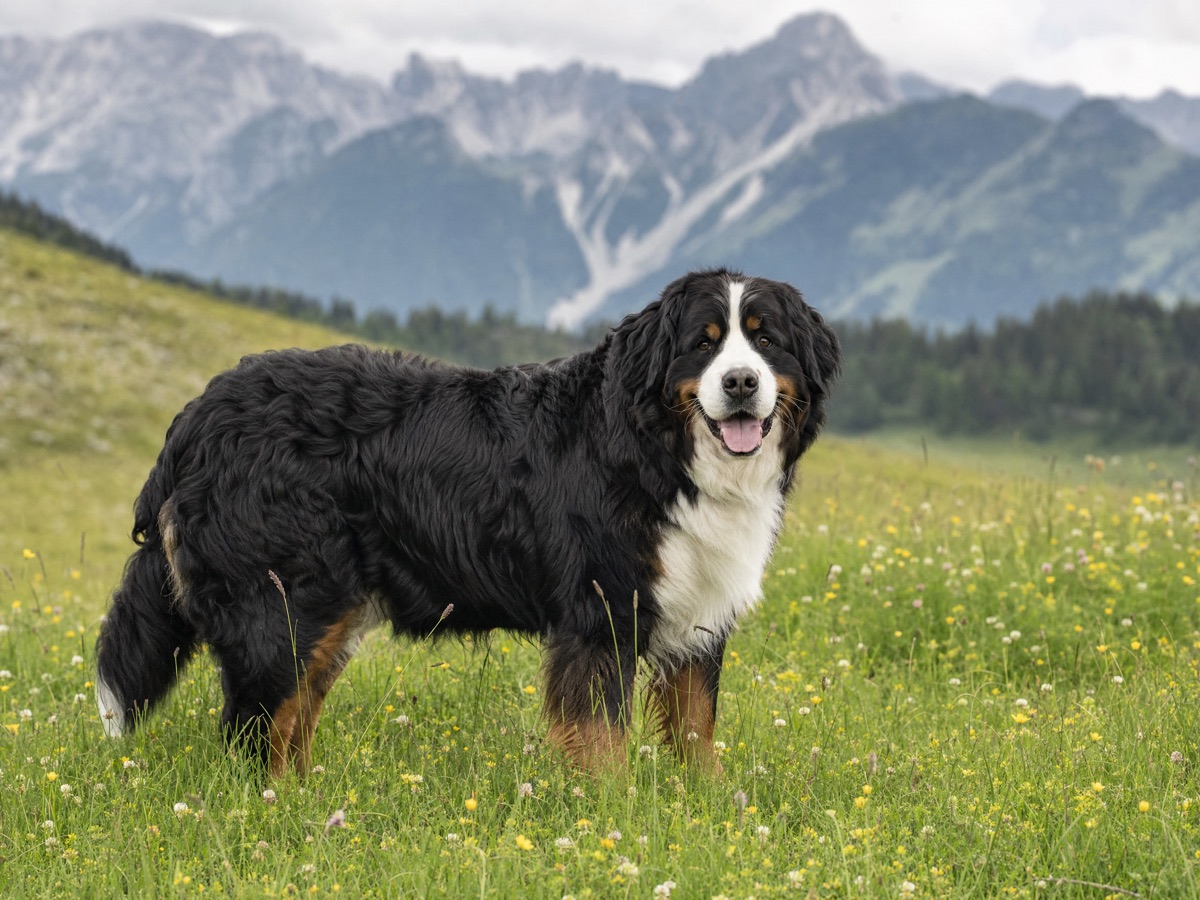
Bernese Mountain Dog
A gentle tricolor giant — the affectionate soul of the Swiss Alps.
On these lists: Dogs for cold climates · Dogs for hiking
Vital stats
| Size | Large · 58–70 cm |
| Weight | 35–55 kg |
| Life expectancy | 7–10 years |
| Energy | Moderate — 45–60 min/day |
| Shedding | Heavy, year-round |
| Coat | Long, thick double coat · tricolour |
| Group | Working · FCI №45 / AKC |
| Origin | Bern, Switzerland |
| FCI group | 2 — Pinscher and Schnauzer, Molossoid and Swiss Mountain Dogs · FCI 45 |
Breed traits
Friendliness
Care
Mind
The Bernese Mountain Dog by the numbers
The Bernese Mountain Dog facts owners search for most — price, lifespan, weight, shedding and colours, in one place.
Less common, so expect a waitlist and some travel to a reputable breeder — which pushes the price up. Ongoing costs run high — more food, bigger doses at the vet, and pricier insurance. Its coat also needs a professional groom every few weeks — a real line in the budget.
We don't quote a single figure: the real price swings with breeder, region, bloodline and health testing — and a rescue costs a fraction of a breeder's litter. Adopting is almost always the cheapest route.
Temperament
A Swiss farm all-rounder — drover, draft dog, watchdog — the Berner carries that steady usefulness into family life: placid, deeply attached, and happiest with a job like carrying a pack or pulling a child's cart. It leans on its people literally and figuratively, and wilts if left out of family goings-on.
Habits & quirks
The Berner lean
It expresses love with its whole bodyweight — brace accordingly.
Snow joy
The first snowfall turns this dignified giant into a delighted puppy.
Doorway supervisor
It settles where it can watch the whole family at once, preferably blocking a corridor.
Slow to grow up
Berners stay puppyish in mind for two to three years while the body turns enormous.
Health
Two things shape a Bernese's health: the joints and cancer. The hips and elbows can develop dysplasia, and the breed is tragically prone to histiocytic cancers, which is the main reason it is so short-lived. Buy from a breeder who screens hips and elbows and pays real attention to cancer in the lines, keep your Bernese lean to spare the joints, and stay on top of vet checks as the dog ages.
Nutrition
| Health | Choose breeders who screen hips, elbows and for histiocytic cancers — the breed's tragically common weak point. |
| Grooming | Brush two or three times weekly, daily during the twice-yearly coat blows. |
| Heat | Built for alpine cold — keep exercise to cool hours and never leave it in warm cars or sun. |
| Exercise | Steady daily walks and hikes rather than sprints; go gently on joints for the first two years. |
A big dog carries its weight on big joints, so keep a Bernese lean and measure the meals rather than free-feeding. Through the long puppy growth, feed a large-breed diet so the dog comes up slowly — rushed growth is hard on joints that are still forming. Count treats into the day's total and keep ribs you can feel under that thick coat.
Puppy guide
A Bernese puppy grows into a giant, and its joints need protecting while it does. Keep exercise steady and moderate for the first two years — daily walks rather than sprints or long runs — and go easy on stairs and jumps. Start brushing early so the dog learns to enjoy it, and mind the heat from the beginning: this is an alpine breed, happiest in the cool.
Training
Bernese are gentle, steady and eager to please, and they take well to calm, kind, reward-based training. Start early and socialise often while the dog is still liftable, because a friendly giant is far easier to live with than an unsocialised one. Keep sessions warm and patient; harsh handling is wasted on a dog this soft, and does more harm than good.
Known health issues
No breed is problem-free. These are the conditions most worth knowing about for this breed — with what a good breeder screens for and what an owner watches. General guidance, not a substitute for your vet.
Hip dysplasia
A poorly fitting hip joint that wears early and can cause pain and arthritis, most common in larger breeds. Good breeders screen: Hip-scored parents (BVA/OFA/FCI). Watch for: Stiffness, a bunny-hop run, or reluctance on stairs.
Elbow dysplasia
A developmental fault in the elbow that leads to lameness and arthritis, seen in fast-growing large breeds. Good breeders screen: Elbow-scored parents. Watch for: Front-leg limping that worsens after exercise.
Life expectancy
Bernese Mountain Dogs live 7–10 years. The Bernese is a short-lived breed, and cancer is the main reason. You can't screen it away entirely, but you can tilt the odds: buy from a breeder who pays honest attention to cancer and joints in their lines, keep the dog lean, and catch problems early with regular vet checks. Good breeding is the single biggest lever you have.
Popular Bernese mixes
Bernedoodle
A big, gentle, often lower-shedding cross bred for a friendly family temperament. Coat varies a lot from pup to pup, and it shares the Bernese's joint and cancer risks, so health-test the lines.
Golden Mountain Dog
A large, calm, affectionate family dog that loves company. Sturdy and sweet, but it shares both parents' joint and cancer risks — screen the lines.
Bernese Shepherd
A big, loyal, protective cross with more drive than a purebred Bernese. Smart and trainable; it needs real exercise and early socialising.
Saint Bernese
An enormous, gentle, devoted family giant with a heavy coat. Giant-breed care throughout, and it feels the heat, so keep it cool.
Labernese
A large, friendly, easy-going family mix — more active than a Bernese and very trainable. Watch the growing joints and the appetite.
Similar breeds
Breeds with a similar build and background — worth a look if this one isn't quite the fit.
Breeds that look like this
Common questions
Are Bernese Mountain Dogs good family dogs?
Wonderfully — they're gentle, patient and deeply attached to their people. They do need space, cool conditions and plenty of company.
How long do Bernese Mountain Dogs live?
Sadly only about 7–9 years on average — one of the shorter-lived breeds. Buy from health-testing breeders to improve the odds.
Do Bernese Mountain Dogs shed a lot?
Heavily, all year, with two spectacular seasonal moults. Regular brushing helps, but black tumbleweeds are part of the deal.
Is the Bernese Mountain Dog hypoallergenic?
Not really. No dog is truly hypoallergenic, and the Bernese Mountain Dog's shedding coat releases plenty of the dander that sets off allergies. If someone at home is allergic, this isn't the easiest breed to live with — spend time around one first.
Is the Bernese Mountain Dog easy to train?
Reasonably. The Bernese Mountain Dog is trainable with consistency and rewards, though it isn't the quickest study. Keep sessions short and positive, and be patient with the basics like recall.