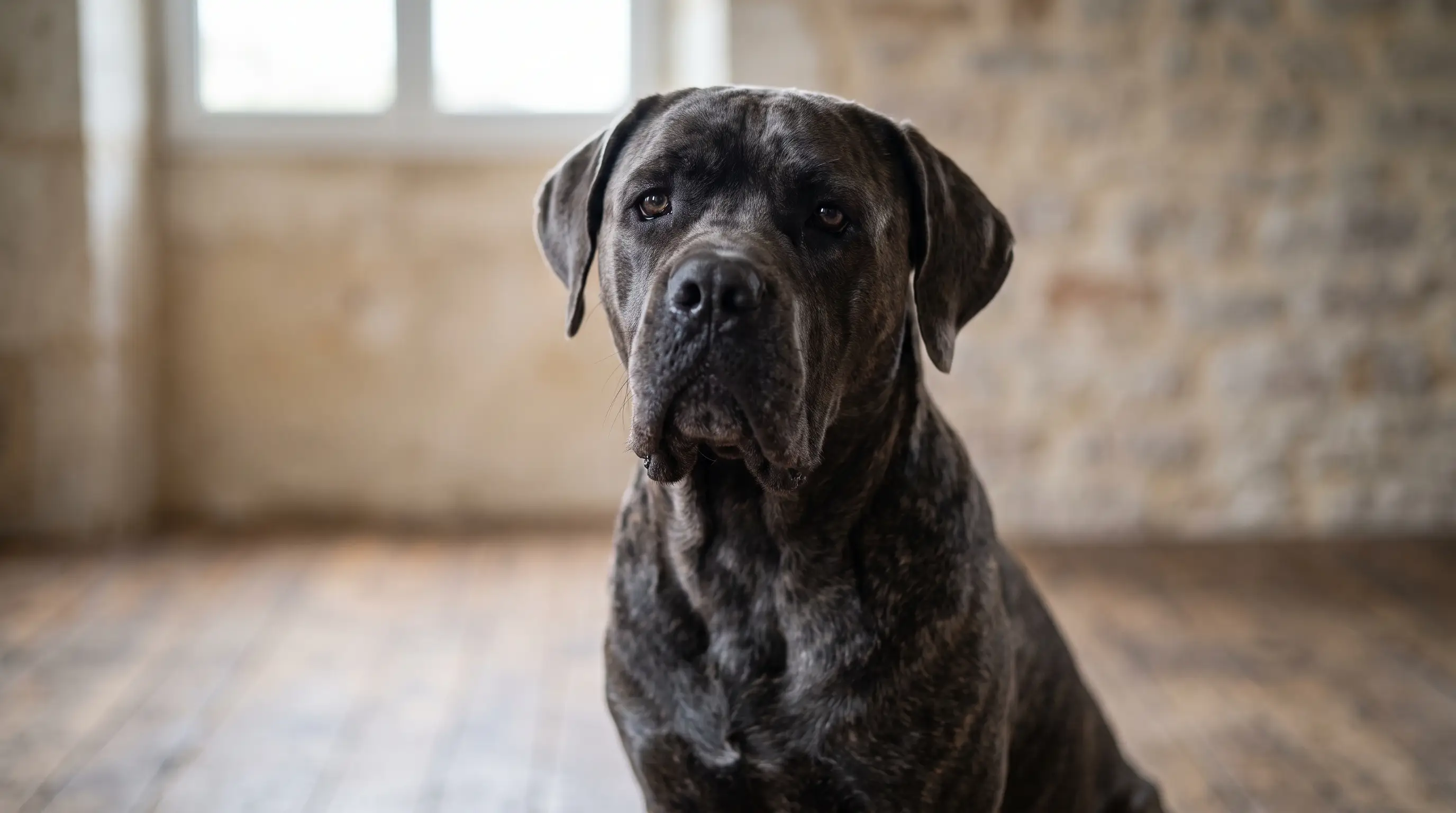
Cane Corso
Rome's old bodyguard, still on duty — powerful, serious and bound to its family.
On these lists: Protection dogs
Vital stats
| Size | Large · 60–68 cm |
| Weight | 40–50 kg |
| Life expectancy | 9–12 years |
| Energy | Moderate–high — 60–90 min/day |
| Shedding | Moderate, seasonal |
| Coat | Short, dense · black, grey, fawn, brindle |
| Group | Working · FCI №343 / AKC |
| Origin | Southern Italy |
| FCI group | 2 — Pinscher and Schnauzer, Molossoid and Swiss Mountain Dogs · FCI 343 |
Breed traits
Friendliness
Care
Mind
The Cane Corso by the numbers
The Cane Corso facts owners search for most — price, lifespan, weight, shedding and colours, in one place.
Widely bred, so you can usually find a litter from a registered breeder without a long wait. Ongoing costs run high — more food, bigger doses at the vet, and pricier insurance.
We don't quote a single figure: the real price swings with breeder, region, bloodline and health testing — and a rescue costs a fraction of a breeder's litter. Adopting is almost always the cheapest route.
Temperament
For centuries the Corso was southern Italy's everything dog — guarding the farm, droving stock, holding wild boar — and that working range shows: it's more athletic and more biddable than most mastiffs, but every bit as protective. Expect a quiet, watchful presence that bonds hard, judges strangers carefully and thrives on clear, calm leadership.
Habits & quirks
The checkpoint
It stations itself where it can see the door, and processes all arrivals.
Velcro giant
Fifty kilos that quietly relocates to whichever room you're in.
The long look
Everything is watched, weighed and filed away for reference.
Chin on knee
Affection arrives as a heavy head, deposited without warning.
Health
The Cane Corso is a big, powerful guardian, and its health hinges on the joints, the heart and the deep chest. Hips and elbows can develop dysplasia, the breed carries some risk of heart disease, and like any deep-chested dog the Corso can bloat (gastric torsion). Buy from a breeder who screens hips, elbows and hearts, feed measured meals rather than one big bowl, learn the signs of bloat, and keep your Corso lean so those big joints aren't carrying extra weight.
Nutrition
| Training | Obedience from puppyhood with calm, consistent structure — a Corso follows leadership it respects, not volume. |
| Socialisation | Meet the world early and often; a guardian breed must learn what normal looks like before it decides what isn't. |
| Exercise | An hour or more of walking plus real work — training, scent games, drag lines — every single day. |
| Health | Buy from breeders who screen hips, elbows and hearts; feed measured meals to manage bloat risk and know its signs. |
Feed a Cane Corso to stay lean and grow slowly — this is a heavy, deep-chested dog, and both a fast-growing puppy and an overweight adult put strain where it does the most harm. Weigh the meals, split them across the day rather than feeding one big bowl (which also helps with the bloat risk), count treats into the total, and keep ribs you can feel under the muscle. On a large-breed puppy food a Corso should come up slowly; pushing the growth stresses joints that are still forming.
Puppy guide
A Cane Corso puppy grows into a very large, very strong guardian, and what you do in the first year decides what kind of adult you get. Start socialisation the day he arrives and never really stop — a guardian breed has to meet the world early and often so it learns what normal looks like before it decides what isn't. Build calm obedience from the start, keep exercise easy on the developing joints, and grow him slowly on large-breed food. Manners are far easier to set in a puppy than to fix in fifty kilos of adult dog.
Training
A Cane Corso is intelligent and, for a mastiff, genuinely trainable, and with a dog this powerful that training isn't optional — it's the whole job. Start obedience in puppyhood and keep it going for life, with the calm, consistent, reward-based structure this breed respects; a Corso follows leadership it trusts, not a raised voice. Give it real work every day — training, scent games, drag work — because a Corso with a job and clear rules is steady and devoted, while one left with neither is simply a very strong dog with time on its hands. This is not a first dog.
Known health issues
No breed is problem-free. These are the conditions most worth knowing about for this breed — with what a good breeder screens for and what an owner watches. General guidance, not a substitute for your vet.
Hip dysplasia
A poorly fitting hip joint that wears early and can cause pain and arthritis, most common in larger breeds. Good breeders screen: Hip-scored parents (BVA/OFA/FCI). Watch for: Stiffness, a bunny-hop run, or reluctance on stairs.
Elbow dysplasia
A developmental fault in the elbow that leads to lameness and arthritis, seen in fast-growing large breeds. Good breeders screen: Elbow-scored parents. Watch for: Front-leg limping that worsens after exercise.
Bloat (GDV)
A sudden, life-threatening twisting of the stomach, mostly in deep-chested breeds — a true emergency. Good breeders screen: Ask about family history; discuss preventive gastropexy for high-risk lines. Watch for: A swollen belly, unproductive retching, restlessness — go to a vet at once.
Life expectancy
Cane Corsos live 9–12 years. Like most big, heavy breeds the Cane Corso is shorter-lived than a small dog, but you can aim for the better end of that range: keep him lean to spare the joints, buy from lines that screen hips, elbows and hearts, and feed measured meals with an eye on bloat. Steady weight and good breeding are the two things most within your control.
Similar breeds
Breeds with a similar build and background — worth a look if this one isn't quite the fit.
Breeds that look like this
Common questions
Is a Cane Corso a good family dog?
With its own family, deeply affectionate and protective, including with children it's raised alongside. It needs an experienced owner, firm training and careful management around visitors and other dogs.
Is a Cane Corso a good first dog?
No — the combination of size, power and guarding instinct needs handling experience. First-time owners wanting the look should meet the commitment honestly before choosing one.
How much exercise does a Cane Corso need?
At least an hour daily, plus mental work — this is an athletic working mastiff, not a sofa ornament. Under-worked Corsos become restless, destructive and harder to manage.
Does the Cane Corso shed a lot?
Moderately. The Cane Corso sheds a fair amount, steadily through the year with heavier seasonal patches. A weekly brush keeps most of the loose hair off your floors and clothes.
Is the Cane Corso hypoallergenic?
Not really. No dog is truly hypoallergenic, and the Cane Corso's shedding coat releases plenty of the dander that sets off allergies. If someone at home is allergic, this isn't the easiest breed to live with — spend time around one first.
Is the Cane Corso easy to train?
Reasonably. The Cane Corso is trainable with consistency and rewards, though it isn't the quickest study. Keep sessions short and positive, and be patient with the basics like recall.