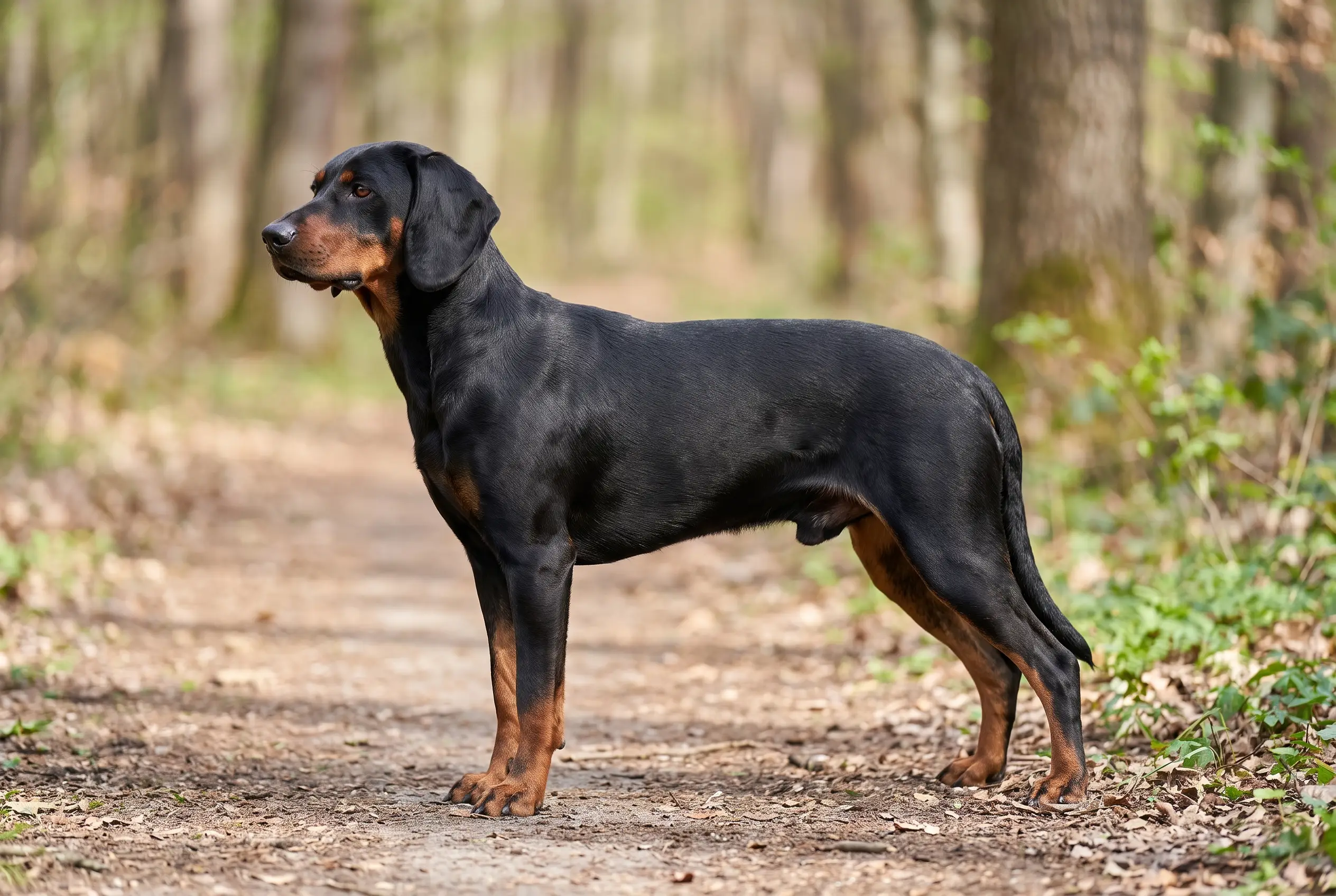
Brandlbracke
Vieräugl, "four-eyes" — the tan spot above each eye that gives this Austrian hound a second pair.
Vital stats
| Size | Medium · 48–56 cm (dogs 50–56, bitches 48–54) |
| Weight | 15–22 kg — breed literature; the standard sets no weight |
| Life expectancy | 12–14 years — breed literature, not survey data |
| Energy | High — built for full days on mountain terrain |
| Shedding | Low — short coat, sheds lightly year-round |
| Coat | Short, dense, smooth with a silky sheen · black with light-to-dark fawn markings |
| Group | Hound · Medium-sized Scenthound (FCI №63, Group 6) |
| Origin | Austria |
| FCI group | 6 — Scent hounds and related breeds · FCI 63 |
Breed traits
Friendliness
Care
Mind
The Brandlbracke by the numbers
The Brandlbracke facts owners search for most — price, lifespan, weight, shedding and colours, in one place.
Less common, so expect a waitlist and some travel to a reputable breeder — which pushes the price up. Plan for steady ongoing costs — mid-range food, routine vet care and insurance.
We don't quote a single figure: the real price swings with breeder, region, bloodline and health testing — and a rescue costs a fraction of a breeder's litter. Adopting is almost always the cheapest route.
Temperament
The standard's own behaviour clause is short and specific: "Sensitive nose; giving tongue, above all, for hare; tracking firmly and willingly with agreeable temperament." Read plainly, that is a dog built around its nose first and everything else second — it opens up vocally the moment it strikes a scent, hare above all other game, and holds a track with a persistence the standard calls firm and willing. "Agreeable temperament" is the standard's own promise that none of this comes wrapped in hardness; breed literature adds that it is friendly and balanced at home, if not an obvious fit for a household built around small children. It is, in the end, a working hunter's dog before it is anything else, and its nose is the part of it that never turns off.
Habits & quirks
Four eyes, no exceptions
The two tan spots above the eyes — Vieräugl in Austrian dialect — aren't a colour preference, they're a pass/fail line in the standard. A Brandlbracke missing either one is disqualified from the ring outright, whatever else about it is correct.
Announces the hare from a distance
"Giving tongue" means baying loudly and continuously on a hot trail, and the standard singles out hare as the game it does this for above all. Hunters follow the voice, not the dog, through cover where they'd otherwise see nothing.
A body built for the climb
Strong bone, a long back and a slightly arched loin carry it over ground the standard splits into "high mountains as well as flat country" in the same sentence — this is a hound with no fixed terrain preference, only stamina.
Sold to hunters, not households
German and Austrian breed clubs place puppies almost exclusively with hunters, and between the two countries only around 220 are born in an average year — which keeps the breed close to unfindable anywhere else.
Health
Neither the breed standard nor the breed literature records a widely recognised disorder specific to the Brandlbracke — this is a hardy working scenthound. Two things are worth attention anyway. The hanging, medium-length ears want a regular check for infection, the usual price of a drop ear on an outdoor dog. And because the breeding population outside Austria and Germany is small and closed, ask about pedigree depth wherever a litter turns up. Beyond that, give it the work its nose needs and keep it lean.
Nutrition
| Exercise | This is a hound built to work high mountains and open country in the same day, so a walk around the block does not come close. Give it long daily distance with a scent to follow — hunting, tracking work or long off-lead hikes suit it far better than a lead-walk loop. |
| Grooming | The short, dense, silky coat sheds lightly and needs only an occasional brush to stay tidy. There is no undercoat blowout to plan around, which is unusual for a hound that otherwise lives outdoors in all weather. |
| Training | The nose runs the show, and the standard's own words — tracking "firmly and willingly" — describe a dog that commits to a trail once it starts one. Recall work has to start early and stay consistent; this is not a breed that argues with its own instincts and loses. |
| Health | Neither the standard nor breed literature documents a widely recognised breed-specific disorder. The hanging, medium-length ears are worth a regular check for infection, and given how small and closed the breeding population is outside Austria and Germany, pedigree depth is worth asking about wherever a litter turns up. |
This is a scenthound built to work high mountains and open country in the same day, and it burns fuel accordingly — so feed to the work the dog actually does and keep it lean and fit. A hunting Brandlbracke in season and one having a quieter week don't need the same bowl. Weigh the meals, count treats into the day's total, and aim for ribs you can feel; a working hound carries no spare weight.
Puppy guide
A Brandlbracke puppy is a nose on legs from the start, bred for drive and stamina, so the first year is about direction. Start recall early and keep at it, because once this dog locks onto a scent it commits — you're training the off switch before the instinct fully arrives. Socialise widely, get it used to having its ears checked, and give the growing brain and body real outdoor work. Bear in mind it isn't the obvious pick for a home built around small children.
Training
The nose runs the show here, and the standard's own words — it tracks firmly and willingly — describe a dog that gives itself fully to a trail once it starts one. That makes recall the make-or-break lesson: start it early, stay consistent, and never assume you'll out-argue the instinct in the moment. This is an independent, driven hunter, so keep training reward-based and give the nose a real job — a Brandlbracke with nothing to track finds something, loudly.
Life expectancy
Brandlbrackes live 12–14 years — breed literature, not survey data. A working hound kept lean, fit and busy is a long-lived one. Give the Brandlbracke real daily distance with a scent to follow, keep the weight off, check the ears, and — because the breeding pool is small outside Austria and Germany — ask about pedigree depth when you buy. The dog is hardy; the care is mostly about work and a sensible weight.
Similar breeds
Breeds with a similar build and background — worth a look if this one isn't quite the fit.
Breeds that look like this
Common questions
Is the Brandlbracke the same breed as the Black and Tan Coonhound?
No — same colour pattern, same-sounding English name, unrelated breeds on different continents. The Brandlbracke is FCI standard No. 63, an Austrian mountain scenthound that trails hare and wounded game by voice. The Black and Tan Coonhound is FCI standard No. 300, bred in the American South off Bloodhound and foxhound stock to tree raccoons at night. Nothing links them beyond a coat that happens to come out black with tan points in both.
Why is it called Vieräugl?
Vieräugl is Austrian dialect for "four-eyes," and it names the two small tan spots the standard requires above each eye, on top of the dog's own pair. At a glance the marking reads as a second set of eyes watching from the brow. The standard treats the marking as essential, not decorative — a Brandlbracke without both spots is disqualified.
Can I get a Brandlbracke as a family pet, not a hunting dog?
It is possible but genuinely hard. Breed clubs in Germany and Austria place puppies with hunters as a matter of course, the whole breed produces only around 220 puppies a year across both countries, and the dog itself is built around a working nose that expects a job. A non-hunting home can work if it supplies real daily scent work and distance, but finding a breeder willing to sell outside hunting circles is the first hurdle, not the last.
Does the Brandlbracke shed a lot?
Not much. The Brandlbracke is a low-shedding breed, so loose hair around the home stays minimal. It still needs regular grooming, but you won't be fighting drifts of fur.
Is the Brandlbracke hypoallergenic?
No dog is truly hypoallergenic, but the Brandlbracke comes closer than most: its low-shedding coat releases less of the dander that triggers allergies. Many allergy sufferers manage well with this breed, but spend time around one before committing.
Is the Brandlbracke easy to train?
Reasonably. The Brandlbracke is trainable with consistency and rewards, though it isn't the quickest study. Keep sessions short and positive, and be patient with the basics like recall.