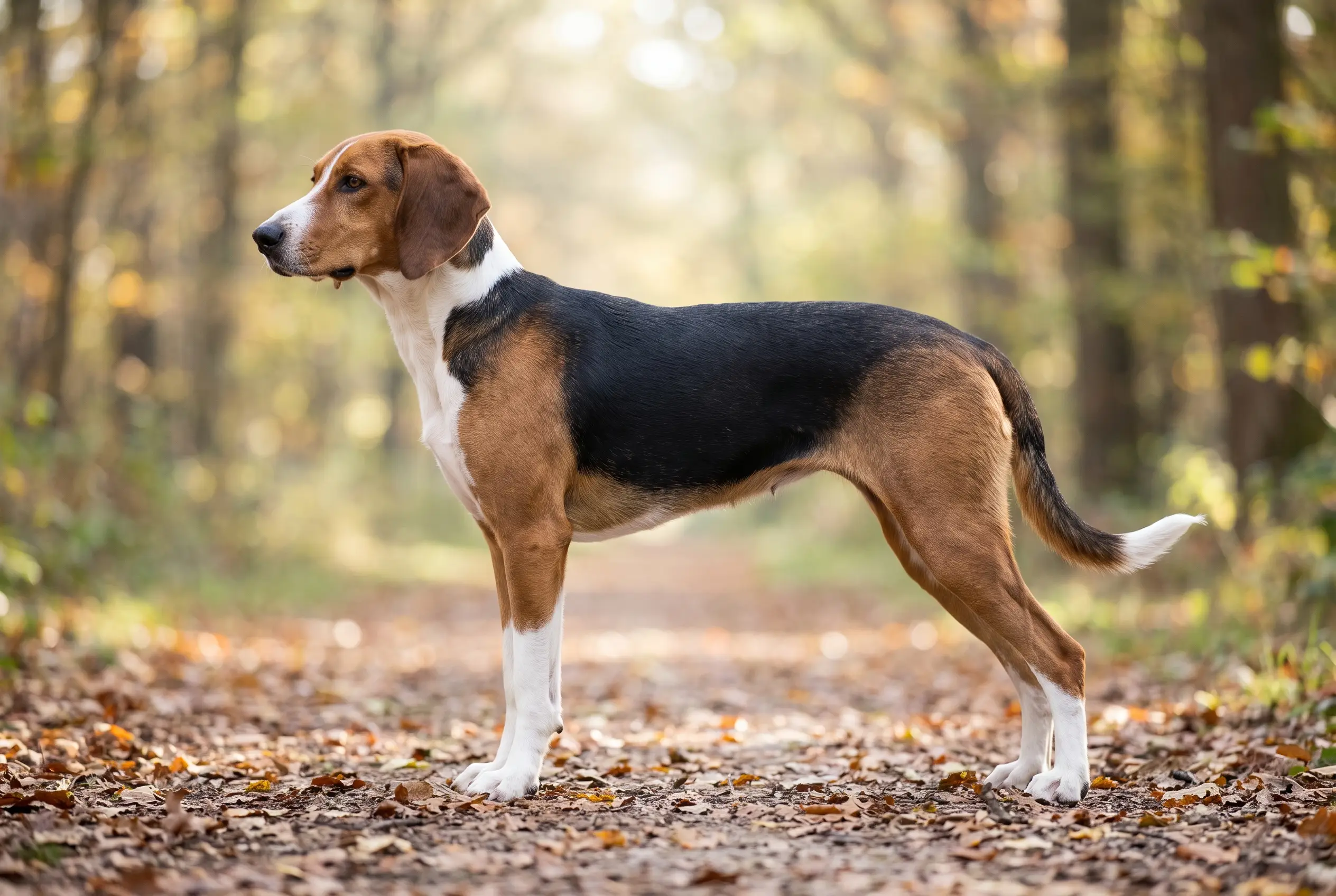
Deutsche Bracke
Assembled in 1900 from Germany's fading regional Bracken types, and marked ever since by a white blaze and collar.
Vital stats
| Size | Small · 40–53 cm at the withers (standard allows moderate departure either way) |
| Weight | 15–23 kg — breed literature; the standard sets no weight |
| Life expectancy | 9–15 years — breed literature, not survey data |
| Energy | High — bred for full days trailing and driving game over rough ground |
| Shedding | Low — short, dense coat sheds lightly |
| Coat | Short, dense, hard, almost bristly · tricolour: red-to-yellow with black saddle and white Bracken markings |
| Group | Hound · Small-sized Hound (FCI №299, Group 6) |
| Origin | Germany |
| FCI group | 6 — Scent hounds and related breeds · FCI 299 |
Breed traits
Friendliness
Care
Mind
The Deutsche Bracke by the numbers
The Deutsche Bracke facts owners search for most — price, lifespan, weight, shedding and colours, in one place.
Less common, so expect a waitlist and some travel to a reputable breeder — which pushes the price up. Plan for steady ongoing costs — mid-range food, routine vet care and insurance.
We don't quote a single figure: the real price swings with breeder, region, bloodline and health testing — and a rescue costs a fraction of a breeder's litter. Adopting is almost always the cheapest route.
Temperament
The standard itself has no dedicated behaviour and temperament section — unusual even within this FCI wave — and the closest it comes is buried under disqualifying faults: "Aggressive or overly shy dogs" fail outright, alongside any dog clearly showing physical or behavioural abnormalities. That's a floor, not a portrait: it says what a Deutsche Bracke must not be, not what it is. The rest has to come from breed-club material rather than the standard, and it agrees on a mild, working-dog character. Germany's own breed club describes an enduring, passionate hunting dog with a friendly, open-minded nature; older English-language club text calls it affectionate and better suited to living with the family than being kennelled apart, and adds that it is "a very persistent tracking dog with a good sense of direction" — a nose that, once committed to a trail, keeps going.
Habits & quirks
The breed that outlived its cousins
The FCI's own history clause states it plainly: of Germany's once numerous regional Bracken types, "the only one surviving in Germany is the Westphalian Bracke" — the rest of the old brackenschläge simply didn't make it. Even the Westphalian line wasn't one dog to start with: its leading local strain, the tricolour Sauerländer Holzbracke, was melted together with local Steinbracken, and since 1900 the fused type has carried a single name, Deutsche Bracke. Breed-club history, not the standard, ties the effort to the Deutscher Bracken-Club, founded in 1896; sources differ on whether it started out in Finnentrop before relocating to Olpe in 1911 or was based in Olpe from the outset, but Olpe is the town most associated with the breed's early organisation either way.
The blaze, the collar, the white feet
The standard's colour clause reads like a checklist: "Red to yellow with black saddle or blanket and the white 'Bracken' markings: blaze running through, white muzzle with neck ring (closed neck ring should be aimed for), white chest, legs and tip of tail." A closed neck ring is the detail breeders chase hardest — the standard states it as a goal rather than a requirement, which is its way of admitting how hard it is to get right.
A voice built into the job
The standard's own utilization line is a single word, "Hound," so the fuller picture comes from breed history: bred to trail hare and fox by voice, work German hunting law has since curtailed, the Deutsche Bracke today earns its keep mostly driving hoofed game — deer and wild boar among it — toward waiting guns. It works either way: alone on a lead over a small patch of ground, or loose in a pack that the breed club says needs a minimum of 1,000 hectares to hunt properly. Either way it calls as it goes; English breed sources describe cries that tell the hunter not just where the dog is, but what kind of game it's following.
A head measured to the centimetre
Most standards describe head shape in adjectives; this one hands you a ruler. "Length of head in dogs of medium size approximately 21 cm, from muzzle to between eyes about 9 cm." That precision has teeth — the fault list separately calls out a "Teckel-like (Dachshund type) head" as a fault by name, so a head that reads short or wrong-shaped costs the dog in the ring, not just on paper.
Health
There is good news buried in a dry standard: beyond the usual requirement to breed only functionally and clinically healthy dogs, breed literature flags no health problem specific to the Deutsche Bracke. Two things are still worth doing. The ears hang long and sit close to the head, so check them on a routine — especially after a day working through cover — the way you would with any drop-eared hound. And because the population outside Germany is small, ask a breeder about the depth of the pedigree behind the parents.
Nutrition
| Exercise | This is a hound bred to work full days over difficult ground, not to skip a walk. Breed literature puts the daily minimum at around ninety minutes, and that reads like a floor rather than a target — hunting, tracking work, or long off-lead hikes with a scent to follow all suit it better than a lead-walk loop. |
| Grooming | The coat the standard calls "almost bristly" sheds lightly and needs only an occasional brush to stay in order. The ears run long, about 14 cm, and sit close to the head — worth a regular check for the usual drop-ear buildup, especially after a day working through cover. |
| Training | With no temperament section in the standard to lean on, behaviour has to come from breed-club material: an enduring, passionate hunting dog with a friendly, open-minded nature by the German club's own description. Older English club text adds a persistent nose and "a good sense of direction," which in practice means recall has to start early and stay consistent — a dog this committed to a trail doesn't stop on its own. |
| Health | The standard's closing note is the same boilerplate used across the German and Austrian Bracken: breed only "functionally and clinically healthy dogs, with breed typical conformation," and disqualify any dog "clearly showing physical or behavioural abnormalities." Beyond that, breed literature reports no widely flagged condition specific to the Deutsche Bracke. The drop ears are worth a routine check, and pedigree depth is worth asking about given how small the population runs outside Germany. |
This is a hound built to work full days over rough ground, and a working Deutsche Bracke burns fuel to match — so feed to the actual workload, not to a fixed scoop. A dog hunting and tracking through the week eats differently from the same dog between seasons, and the treats you drop on a long tracking session count toward the day's total. Aim for ribs you can feel under the short, hard coat: lean is what lets a stamina dog do what it was bred for, and a scenthound that will follow its nose all day should never be carrying extra weight.
Puppy guide
A Deutsche Bracke puppy is a friendly, open-minded thing, and it comes with a nose that means business. The single most important lesson is recall, and it has to start early and stay consistent, because a dog this committed to a scent does not call itself off a trail once the drive matures. Socialise him broadly while he is young, give the growing body sensible rather than punishing exercise, and channel the nose into games and short tracking work so that following you is as rewarding as following a rabbit. Get the recall laid down in the first year and the rest of this hound is easy company.
Training
With no temperament section in the standard to lean on, what breeders describe is an enduring, passionate hunting dog with a friendly, open-minded nature — easy enough to live with, and willing. The catch is the nose. Older club text calls it a persistent tracker with a good sense of direction, which in a suburban garden means a dog that will pick a line and go, so recall has to start early and stay consistent rather than being bolted on later. Reward-based work suits the open temperament; a committed trail does not stop on its own, so build the recall before the drive fully matures and keep it in practice.
Life expectancy
Deutsche Brackes live 9–15 years — breed literature, not survey data. Breed literature puts the Deutsche Bracke's lifespan across a wide band, and no breed-specific disease pulls the average down. What keeps a hound at the good end of any range is unglamorous: lean weight, sound joints kept that way by real daily work rather than idleness, ears checked so small problems stay small, and parents from a breeder who can talk about the pedigree behind them. Give this dog the days of scent work it was built for and it tends to age well.
Similar breeds
Breeds with a similar build and background — worth a look if this one isn't quite the fit.
Breeds that look like this
Common questions
Is the Deutsche Bracke the same dog as the Westfälische Dachsbracke?
No, but they're close enough to blur together at a glance. The Westfälische Dachsbracke (FCI №100) is, in breed-reference terms, a short-legged version of this same dog — the same tricolour pattern, the same white Bracken markings on the muzzle, chest, legs and tail tip, but standing only about 30 to 38 cm at the withers against the Deutsche Bracke's 40 to 53 cm. Think of them as the tall and short members of the same Westphalian family, both named Bracke and both bred from the same regional stock.
How is the Deutsche Bracke connected to Sweden's Drever?
Through its short-legged relative, not directly. The Westfälische Dachsbracke — the short-legged version of the Deutsche Bracke — was imported to Sweden around 1910, registered there from 1913, and renamed Drever in 1947 once it had earned its own reputation tracking Swedish deer. The Drever kept the short legs and the tracking nose; the tricolour Bracken markings mostly didn't survive the crossing, and its own FCI standard allows any colour as long as white markings show.
Does the Deutsche Bracke make a good family pet?
Only for the right household, and mostly in Germany. Older breed-club material calls it affectionate and better suited to living with the family than being kennelled apart, but this is still a dog bred for full days of scent work, kept and placed almost entirely by hunters, and rarely seen as a pet even at home — the UKC is the only major English-speaking registry that recognises it at all. A non-hunting home can work if it supplies real daily distance and something for the nose to do; finding a breeder outside Germany willing to place one is the harder part.
Does the Deutsche Bracke shed a lot?
Not much. The Deutsche Bracke is a low-shedding breed, so loose hair around the home stays minimal. It still needs regular grooming, but you won't be fighting drifts of fur.
Is the Deutsche Bracke hypoallergenic?
No dog is truly hypoallergenic, but the Deutsche Bracke comes closer than most: its low-shedding coat releases less of the dander that triggers allergies. Many allergy sufferers manage well with this breed, but spend time around one before committing.
Is the Deutsche Bracke easy to train?
Reasonably. The Deutsche Bracke is trainable with consistency and rewards, though it isn't the quickest study. Keep sessions short and positive, and be patient with the basics like recall.