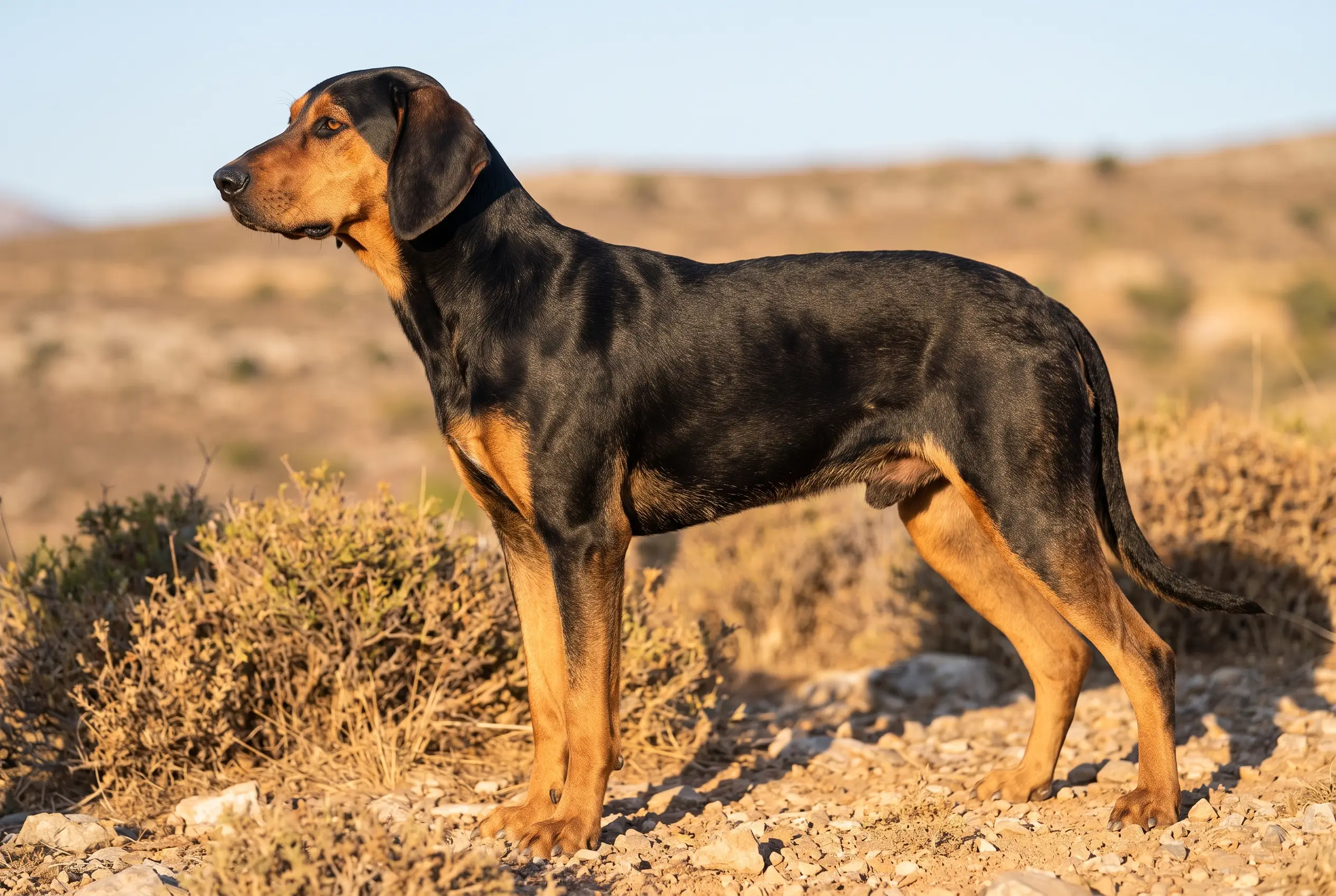
Hellinikos Ichnilatis
Greece's only FCI-recognised hound, known for a voice that carries the hunt long after the dog is out of sight.
Vital stats
| Size | Medium · 47–55 cm (males), 45–53 cm (females) |
| Weight | 17–20 kg — set directly by the standard |
| Life expectancy | About 13 years — breed literature, not survey data |
| Energy | Very high — a pack hound built to run all day over rough ground |
| Shedding | Low to moderate — short, dense coat |
| Coat | Short, dense, slightly harsh, close-lying · black and tan only, small white chest patch tolerated |
| Group | Scenthound · Medium-sized Hound (FCI №214, Group 6) |
| Origin | Greece |
| FCI group | 6 — Scent hounds and related breeds · FCI 214 |
Breed traits
Friendliness
Care
Mind
The Hellinikos Ichnilatis by the numbers
The Hellinikos Ichnilatis facts owners search for most — price, lifespan, weight, shedding and colours, in one place.
Less common, so expect a waitlist and some travel to a reputable breeder — which pushes the price up. Plan for steady ongoing costs — mid-range food, routine vet care and insurance.
We don't quote a single figure: the real price swings with breeder, region, bloodline and health testing — and a rescue costs a fraction of a breeder's litter. Adopting is almost always the cheapest route.
Temperament
This standard predates the FCI's dedicated behaviour-and-temperament section, so its character comes through in three places instead of one. General appearance calls for a dog "strong, vigorous, lively, keen." The Utilization clause asks for a hound that "responds completely in all terrains of lowland or mountains and even in the more rocky and unworkable terrains," hunting "either alone or in a pack," and adds the line Greek hunters prize above the rest: its voice is "resonant and harmonious." The only explicit guardrail on character sits in the disqualifying faults — "aggressive or overly shy" throws a dog out, which sets a floor of steady nerve rather than a promise of an easygoing companion. Put together, this describes a hound bred to hunt hare hard, all day, over difficult ground, and to announce every step of it. It is not bred to sit quietly in a living room.
Habits & quirks
Black and tan, no exceptions
The colour section allows exactly one scheme: black and tan, with "a small white patch on the chest" tolerated as the sole exception. Nose, nails and visible mucous membranes must be black, and the standard disqualifies any "other colour than the specified for the coat, the nose, the eyes and the nails."
A voice built to carry
Greek hunters follow this hound as much by ear as by eye. On a hot trail it gives tongue — holds a continuous, ringing bark that lets a hunter track its progress across a ridge or through cover long after the dog has vanished from sight. The standard names this directly, calling the voice "resonant and harmonious" in the same clause that describes the hunt itself.
A head measured in ratios
The standard sets the proportions almost like arithmetic: head length to height at the withers as 4.35:10, skull width capped at half the head's total length (a cephalic index under 50), neck length close to 6.5:10 of head length. Few FCI standards spell out proportion this precisely.
Born without dewclaws
The hock is described running "almost straight, without dewclaws," and the standard disqualifies dewclaws outright. A dog is expected to be born clean-legged, not trimmed of them afterward.
Health
There's no health survey behind this breed — the population is small, kept almost entirely by Greek hunters, and barely studied anywhere else — so nobody can honestly hand you a list of breed-specific conditions. What's left is sensible due diligence for any hard-working, drop-eared hound: ask about hip soundness, and check the ears regularly, since they hang close and hold moisture after a day in cover. Treat the thin paper trail as a reason for caution, not a clean bill of health.
Nutrition
| Exercise | This is a hound built for a full day's hunting over rocky, broken ground, and it needs an outlet to match — long runs, scent work, or real hunting, not a walk around the block. The prey drive runs strong and is barely documented outside Greece's hunting community, so treat a secure yard and a solid recall as non-negotiable before it ever runs off-lead. |
| Grooming | The short, dense, slightly harsh coat sheds lightly and needs only an occasional brush. There is no clipping, stripping or seasonal blowout to plan around. |
| Training | Bred for independent decisions on a scent line, not for taking direction, so expect a dog that thinks for itself before it thinks of you. Start recall early and keep sessions short and positive; the standard's ban on "aggressive or overly shy" temperaments describes a floor of stable nerves, not an easy household companion. |
| Health | The standard and the little breed literature available report no widely recognised breed-specific conditions, but there is no health survey behind that claim — the population is small, worked mostly by hunters, and barely studied outside Greece. Ask about hip soundness and ear health, sensible due diligence for any drop-eared hound, rather than anything documented for this breed specifically. |
Feed a Hellinikos Ichnilatis for the serious mileage it covers — this is a hound built to run rough ground all day — and adjust the bowl to how much real work it actually gets, which for most homes is less than a hunting pack. Weigh the meals, count treats into the day's total, and keep it lean enough to feel the ribs under the short, close coat. Lean weight is what keeps a working hound's legs and joints in the shape the job demands.
Puppy guide
A Hellinikos Ichnilatis puppy arrives with a hunter's prey drive already running and a hound's habit of making its own decisions, so the first year is groundwork. Socialise it widely and start recall the moment it comes home, before the nose and the chase instinct take charge, and get secure fencing in place early — this is not a breed that shrugs off an open gate. Keep the hard exercise sensible while the joints form, and channel the energy into scent games rather than endless flat-out running.
Training
This is a hound bred to work a scent line on its own judgement, not to take direction, so expect a dog that thinks for itself before it thinks of you. Start recall early, keep sessions short, positive and interesting, and proof it hard around distractions — though a strong prey drive means an off-lead recall near game will always be a gamble. The standard only rules out aggressive or overly shy dogs, which sets a floor of steady nerves rather than promising an easy, biddable companion.
Life expectancy
Hellenic Hounds live About 13 years — breed literature, not survey data. That figure is breed literature rather than survey data, so read it as a rough guide for a hound this size. The parts you influence are the familiar ones: lean weight, clean ears, sound hips, and the daily hard work this breed was built around. A Hellinikos Ichnilatis kept fit and genuinely occupied is a tough, durable dog.
Similar breeds
Breeds with a similar build and background — worth a look if this one isn't quite the fit.
Breeds that look like this
Common questions
Is the Hellinikos Ichnilatis a good family pet?
Not really, and it isn't bred to be one. It is Greece's only FCI-recognised breed and essentially unknown outside the country, kept almost exclusively by hunters for hare work. The standard asks for a dog that is stable rather than aggressive or shy, but that is a temperament floor, not a promise of an easy house dog — expect a strong prey drive, a hound's independence, and a daily need for real work that most ordinary homes cannot give it.
What does it mean when a hound "gives tongue"?
It means the dog barks continuously and rhythmically while actively working a scent trail, rather than barking to get attention. For a Balkan pack hunter like this one, that voice is the point: hunters on foot or horseback follow the sound through cover and across ridgelines long after they've lost sight of the dog, reading its pitch and rhythm to judge whether it is still on the line. The FCI standard calls the voice "resonant and harmonious" and treats it as a defining trait, not an afterthought.
Is the Hellinikos Ichnilatis related to the Black and Tan Coonhound?
No, despite the matching colour. The Black and Tan Coonhound (FCI №300) is an American trail hound developed from European scenthounds and bred to tree raccoons. The Hellinikos Ichnilatis (FCI №214) is a much older Balkan pack hound built to trail hare across Greek mountain terrain, and the two breeds share a coat pattern rather than any recent ancestry.
Does the Hellinikos Ichnilatis shed a lot?
Moderately. The Hellinikos Ichnilatis sheds a fair amount, steadily through the year with heavier seasonal patches. A weekly brush keeps most of the loose hair off your floors and clothes.
Is the Hellinikos Ichnilatis hypoallergenic?
Not really. No dog is truly hypoallergenic, and the Hellinikos Ichnilatis's shedding coat releases plenty of the dander that sets off allergies. If someone at home is allergic, this isn't the easiest breed to live with — spend time around one first.
Is the Hellinikos Ichnilatis easy to train?
Reasonably. The Hellinikos Ichnilatis is trainable with consistency and rewards, though it isn't the quickest study. Keep sessions short and positive, and be patient with the basics like recall.