Czechoslovakian Wolfdog
A 1955 army experiment that never stopped behaving like one.
Vital stats
| Size | Large · from 65 cm (dogs), 60 cm (bitches) — the standard sets no upper limit |
| Weight | From 26 kg (dogs), 20 kg (bitches) · most adults 20–30 kg |
| Life expectancy | 13–16 years |
| Energy | Very high — built to cover ground all day, not to walk a block |
| Shedding | High — the winter undercoat comes out in sheets each spring |
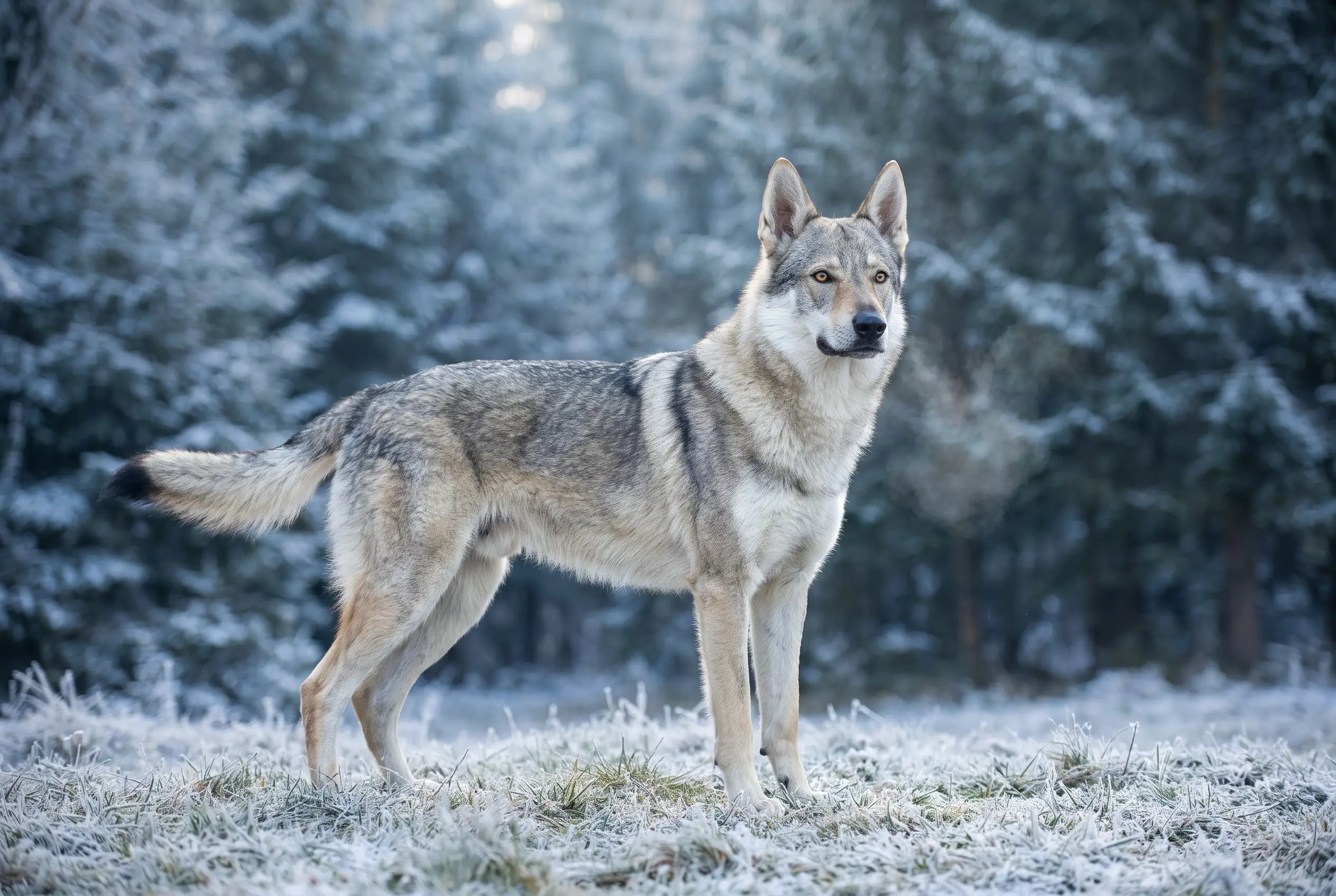
| Coat | Straight, close-lying double coat · yellowish-grey to silver-grey, always with a light mask |
| Group | Herding · Sheepdogs, with working trial (FCI №332, Group 1) |
| Origin | Czechoslovakia |
| FCI group | 1 — Sheepdogs and Cattledogs · FCI 332 |
Breed traits
Friendliness
Care
Mind
The Czechoslovakian Wolfdog by the numbers
The Czechoslovakian Wolfdog facts owners search for most — price, lifespan, weight, shedding and colours, in one place.
Less common, so expect a waitlist and some travel to a reputable breeder — which pushes the price up. Ongoing costs run high — more food, bigger doses at the vet, and pricier insurance.
We don't quote a single figure: the real price swings with breeder, region, bloodline and health testing — and a rescue costs a fraction of a breeder's litter. Adopting is almost always the cheapest route.
Temperament
The standard asks for a dog that is lively, very active, capable of endurance, docile with quick reactions, fearless, courageous, suspicious, and enormously loyal to its owner. The word suspicious is in the text, and it shows. A Czechoslovakian Wolfdog picks one or two people, gives them almost everything, and treats the rest of the world as a question to be answered slowly. It reads posture and movement better than it takes spoken commands, its prey drive switches on at a hundred metres, and repetition kills its interest — the third recall drill in a row simply gets ignored. That last part broke the original programme too: Border Guard handlers rotated roughly every fifteen months, and by the third or fourth change the dogs had stopped working for the new one. The independence, the stamina and the one-person attachment are what people fall for, and they are the same reasons this is a poor first dog and a poor pet for most homes.
Habits & quirks
Trots rather than walks
The standard describes a light-footed, ground-covering trot with the head and neck carried near the horizontal. That gait is for crossing country all day, which is why an hour on the lead barely registers.
Doesn't bark
Barking is close to absent — it is not how this dog talks. You get whining, grunting, low growling and, some evenings, howling, usually taken up by every dog on the street.
Leaves
Fences get climbed, dug under, or worked at the gate hinge. Owners end up with tall fencing sunk into the ground, and the dog still finds the weak point before they do.
Picks a person
It bonds hard to one handler and holds a lot back from everyone else in the house. Adults that change homes can take months to transfer that attachment, and some never fully do.
Health
On the whole this is a hardy, long-lived breed, but there are three things a breeder has to show you paper for, not just talk about. Hip dysplasia is screened by X-ray. Degenerative myelopathy, a progressive spinal disease, has a SOD1 DNA test — it was confirmed in the breed at the University of Bologna in 2015, so it is a real risk, not a theoretical one. Pituitary dwarfism, which the Czech and Slovak clubs screen for by DNA, is the third. Ask for the certificates and read them; assurances are not screening.
Nutrition
| Exercise | Two hours a day of real movement is the floor: running, cycling, hiking, canicross, tracking, mantrailing. It was selected for stamina, so a genuinely tired one is a rare sight — the aim is a worked mind rather than an exhausted body. |
| Grooming | Easy for most of the year. The coat is straight, close and largely self-cleaning, and a weekly brush covers it. Spring is the exception: the huge winter undercoat comes out in handfuls for weeks, and nothing keeps it off the floor. |
| Training | Short sessions, high-value food, and nothing repeated more than a few times. It will not grind through drills to please you. Socialise from eight weeks and keep going past two years, because the breed matures slowly and reserve hardens into fear if it is left alone. Do not trust off-lead recall around livestock, cats or wildlife. |
| Health | Hardy on the whole, with three things to make a breeder show paperwork for: hip dysplasia, degenerative myelopathy (a SOD1 DNA test — the disease was confirmed in the breed at the University of Bologna in 2015), and pituitary dwarfism, which the Czech and Slovak clubs screen for by DNA. Certificates, not assurances. |
Feed a Czechoslovakian Wolfdog to the work it does, and it does a great deal — this is a lean, ground-covering dog built for stamina, not bulk, so the goal is a fit, hard condition rather than a heavy one. Weigh the meals and match them to the day: a two-hour working day and a quiet one are not the same amount of food. Keep it genuinely lean, with ribs easy to feel, because extra weight works against both the stamina and the hips. There is nothing unusual to manage in the bowl; a good complete food suited to a large active breed, split across the day, is the whole story.
Puppy guide
Socialisation is the whole game with a Czechoslovakian Wolfdog puppy, and the clock is real: start at eight weeks and keep going hard past two years, because this breed matures slowly and any reserve left alone hardens into fear. Introduce people, dogs, places, traffic and handling steadily and positively while the mind is still open. The prey drive is already there — never trust a young one off-lead around livestock, cats or wildlife, and build recall on a long line instead. Grow the body into its work rather than forcing it, and accept from the start that this is a dog that needs an experienced hand and years of patient exposure, not a quick puppy course.
Training
This is a dog that reads your posture and movement better than your words, and it will not grind through drills to please you — the third repeat of an exercise simply gets ignored. Keep sessions short, pay in high-value food, and stop before it's bored rather than after. It's genuinely trainable in the right hands, which is why it sits in a working group, but the independence is real and recall is never fully reliable around anything worth chasing, so keep a long line on until you're sure and honest about the fact that around livestock and wildlife you may never be. Reward, vary, and quit while you're ahead.
Life expectancy
Czechoslovakian Wolfdogs live 13–16 years. Czechoslovakian Wolfdogs are long-lived for a large dog, and much of holding a dog at the top of that range comes down to buying well and keeping it fit. Start with a breeder who screens hips and DNA-tests for degenerative myelopathy and pituitary dwarfism, then give the dog the hours of real exercise it was built for and keep it lean over that working frame. A fit, worked, honestly-bred wolfdog is a genuinely durable animal — the number is generous, and sound choices keep it that way.
Similar breeds
Breeds with a similar build and background — worth a look if this one isn't quite the fit.
Breeds that look like this
Common questions
Is a Czechoslovakian Wolfdog legal to own?
It depends where you live, so check before you fall for a photo. Norway bans it outright: the Norwegian Food Safety Authority lists it as one of six prohibited breeds, and the ban covers owning, breeding and importing, down to semen and embryos. In the UK it is a recognised breed of dog and needs no Dangerous Wild Animals Act licence — that licence catches first- and second-generation wolf crosses, which this breed has not produced since the 1950s. In the Czech Republic and Slovakia, its home countries, it is an ordinary registered breed. Elsewhere the picture varies country by country, and in the United States it varies county by county, because local wolf-hybrid rules can catch a dog on ancestry and appearance alone. Landlords and insurers are a separate hurdle again.
Is it a good family dog?
For most families, no. The last wolf cross went into the breed in 1983 and modern dogs are many generations past it, but the temperament did not wash out: high prey drive, unreliable recall, a talent for escaping, and no patience for repetition. Inside its own household it can be gentle and deeply attached, and it is not an aggressive breed — the standard disqualifies both aggression and excessive shyness. What it needs is hours of daily work, fencing that actually holds, an experienced owner and usually another dog for company. Small pets are not safe around it. European rescues regularly take in the ones bought on looks.
How is it different from a Saarloos Wolfdog?
Two separate wolf-cross breeds, made for different reasons. The Saarloos Wolfdog (FCI standard 311) was started in the Netherlands in 1935 by Leendert Saarloos, who crossed a German Shepherd with a European wolf from Rotterdam zoo; the Dutch Kennel Club recognised it in 1975 and the FCI in 1981. It was never built around a job, and it tends to be more reserved and quicker to withdraw from a stranger. The Czechoslovakian Wolfdog was built for border patrol, sits in the FCI's Group 1 with a working trial attached, and is the harder-driving and more trainable of the two. Neither belongs with a first-time owner.
Does the Czechoslovakian Wolfdog shed a lot?
Moderately. The Czechoslovakian Wolfdog sheds a fair amount, steadily through the year with heavier seasonal patches. A weekly brush keeps most of the loose hair off your floors and clothes.
Is the Czechoslovakian Wolfdog hypoallergenic?
Not really. No dog is truly hypoallergenic, and the Czechoslovakian Wolfdog's shedding coat releases plenty of the dander that sets off allergies. If someone at home is allergic, this isn't the easiest breed to live with — spend time around one first.
Is the Czechoslovakian Wolfdog easy to train?
They can be a challenge. The Czechoslovakian Wolfdog is intelligent but independent, and would rather make its own decisions than take orders. Reward-based training and patience work best; expect recall in particular to take time.