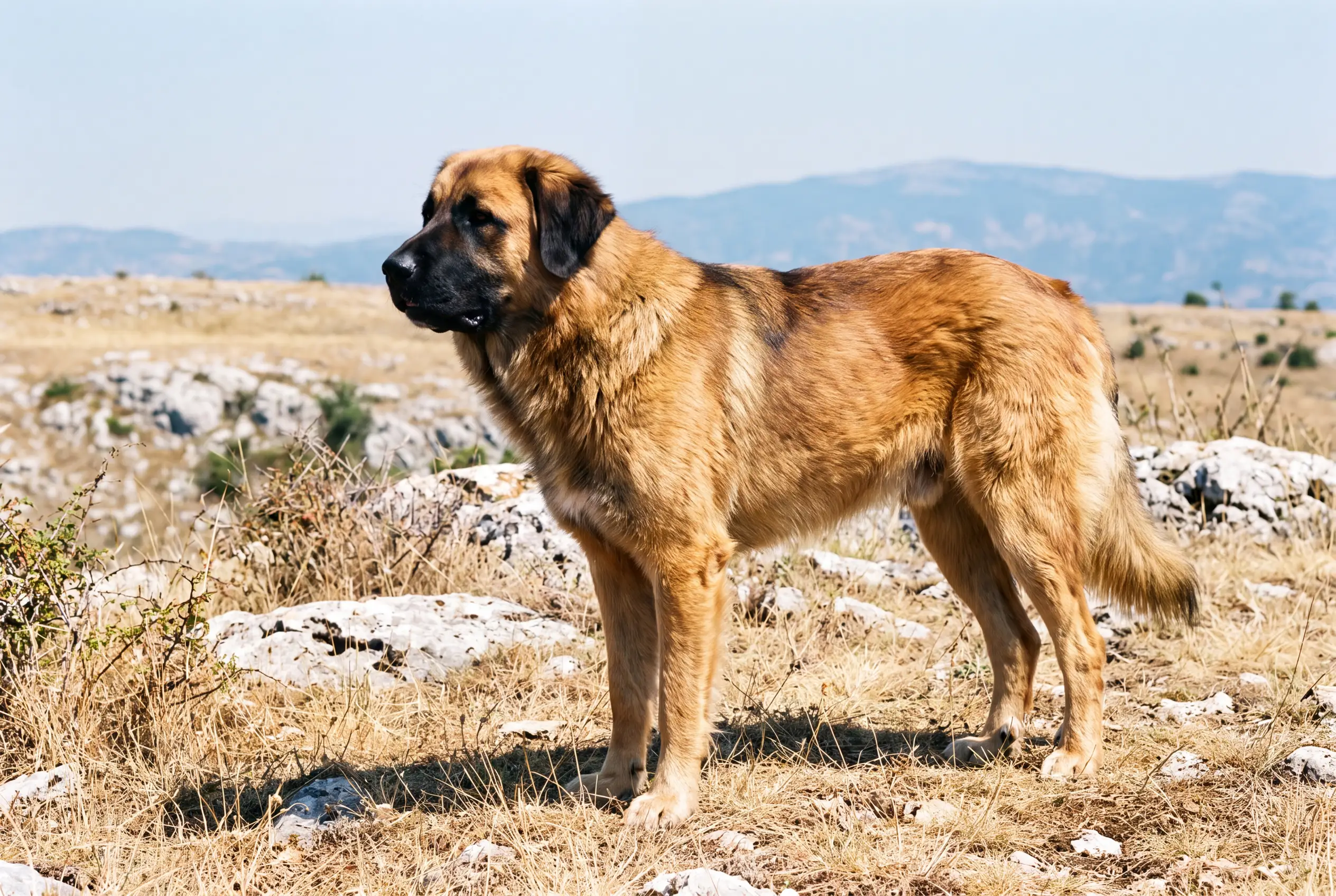
Macedonian Shepherd Dog
A black mountain guardian, newly and only provisionally on the FCI's books.
Vital stats
| Size | Large · 65–68 cm males, 62–66 cm females (±2 cm) |
| Weight | 40–45 kg males · 37–42 kg females |
| Life expectancy | No published figure — the FCI standard sets none |
| Energy | Moderate — stamina for all-day patrol, no urge to sprint |
| Shedding | Heavy — dense undercoat under a rough outer coat |
| Coat | Rough double coat, 9.5 cm at the withers · black or black and tan |
| Group | Working · Mountain Dog (FCI №378, Group 2) |
| Origin | The mountain pastures of North Macedonia |
| FCI group | 2 — Pinscher and Schnauzer, Molossoid and Swiss Mountain Dogs · FCI 378 |
Breed traits
Friendliness
Care
Mind
The Macedonian Shepherd Dog by the numbers
The Macedonian Shepherd Dog facts owners search for most — price, lifespan, weight, shedding and colours, in one place.
Less common, so expect a waitlist and some travel to a reputable breeder — which pushes the price up. Ongoing costs run high — more food, bigger doses at the vet, and pricier insurance. Its coat also needs a professional groom every few weeks — a real line in the budget.
We don't quote a single figure: the real price swings with breeder, region, bloodline and health testing — and a rescue costs a fraction of a breeder's litter. Adopting is almost always the cheapest route.
Temperament
The standard's own wording is warmer than most guardian breeds get: reserved towards strangers, determined and brave when guarding stock and property, calm, good-hearted, cautious on the job, stable and fearless with no aggression at all, affectionate and loyal to its owner. Aggressive dogs and overly shy dogs are both disqualified. One word in the middle of that list carries the weight, though, and it is independent. This is a dog selected to stand with sheep on a mountain, out of sight of anyone, and settle a matter with a wolf at three in the morning without being told to. Day to day that reads as an animal which watches, weighs, and mostly does nothing, then acts on its own reading rather than yours. Owners in North Macedonia describe a peaceable dog around the household and good with children. What no source describes is a biddable one. Outside its home country there is almost no body of experience with the breed living as a pet, so anyone taking one on is working from the standard and from Macedonian practice rather than from a broad record.
Habits & quirks
Black, and the standard means it
Two colours are allowed and no others: black, or black with tan markings over the eyes, on the sides of the muzzle and lower lip, inside the ears, on the forechest, on the inner and rear surfaces of the legs, on the feet and around the anus. A white spot on the chest passes up to 5 cm across, and white on the toes passes if it stops below the pastern. Brindle is a disqualifying fault, as is any colour not named. So is a short smooth coat or a missing undercoat.
The tail tells you it is working
At rest it hangs low with a slight curve, reaching to the hock. Alert or moving, it comes up and curves above the back along the line of the spine, closing into a sickle with a hook at the tip. The standard is particular about the line it follows: a tail carried out to the left or the right of the spine in movement is listed as a fault.
A standard written in percentages
Most standards describe proportions. This one calculates them. Body length 10 to 12% over the height at the withers, chest depth about 45% of the height, head length 41 to 43% of the height, ears about 45% of the length of the head, shoulder angle averaging 110°, stifle 125°, pelvis set at 30°. A 2025 survey of 221 dogs found the live population landing close to the paper: 10.75% and 12.54% for body length in males and females, and a head at roughly 42.7% and 43% of height.
Older in pictures than on paper
The standard's history section points at the visual record rather than a stud book: folk songs, medieval frescoes and iconostases. It singles out one artefact, the fresco in the church of St George at Kurbinovo, above Lake Prespa, painted in 1191, and notes that the breed club took it into its logo. The written standard is 835 years younger than the picture.
Care
| Exercise | Less than the frame suggests and different in kind. An hour or two of walking a day suits an adult, over ground it can survey rather than a pavement circuit. The standard asks for a dog that works in very low and very high temperatures and moves with a long reach and a strong drive behind, which is the build of an animal that covers distance all day instead of chasing anything down. Keep a youngster off forced mileage, stairs and jumps well into its second year. |
| Coat | Rough guard hair averaging 9.5 cm at the withers, longest on the neck, withers and thighs, over an undercoat the standard calls well developed. Two or three brushings a week keep it from matting behind the ears, through the neck and in the breeches, and it becomes a daily job for a few weeks when the undercoat comes out. Do not clip it: the standard treats a short smooth coat or an absent undercoat as a disqualifying fault, and the coat works in both directions in a climate that swings hard between the seasons. |
| Training | Reward-based, started in puppyhood, and largely finished before the dog outweighs you. Lead manners, a settle and a calm routine for visitors are the things worth having in place early, along with wide socialisation through the first two years. Obedience drills are not the point and will not get you far. The breed was selected to act alone at night, so it assesses an instruction before it follows one. Fencing does more than any command: a guardian that decides the boundary lies somewhere else will go and stand there. |
| Health | Honestly, nobody knows yet. There is no published health survey for the Karaman, no life expectancy figure in the standard or the literature, and a registered base of around 2,000 dogs, which is small enough that pedigree depth is worth asking about. The FCI text says only that dogs used for breeding must be functionally and clinically healthy. Until breed data exists, the sensible line is what you would ask of any large deep-chested guardian: hip and elbow scores on both parents, an eye check, split meals with exercise kept clear of them, and a look at the skin under all that coat in spring and autumn. |
Life expectancy
This breed has a typical life expectancy of No published figure — the FCI standard sets none.
Similar breeds
Breeds with a similar build and background — worth a look if this one isn't quite the fit.
Breeds that look like this
Common questions
Is the Karaman just a black Šarplaninac?
The FCI keeps them as two breeds. The Šarplaninac holds standard No. 41 with North Macedonia and Serbia recorded together as the country of origin, and its name has been formally contested; the Karaman holds No. 378, provisionally, with R.N. Macedonia recorded on its own. Past the paperwork, sources disagree, and it is worth saying so rather than picking one. Standard 378 describes an autochthonous breed bred continuously over centuries. Molosser breed literature describes something else: a dark-coated type seen occasionally in the region for a long time, left outside the Šarplaninac standard, which prefers grey and does not name black, and then consolidated into a separate breed by Macedonian breeders in the modern era. A third account, unproven either way, puts the Karaman's roots outside the Balkans altogether. Press coverage of the 2026 decision quoted scientists on genetic and anatomical differences, including tail carriage, eye colour and foot shape, without naming a study. Treat anyone who tells you the question is settled as ahead of the evidence.
What does provisional acceptance actually mean?
That the breed is in the FCI's books but not through the door. Provisional acceptance gives the Karaman standard No. 378, a place in the nomenclature, entry into member studbooks, and the right to be shown and judged at FCI international shows, where it can compete for the CAC and for Best of Breed and beyond. It is not eligible for the CACIB. The FCI keeps provisional breeds on a separate list and reviews them over a period of years before granting definitive status, and until that happens the standard text, and the status itself, can still change. Anything you read calling the Karaman fully recognised is running ahead of the paperwork.
Can you get one outside North Macedonia?
In practice, not yet. The kennel association there put the registered population at about 2,000 dogs in spring 2026, essentially all of them in the country, and its head described recognition as the thing that opens the borders, which tells you where the borders stood beforehand. There is no established breeding base in western Europe or North America and no breed club outside North Macedonia to route an enquiry through. If a litter is advertised to a European buyer, the questions worth asking are which registry the parents sit in, what the export paperwork looks like, and whether the dogs are registered as Karaman at all rather than as something adjacent.
Does the Macedonian Shepherd Dog shed a lot?
Yes — the Macedonian Shepherd Dog is a heavy shedder, dropping hair year-round or in big seasonal moults. Brush it several times a week and expect regular vacuuming; it isn't the coat for you if loose fur is a dealbreaker.
Is the Macedonian Shepherd Dog hypoallergenic?
Not really. No dog is truly hypoallergenic, and the Macedonian Shepherd Dog's shedding coat releases plenty of the dander that sets off allergies. If someone at home is allergic, this isn't the easiest breed to live with — spend time around one first.
Is the Macedonian Shepherd Dog good with children?
It depends. The Macedonian Shepherd Dog tends to be more reserved, so it suits older, calmer children better than boisterous toddlers. Early socialisation and careful, supervised introductions matter more with this breed.
Is the Macedonian Shepherd Dog easy to train?
They can be a challenge. The Macedonian Shepherd Dog is intelligent but independent, and would rather make its own decisions than take orders. Reward-based training and patience work best; expect recall in particular to take time.