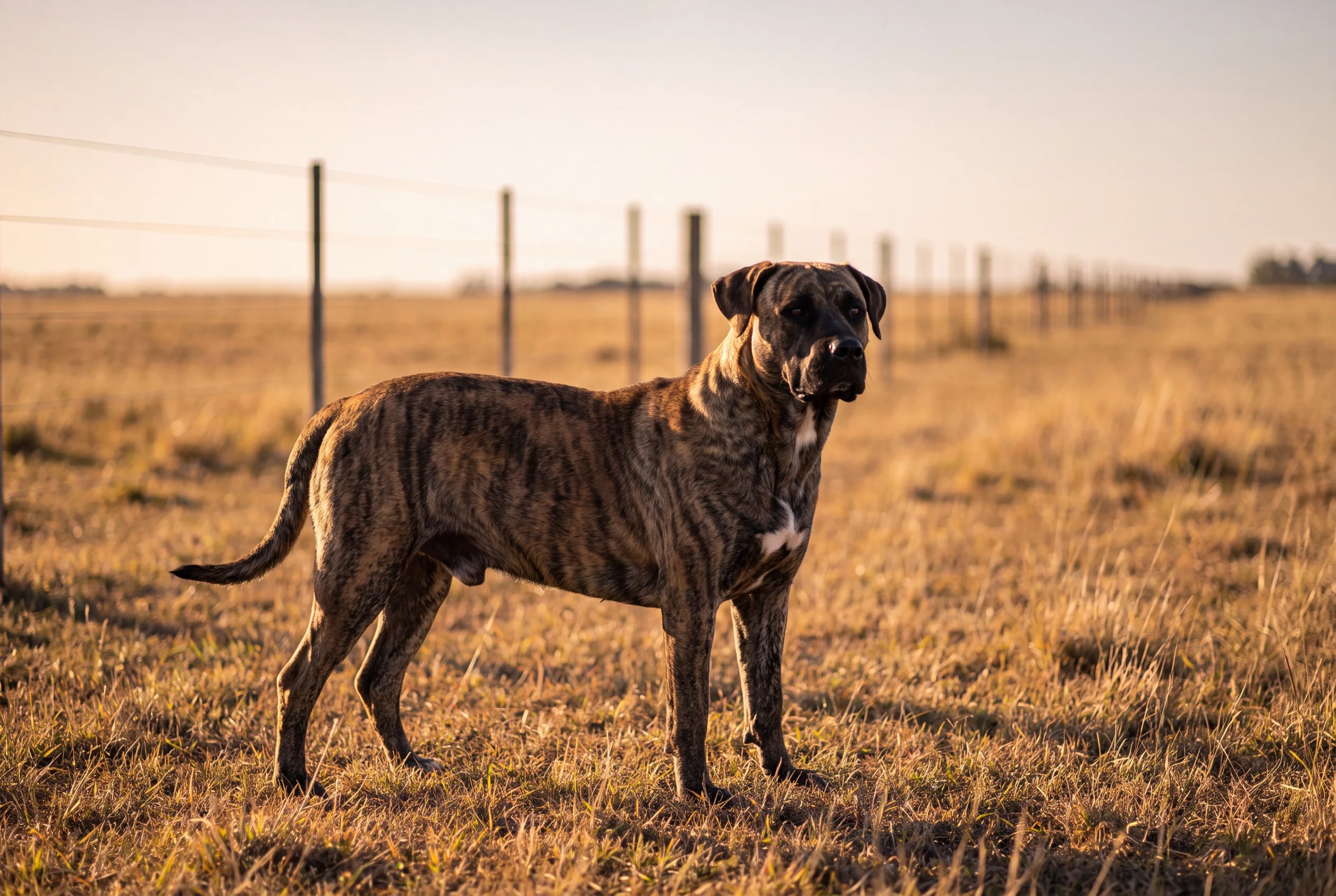
Cimarrón Uruguayo
Forty kilos of brindle cattle dog that spent two centuries wild before anyone claimed it.
Vital stats
| Size | Medium-large · 58–61 cm (males) · 55–58 cm (females) |
| Weight | 38–45 kg (males) · 33–40 kg (females) |
| Life expectancy | 10–13 years |
| Energy | High — a stock dog's working day, not a guard dog's watch |
| Shedding | Moderate — short coat, but there is an undercoat under it |
| Coat | Short and smooth with undercoat · brindle or fawn, bluish variants of both, mask optional |
| Group | Working · Mastiff (FCI №353, Group 2) |
| Origin | Cerro Largo and the Uruguayan interior, Uruguay |
| FCI group | 2 — Pinscher and Schnauzer, Molossoid and Swiss Mountain Dogs · FCI 353 |
Breed traits
Friendliness
Care
Mind
The Cimarrón Uruguayo by the numbers
The Cimarrón Uruguayo facts owners search for most — price, lifespan, weight, shedding and colours, in one place.
Less common, so expect a waitlist and some travel to a reputable breeder — which pushes the price up. Ongoing costs run high — more food, bigger doses at the vet, and pricier insurance.
We don't quote a single figure: the real price swings with breeder, region, bloodline and health testing — and a rescue costs a fraction of a breeder's litter. Adopting is almost always the cheapest route.
Temperament
The standard gives three words: balanced, intelligent, of great courage. The practical version is a dog that is confident to the point of not asking, sharply territorial about ground it has decided is its own, and indifferent to strangers who have not been introduced. It is not nervy and it is not a barker. It watches, works out what it thinks is happening, and acts on that conclusion. Indoors it is steady and affectionate with its own people, and Uruguayan owners talk about it as a family dog before anything else. The friction is outside. An adult male will meet a strange male head-on, and the hunting drive the standard still credits is not decorative. This needs someone who has handled a large self-directed working dog before, who socialises hard through the first two years and keeps going, and who has fencing that means it. The FCI disqualifies both aggressive and overly shy dogs, and serious breeders select against both. None of that changes the fact that it is forty kilos with its own opinions.
Habits & quirks
Moves cattle rather than living with them
Ranch work here means driving and gripping. A Cimarrón pushes stock where it needs to go, takes hold of a difficult animal, and comes back to the house afterwards. Leave it in a field for a season with a flock and you have wasted the dog and bored it into trouble.
Walks the boundary, not the doorway
Its guarding runs on the property line. It settles on a perimeter it has chosen, checks the fence on its own schedule, and treats anyone arriving at the gate as its business before it is yours.
Breathes like a working dog
The muzzle is only slightly shortened and the lips are tight, which spares it the heat problems that limit the flatter-faced molossers. It will still overheat on a bad summer afternoon, but it can put in a genuine day's work in weather that would ground a Ca de Bou.
Saves its voice
Most Cimarróns bark late and rarely. The upside is a dog that does not sound off at every passing car. The consequence is that when it does, an owner learns to go and look.
Health
The Cimarrón is a robust dog with a genuine working history behind it, but it's a big, deep-chested breed and there are sensible checks to ask a breeder about. Ask to see hip and elbow scores and an eye check on the parents, and ask what the breeder does about bloat: gastric torsion is a real risk in a deep-chested dog this size. The registered population is also young, so pedigree depth and inbreeding coefficients are fair questions rather than fussy ones. No published health survey exists for the breed, so treat any confident list of its problems as breeder report rather than data, and buy from someone who tests and tells you the results.
Nutrition
| Exercise | Ninety minutes to two hours of real work a day: long walks on varied ground, tracking, drag lines, anything with a task attached. It has stamina that the show molossers do not, and a Cimarrón left with a small garden and no job becomes a fence problem quickly. |
| Grooming | Short coat over an undercoat, so a rubber mitt or slicker once a week and daily passes when the undercoat lifts in spring and autumn. The lips do not hang, so drool is minimal. Check inside the dropped ears, which trap damp in a humid summer. |
| Training | Start at eight weeks and do not stop at adolescence. It learns quickly, loses interest faster, and closes down under a heavy hand. Recall, loose-lead walking and a reliable settle come before anything else, and drilling is wasted on it. Socialise to strange people, dogs and traffic continuously, because a territorial dog that has met little will decide too much on its own. |
| Health | Ask for hip and elbow scores and an eye check, and ask what the breeder does about bloat in a deep-chested dog of this size. The registered population is young, so pedigree depth and inbreeding coefficients are fair questions. No published health survey exists for the breed, so the problems usually listed for it come from breeder report rather than data. |
Feed the Cimarrón as the large, athletic working dog it is, matching the ration to a real working day rather than a guard dog's quiet watch. Its deep chest is the thing to plan around: split the day's food into two or more meals rather than one big bowl, keep hard exercise well away from mealtimes, and learn the early signs of bloat, because torsion in a dog this size is an emergency. Weigh the food, count what you hand over in training, and keep him lean and hard; this is a breed with stock-dog stamina, and a fit, muscled Cimarrón is what you're aiming for, not a heavy one.
Puppy guide
A Cimarrón puppy grows into forty kilos of self-directed working dog, and how you spend the first two years decides how much of that you can live with. Start socialisation the day it comes home, at around eight weeks, and keep going hard through adolescence, people, other dogs, traffic and everyday handling, over and over, because a territorial breed that has met little decides too much on its own. Go easy on the growing joints: keep a big-breed puppy off forced distances, stairs and repeated jumping while the skeleton is still forming. And build the calm, confident adult on purpose, since this is not a dog you want making its own rules at full size.
Training
The Cimarrón is intelligent and learns quickly, but it's an independent working breed that loses interest fast and closes down under a heavy hand, so keep sessions short, fair and reward-based. Recall, loose-lead walking and a reliable settle come before anything fancy; drilling is wasted on it, and it will not defer to a handler it doesn't rate. Above all, socialise continuously, to strange people, dogs and traffic, well beyond puppyhood, because the territorial streak is real, and a confident dog that meets the world widely is far safer than one that fills the gaps itself. This is a breed for someone who has handled a large guarding or working dog before.
Life expectancy
Cimarróns live 10–13 years. That's a fair span for a molosser of this size, and you protect it with the basics that matter most in a big deep-chested dog: a lean, muscled weight, parents screened for hips, elbows and eyes, meals split and kept away from exercise to lower the bloat risk, and a puppy from a breeder managing a young gene pool with care.
Similar breeds
Breeds with a similar build and background — worth a look if this one isn't quite the fit.
Breeds that look like this
Common questions
What does cimarrón mean?
Feral. In American Spanish the word covered anything domestic that had gone back to living wild, cattle and horses as much as dogs, and one common etymology ties it to cima, a peak, for animals that took to high ground. It describes the breed's foundation exactly. Spanish and Portuguese colonists brought dogs to the Río de la Plata and abandoned them, the dogs bred among themselves across the Uruguayan plains for generations, and nothing decided which ones passed on their genes except the country. Ranchers only began catching and keeping them once they saw what had come out the other end. The herding, the guarding and the boar work were all found in the dogs before anyone selected for them.
Who should actually own one?
Someone with land, a fence that works, and previous experience of a large guarding or working breed. This is a forty-kilo dog that makes its own calls, holds territory in earnest, and will not defer to a handler it does not rate. It fits a rural or semi-rural home, an owner who wants a dog with a job, and two years of socialisation done properly rather than intended. It does not fit a flat, a first dog, or a household that wants every visitor greeted warmly. On the law: no jurisdiction we could find names the Cimarrón Uruguayo on a banned or restricted list, but a good many countries regulate by morphological type rather than by breed name, and a large brindle molosser can be caught by that wording regardless of its papers. Ask the local authority where you live before you commit, not the breeder.
Was it really hunted as vermin, and was it a fighting dog?
The bounty is documented. From the late eighteenth century the feral packs were taking livestock, the authorities paid for dead ones, and a jawbone or a pair of ears was accepted as proof. The killing ran on and off into the early twentieth century, and the dogs came through mainly in the hills of Cerro Largo and around the Olimar. The traditional ear crop is often explained as a nod to that period, which is a story breed sources repeat and no primary source confirms. Once the survivors were taken in they worked cattle, guarded estates and hunted boar, and several breed encyclopedias also list fighting among the uses ranchers found for them; that claim appears in no FCI or Uruguayan cynological material and should be treated as unverified. What the standard does say is that aggressive or overly shy dogs are disqualified, and the breed has been selected against both since registration began in 1989.
Does the Cimarrón Uruguayo shed a lot?
Moderately. The Cimarrón Uruguayo sheds a fair amount, steadily through the year with heavier seasonal patches. A weekly brush keeps most of the loose hair off your floors and clothes.
Is the Cimarrón Uruguayo hypoallergenic?
Not really. No dog is truly hypoallergenic, and the Cimarrón Uruguayo's shedding coat releases plenty of the dander that sets off allergies. If someone at home is allergic, this isn't the easiest breed to live with — spend time around one first.
Is the Cimarrón Uruguayo good with children?
It depends. The Cimarrón Uruguayo tends to be more reserved, so it suits older, calmer children better than boisterous toddlers. Early socialisation and careful, supervised introductions matter more with this breed.
Is the Cimarrón Uruguayo easy to train?
Reasonably. The Cimarrón Uruguayo is trainable with consistency and rewards, though it isn't the quickest study. Keep sessions short and positive, and be patient with the basics like recall.