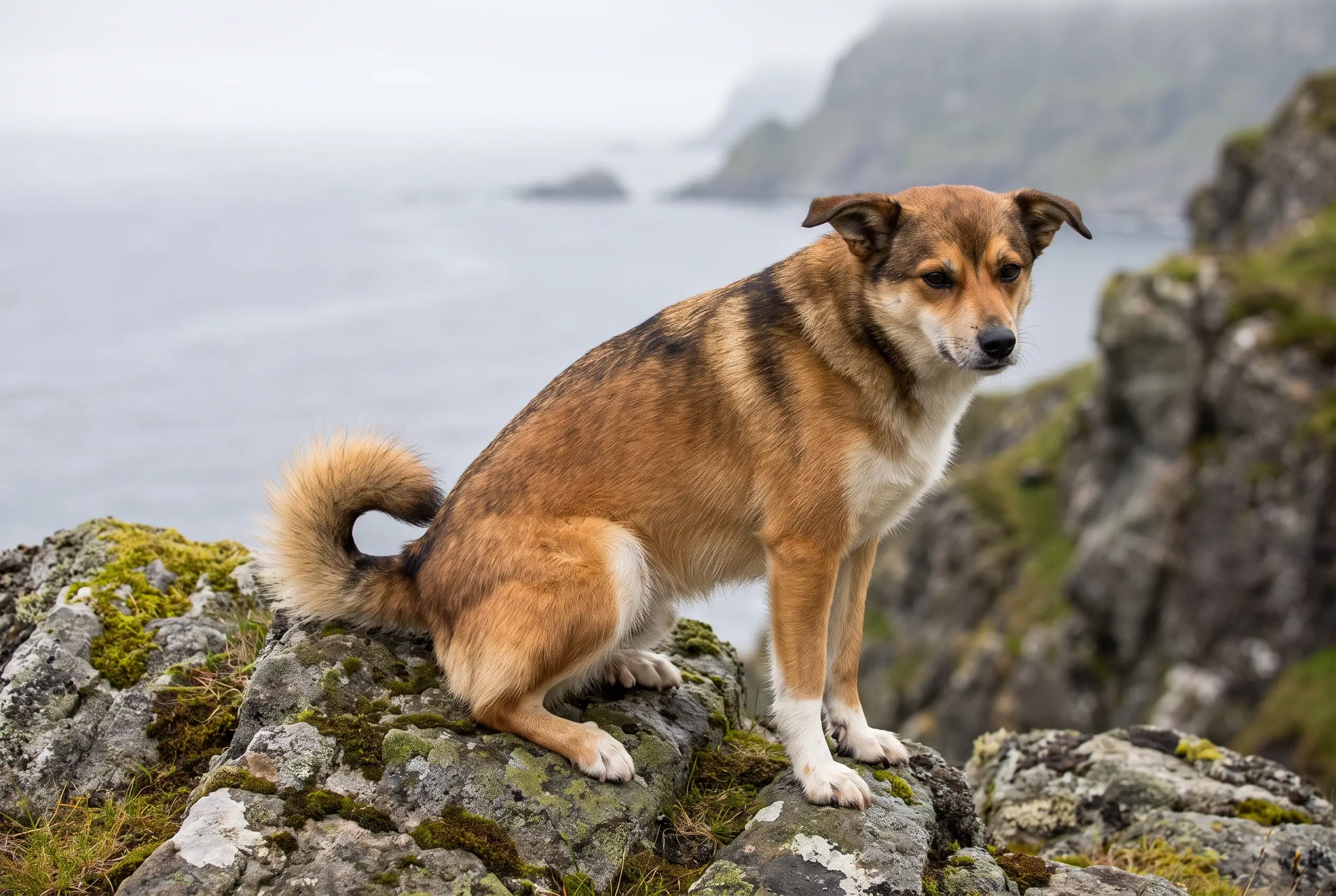
Norwegian Lundehund
Six toes, folding ears, a neck that bends to its spine — evolution's puffin specialist.
Vital stats
| Size | Small · 32–38 cm |
| Weight | 6–7 kg |
| Life expectancy | 12–14 years |
| Energy | Moderate — 45–60 min/day |
| Shedding | Moderate, seasonal |
| Coat | Dense double coat · reddish-brown with black tips and white |
| Group | Non-sporting · FCI №265 / AKC |
| Origin | Værøy, Norway |
| FCI group | 5 — Spitz and primitive types · FCI 265 |
Breed traits
Friendliness
Care
Mind
The Norwegian Lundehund by the numbers
The Norwegian Lundehund facts owners search for most — price, lifespan, weight, shedding and colours, in one place.
Less common, so expect a waitlist and some travel to a reputable breeder — which pushes the price up. Ongoing costs stay modest — it eats little and routine vet care sits at the lower end.
We don't quote a single figure: the real price swings with breeder, region, bloodline and health testing — and a rescue costs a fraction of a breeder's litter. Adopting is almost always the cheapest route.
Temperament
For centuries on Norway's island cliffs, the Lundehund wriggled into rock crevices to retrieve live puffins — solitary, acrobatic work that built a self-reliant, inventive, faintly primitive mind. Expect a playful, alert companion who adores its family, sizes up strangers slowly, and approaches your rules as opening offers.
Habits & quirks
The contortionist
Naps and stretches happen at angles no other dog can survive.
Summit seeking
Sofa backs, windowsills, garden walls: if it can be climbed, it will be.
The squirrel economy
Food and treasures are quietly cached around the house for later.
Slow-warm greetings
Strangers get a career interview before receiving affection.
Care
| Health | The breed carries Lundehund Syndrome, a digestive disorder — work with a knowledgeable vet and watch weight and appetite closely. |
| Feeding | Many do best on carefully managed low-fat diets; sudden changes and rich scraps are asking for trouble. |
| Training | Patience and rewards, always — house-training in particular can take far longer than with other breeds. |
| Exercise | Daily walks plus climbing and puzzle games; agility suits this cliff-goat of a dog perfectly. |
Life expectancy
This breed has a typical life expectancy of 12–14 years.
Similar breeds
Breeds with a similar build and background — worth a look if this one isn't quite the fit.
Breeds that look like this
Common questions
Why does the Lundehund have six toes?
The extra toes and flexible joints evolved for gripping wet cliff faces and squeezing through puffin burrows. Every part of its strange anatomy served the hunt.
How rare is the Norwegian Lundehund?
Among the rarest breeds on earth — distemper outbreaks left only a handful of dogs by the 1940s, and every Lundehund today descends from them. Expect a long search for a puppy.
Are Lundehunds healthy?
The bottleneck left them prone to Lundehund Syndrome, a group of digestive disorders. Many live full lives with dietary management, but buyers should discuss it frankly with breeders.
Does the Norwegian Lundehund shed a lot?
Moderately. The Norwegian Lundehund sheds a fair amount, steadily through the year with heavier seasonal patches. A weekly brush keeps most of the loose hair off your floors and clothes.
Is the Norwegian Lundehund hypoallergenic?
Not really. No dog is truly hypoallergenic, and the Norwegian Lundehund's shedding coat releases plenty of the dander that sets off allergies. If someone at home is allergic, this isn't the easiest breed to live with — spend time around one first.
Is the Norwegian Lundehund good with children?
They can be. The Norwegian Lundehund is reasonably sociable and can be good with children in the right home, especially when socialised early. Supervise around young kids and teach dog and child to respect each other.
Is the Norwegian Lundehund easy to train?
They can be a challenge. The Norwegian Lundehund is intelligent but independent, and would rather make its own decisions than take orders. Reward-based training and patience work best; expect recall in particular to take time.