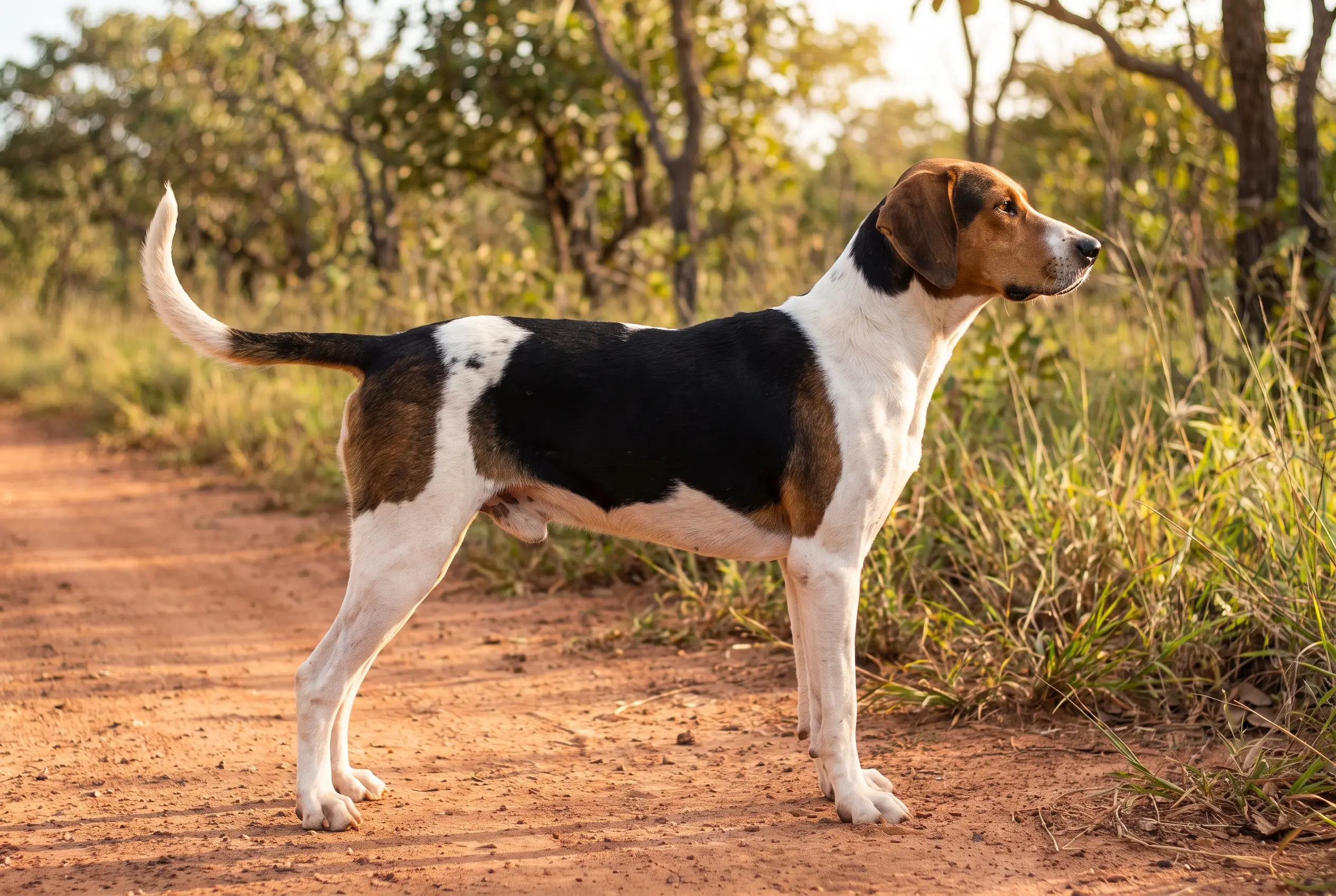
Rastreador Brasileiro
Bred from imported American hounds for Brazil's heat, declared extinct within a decade, and rebuilt from the dogs that survived anyway.
Vital stats
| Size | Large · 60–65 cm (males), 56–63 cm (females) |
| Weight | 26–33 kg (males), 21–30 kg (females) — from the standard itself |
| Life expectancy | 10–13 years — no breed-specific study found; estimate based on comparable large scenthounds, not survey data |
| Energy | Very high — bred to run for hours in rough, hot terrain |
| Shedding | Low to moderate — short, dense, close-lying coat |
| Coat | Short, smooth, dense, a little hard to the touch · black-and-white mottled ("slate blue" effect), with or without tan |
| Group | Hound · Large-sized Scenthound (FCI №275, Group 6) |
| Origin | Brazil |
| FCI group | 6 — Scent hounds and related breeds · FCI 275 |
Breed traits
Friendliness
Care
Mind
The Rastreador Brasileiro by the numbers
The Rastreador Brasileiro facts owners search for most — price, lifespan, weight, shedding and colours, in one place.
Less common, so expect a waitlist and some travel to a reputable breeder — which pushes the price up. Ongoing costs run high — more food, bigger doses at the vet, and pricier insurance.
We don't quote a single figure: the real price swings with breeder, region, bloodline and health testing — and a rescue costs a fraction of a breeder's litter. Adopting is almost always the cheapest route.
Temperament
The standard's own behaviour clause is direct: "Quiet and balanced, attached to its owner, self-confident, intrepid and docile, without being shy or aggressive. Because of their work they should behave calmly, since they hunt in pairs, trios and packs, or even alone as a scent dog." That list is a job description as much as a character sketch — a hound that has to keep its head whether it's running with two others, a full pack, or completely alone on a trail. "Self-confident" and "intrepid" cover the nerve the work requires against animals that don't simply run; "docile" and "attached to its owner" are the standard's own guarantee that none of that comes at the cost of a workable temperament at home. The standard disqualifies aggression and excessive shyness in the same clause, treating a level head as a pass-or-fail trait rather than a bonus one.
Habits & quirks
Declared extinct — then walked back
The FCI's own standard never uses the word extinct. It says only that the breed suffered "a major setback from the 70s to the year 2000 when its breeding was resumed," and the FCI's current recognition record shows the breed listed continuously since 1967 with no visible deletion entry. Brazilian breed accounts, tracing back to old Brazilian dog-magazine articles, fill the gap with a harder story: an epidemic of piroplasmosis and an overdose of tick medication killed dozens of dogs in founder Osvaldo Aranha Filho's own kennel in 1973, and the breed was declared extinct and dropped from Brazilian club rolls the following year. The two accounts agree on the outcome — a real, decades-long gap in organised breeding — and disagree on whether "extinct" is the right word for it.
Named for a howl it no longer needs
The standard calls the Rastreador Brasileiro a direct evolution of the "Urrador Brasileiro," literally the Brazilian Howler — an older regional hunting type from the same countryside that never received its own FCI standard. The tracker's job is pursuit rather than baying, so the loud half of that ancestry survives only in the name.
One coat pattern, several ways to wear it
The colour clause allows a specific menu: "fully mottled black and white, giving a slate blue colouring effect, with or without fawn and/or black markings," plus separately named bicolour and tricolour versions carrying tan. In practice that covers dogs running anywhere from heavily ticked blue-grey to a solid tan-headed tricolour, which is why two Rastreadores from the same litter can look like different breeds standing side by side.
Built to hunt alone or in company
The behaviour clause specifies the dog is expected to work "in pairs, trios and packs, or even alone as a scent dog" — an unusually flexible working arrangement written directly into the temperament section rather than left to a hunter's habit. Its long, low-set ears "almost lacking in erectile capacity" stay close to the head rather than pricking up, which the standard ties to the working head rather than to decoration.
Care
| Exercise | This is a hound built, in the standard's own words, to "run for hours in rough terrain under high temperatures, without much difficulty" — sized and constructed for genuine distance work, not a lead-walk loop. Give it real daily mileage with a scent trail if at all possible; a bored, under-run Rastreador is working against its own design. |
| Grooming | The coat is short, dense and "a little hard to the touch" per the standard, and needs only an occasional brush to stay tidy — there is no undercoat or long-haired maintenance to plan around. The long, low, close-hanging ears are the actual upkeep item; check and clean them regularly, especially after time spent in cover. |
| Training | The standard asks for a dog that is "self-confident, intrepid and docile" at once, and that combination takes direction well without losing its nerve on a hard trail, by breed-club account. Socialise and handle it early — this is still a scenthound built to commit to a trail on its own judgement, so recall has to be built rather than assumed. |
| Health | Neither the FCI standard nor the sources checked for this profile document a widely recognised breed-specific disorder, and no independent lifespan study was located. Given the breed's population history — a near-collapse in the 1970s and a modern population rebuilt largely from surviving farm and hunting dogs rather than a continuous closed studbook — asking about pedigree depth is a sharper question here than it is for most FCI breeds, not a routine formality. |
Life expectancy
This breed has a typical life expectancy of 10–13 years — no breed-specific study found; estimate based on comparable large scenthounds, not survey data.
Similar breeds
Breeds with a similar build and background — worth a look if this one isn't quite the fit.
Breeds that look like this
Common questions
Was the Rastreador Brasileiro really declared extinct?
The FCI's current standard avoids that word — it describes only "a major setback from the 70s to the year 2000 when its breeding was resumed," and the FCI's own recognition record shows the breed listed continuously since 1 September 1967 with no formal deletion entry visible. Brazilian breed histories tell a harder version: an epidemic and a tick-medication overdose gutted founder Osvaldo Aranha Filho's kennel in 1973, and the breed was declared extinct and dropped from Brazilian club rolls soon after, surviving only in dogs already placed with rural hunters and ranchers. Both versions agree that a real, decades-long gap in organised breeding happened; they disagree on whether "extinct" is the accurate word for it, and this profile is not choosing a side.
What breeds went into it?
The FCI standard's own history section names one ancestor specifically: the American Foxhound, brought in by founder Osvaldo Aranha Filho starting in the 1950s to build a hound suited to Brazilian terrain and heat. Brazilian breed accounts widely add several American coonhound lines and a French Petit Bleu de Gascogne to that mix, crossed onto regional hunting dogs already working in the Brazilian countryside — but that fuller list comes from breed literature, not the standard itself.
Can I get a Rastreador Brasileiro outside Brazil?
Realistically, no. This is a Brazilian hunting breed with a population history built almost entirely inside Brazil, no meaningful presence in North American or European kennel clubs, and a modern breeding base assembled from farm and hunting dogs rather than an international network of breeders. Anyone outside Brazil who wants one should expect to work through Brazilian breed clubs directly, in Portuguese, rather than finding a local breeder.
Does the Rastreador Brasileiro shed a lot?
Moderately. The Rastreador Brasileiro sheds a fair amount, steadily through the year with heavier seasonal patches. A weekly brush keeps most of the loose hair off your floors and clothes.
Is the Rastreador Brasileiro hypoallergenic?
Not really. No dog is truly hypoallergenic, and the Rastreador Brasileiro's shedding coat releases plenty of the dander that sets off allergies. If someone at home is allergic, this isn't the easiest breed to live with — spend time around one first.
Is the Rastreador Brasileiro good with children?
They can be. The Rastreador Brasileiro is reasonably sociable and can be good with children in the right home, especially when socialised early. Supervise around young kids and teach dog and child to respect each other.
Is the Rastreador Brasileiro easy to train?
Reasonably. The Rastreador Brasileiro is trainable with consistency and rewards, though it isn't the quickest study. Keep sessions short and positive, and be patient with the basics like recall.