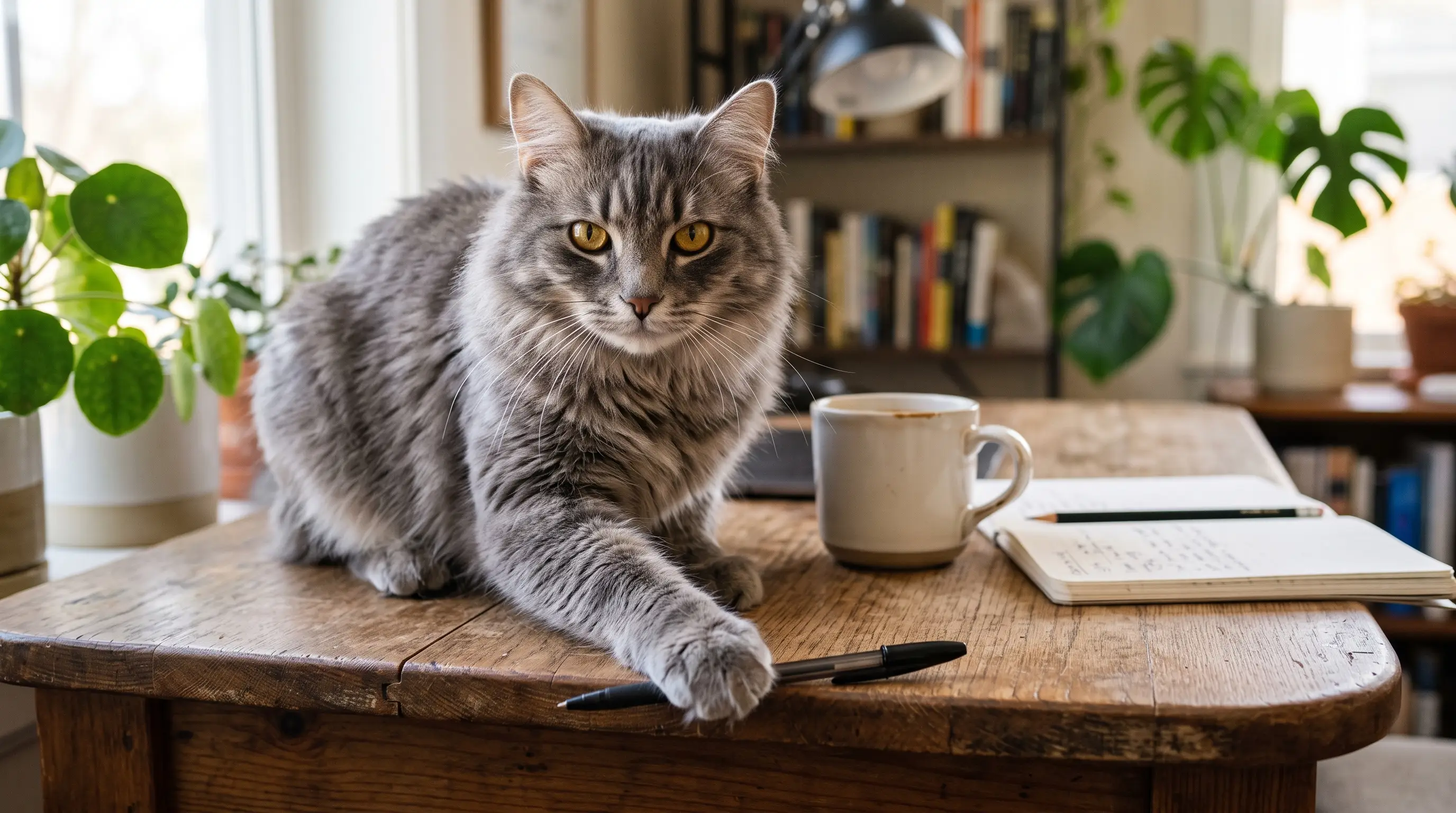
Why cats knock things off tables
Everyone who lives with a cat has watched the sequence: the cat looks at the object, looks at you, and pushes — slowly, deliberately, maintaining eye contact as the pen goes over the edge. It looks like spite. It isn't; cats don't run on spite. What it is, is three ordinary feline systems firing in a domestic setting: a hunter testing something with its paw, a bored predator making its own entertainment, and — the honest one — an animal that has learned exactly which button summons its human. Here's the breakdown, and what to do if your shelves are suffering.
The paw is an instrument
Start with what a paw-tap is for. A cat investigating potential prey doesn't lead with its face — a mouse can bite, a shrew tastes terrible, an insect might sting. It leads with a paw: bat, hop back, watch. Does it move? Does it fight? Is it alive? The sensitive pads and whisker-adjacent reflexes make the forepaw a hunter's probe, and the batting motion is factory-installed — kittens do it to everything from day one.
Your stationery sits squarely in this programme. A pen is prey-sized, light, and moves interestingly when patted. The first knock is genuine investigation; the roll and clatter that follow are a rich, twitchy reward that says, in prey-terms, it moved, keep going. Nothing about a cat's wiring says "desk objects are furniture". To the paw, everything small is a question.
The under-employed predator
Reason two is workload. A cat is built to run several hunts a day; an indoor cat with a full bowl has hours of predatory budget and nothing on the schedule. Under-stimulated cats manufacture their own events, and gravity is the cheapest game in the house: paw the object, watch it fall, enjoy the noise, repeat at the next shelf. If the knocking clusters at the times your cat is most wound up — the same dusk-and-dawn peaks that fuel the zoomies — you're looking at surplus energy, not a personality flaw.
The fix for this layer is the usual, unglamorous one: daily hunting-style play that ends in a catch, food puzzles that make the cat work for part of its meals, and a rotation of toys so nothing goes stale. A cat with a proper hunt in its day files the paperweight under furniture again.
The button that summons you
Now the honest layer. Cats are excellent students of consequence, and the first time your cat nudged a glass and you materialised from three rooms away, it logged the result. From your side, you rescued a glass; from the cat's side, the paw made the human appear. Repeat a few times and the behaviour is trained — by you. This is why the move so often happens at 6am, in your eyeline, with that held stare: the stare isn't defiance, it's monitoring. The cat is watching the button to see if it still works.
It's the same account-keeping we've met across this cluster — the cat that learns which purr opens the food cupboard, and the one whose name only pays out sometimes, as covered in cats know their names. None of it is malice. It's a small, observant animal running experiments on the most interesting lever in its territory: you.
Closing the account, saving the shelves
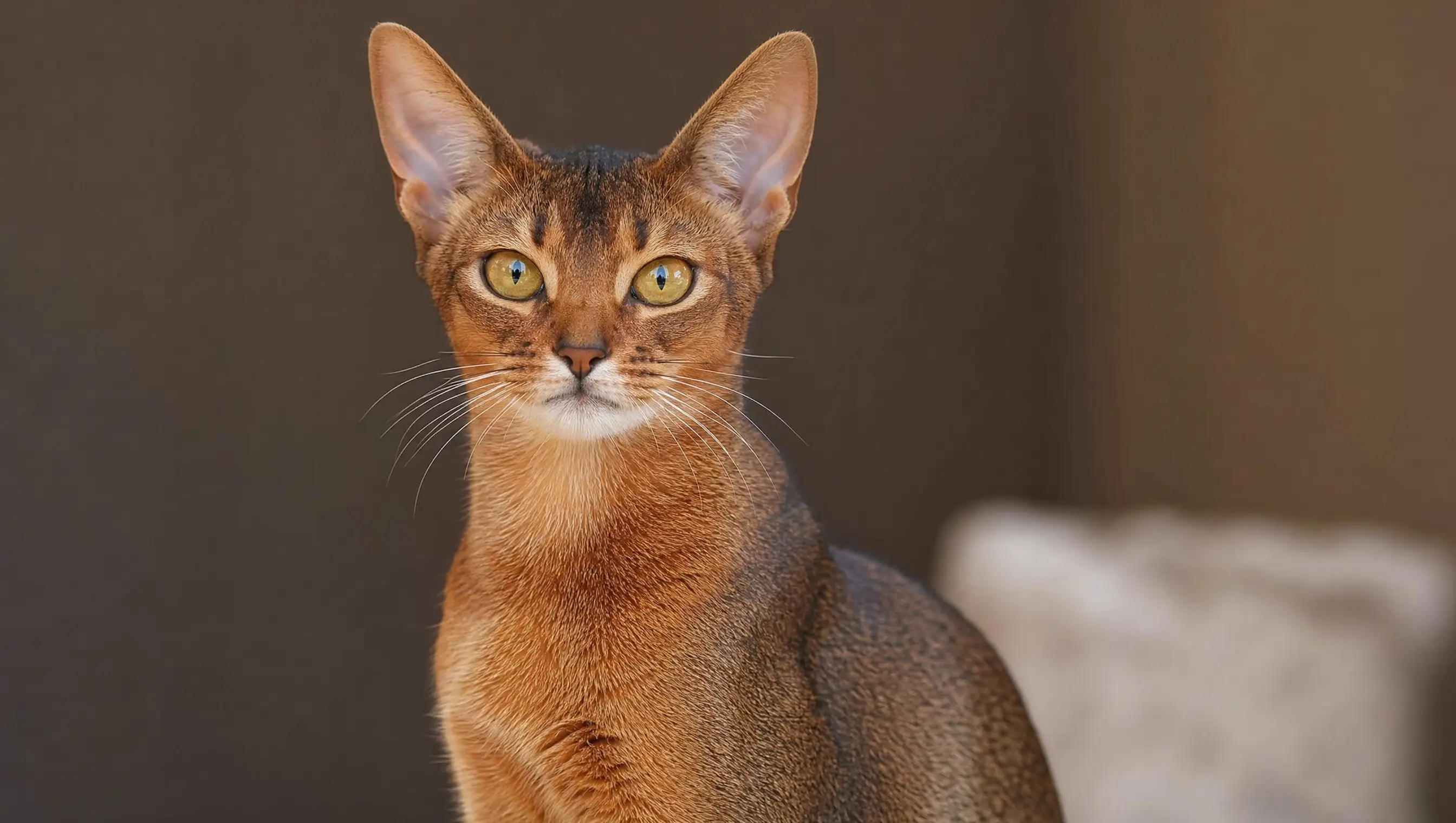
The programme follows from the layers. First, kill the payoff: when something non-breakable goes over, don't react — no jump, no scold, no eye contact, because to an attention-seeking cat a telling-off is still a show. Attend to the cat generously at other times, so the paw stops being the best-paying move in the house. Second, pay the predator: play the daily hunt out of it before the witching hours, and give busy, clever breeds like the Abyssinian genuine work — puzzle feeders, climbing routes, a window with traffic. Third, manage the terrain: breakables off the runways, museum putty under what must stay, and a couple of sanctioned knockables — a ping-pong ball on the desk buys a lot of peace for the glassware.
One caveat for pattern-readers: knocking that arrives suddenly in a formerly indifferent cat, alongside yowling, pacing or weight loss, can be agitation rather than play — older cats especially. A change in the pattern, as always, is the thing worth reading, and the stress signs owners miss is the checklist. But the classic slow push with eye contact, from a young cat at breakfast time? That's not a cry for help. That's a scientist, mid-experiment, and the experiment is you.
Common questions
Why do cats knock things off tables?
Three real reasons: the paw-bat is a hunter's probe for testing whether something is alive; an under-stimulated indoor cat makes its own entertainment, and gravity is the cheapest game in the house; and most powerfully, cats learn that knocking things over reliably makes their human appear. It isn't spite — cats don't do spite.
Why does my cat knock things over while looking at me?
The held eye contact is monitoring, not defiance. If knocking something has ever summoned you, the cat learned the move works and now watches you while pressing the button to check the result. You are the most interesting lever in its territory, and it's running the experiment again.
How do I stop my cat knocking things off shelves?
Close all three accounts: don't react when it happens (a scold is still a show), pay attention generously at other times, burn the energy with daily hunting-style play and food puzzles, and manage the terrain — breakables off the edges, museum putty under keepers, and a sanctioned knockable like a ping-pong ball as a decoy.
Is my cat knocking things over for attention?
Very often, yes — especially if it happens in your eyeline and at predictable times like early morning. The behaviour was almost certainly trained by accident: the first knock produced a human, and cats are excellent students of consequence. The fix is making the move stop paying while other behaviours pay better.
Do cats understand that things break?
No. A cat has no concept of value or fragility — a wine glass and a ping-pong ball are the same experiment with different noises. That's why punishment fails: the cat can't connect your anger to the object's worth. Move what matters, and give the paw legitimate targets.
When is knocking things over a sign something is wrong?
When the pattern changes. A formerly indifferent cat that suddenly starts frantic knocking — especially an older cat, and especially with yowling, pacing, weight loss or a ravenous appetite — may be agitated rather than playing, and conditions like hyperthyroidism can drive it. New, out-of-character behaviour is worth a vet conversation.
More in Cats
Why does my cat lick me? Grooming, love and salt
A cat's lick is mostly a compliment: you've been adopted into the grooming circle. What the sandpaper tongue is doing, why some cats overdo it, and when to gently opt out.
Why does my cat follow me everywhere, even the bathroom?
The supposedly aloof animal trailing you from room to room is behaving exactly as the attachment science predicts. Why cats shadow their person, the bathroom mystery, and the one change that needs a vet.
Do cats love their owners? The kidnap experiment says yes
Science ran the same attachment test on cats that it runs on human infants, and 64% passed. What the secure-base test found, why one earlier study disagreed, and how a cat actually says it.
Do cats miss their owners? They even track the clock
Cats greet you harder after four hours away than after thirty minutes — they know how long you were gone. What missing looks like in a cat, when it tips into separation anxiety, and how to leave well.
How cats choose their favourite person
It isn't whoever fills the bowl. The Swiss living-room study found one habit that predicts a cat's favourite better than food ever did — and the person who ignores cats has it by accident.
Cats know their names. They've decided not to answer
A Tokyo lab proved cats pick their own name out of a string of similar words — even from a stranger's mouth. What cats actually understand of what you say, and why the response is optional.