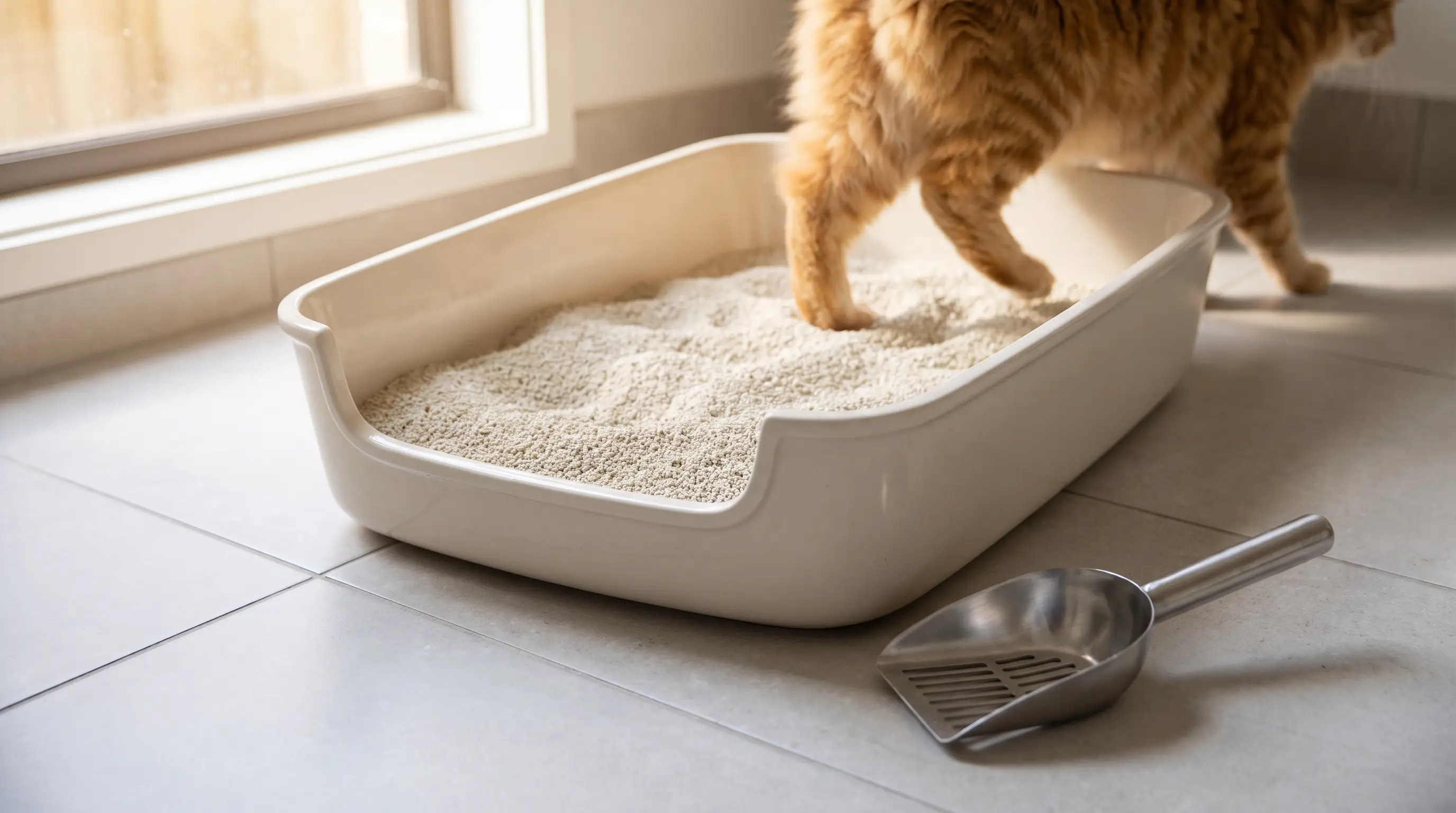
A litter box routine that actually works
Almost every litter box problem is a maintenance problem wearing a behavioural costume. Cats are fastidious about where they go, their standard is higher than ours, and a box that is fine to you can be unusable to them — at which point they find somewhere else and it becomes a much harder conversation. The routine below is small and boring, which is the point: done properly it takes about two minutes a day and prevents most of what people end up googling at midnight.
Daily: two minutes, twice if you can
Scoop every day, and twice a day if the box is used by more than one cat. This is the whole routine really — everything below is maintenance on top of it. Take out the clumps and the solids, then top up the litter you removed so the depth stays constant at around five centimetres, because a box that gets shallower through the week ends up with a cat standing on plastic.
While you are there, look at what you are scooping. The litter tray is the best health monitor in the house and it is free: you notice a cat straining, going more often, producing less, or producing something loose long before anything else in its behaviour changes. A cat that has stopped producing anything for a day, especially a male, is an emergency rather than a wait-and-see.
Weekly: wash it, and skip the bleach
Once a week, empty the box completely, wash it with hot water and a little unscented dish soap, dry it, and refill. That is it. The point is the film of oils and waste that builds on the plastic and holds smell even when the litter is fresh — scooping never reaches it, and it is what makes a technically clean box still smell like a litter box.
Skip the strongly scented cleaners, and skip anything with ammonia entirely, because ammonia is what cat urine smells of and you will be telling the cat this is already a toilet — for the whole room. Bleach is a poor idea for the same reason plus the obvious one. Hot water and plain soap genuinely is the answer here.
Monthly: check the box itself
Once a month, look at the plastic rather than the litter. Trays develop fine scratches from claws and from scooping, those scratches hold bacteria and odour, and no amount of washing gets it back once they are deep. A tray that still smells the day after a full wash has reached the end of its life, which is usually somewhere around a year of daily use.
Same visit, check the location still works. Boxes migrate — a new appliance, a rearranged room, a bin that now sits beside it — and a spot that was quiet in March can be next to the washing machine by September. If a cat that was reliable has become unreliable, what changed around the box is the first thing to look at, before anything about the cat.
How many, and where
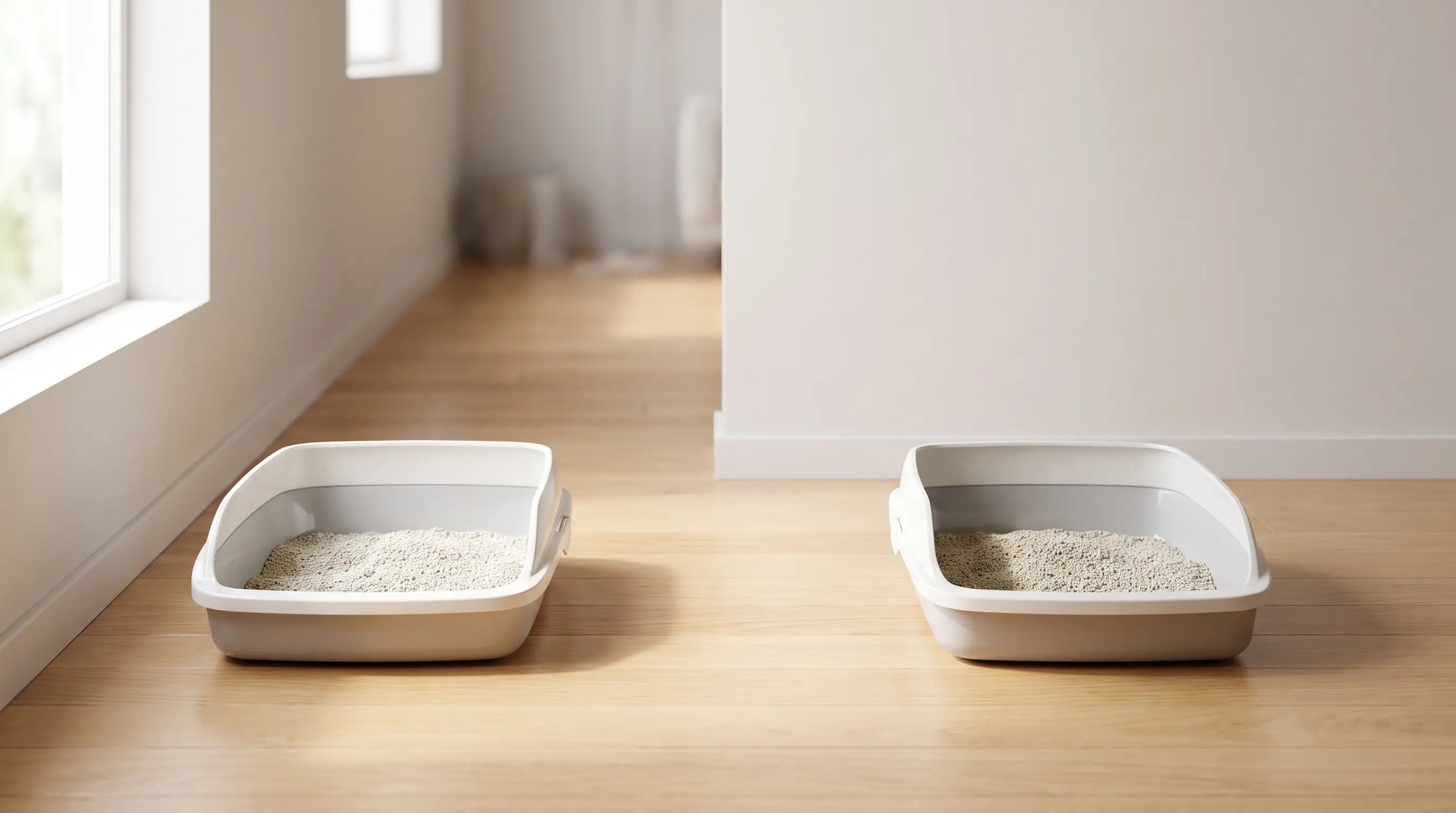
The rule is one box per cat plus one spare, and the spare is not padding: it means no cat can ever be caught out by another cat sitting in the only option. Two cats, three boxes. And they have to be in different places — three trays in a row along one wall is one box as far as a cat is concerned, because one animal standing there blocks all of them.
Placement is where most homes go wrong. A box wants a quiet spot with an escape route and a line of sight, so a cat is never cornered while it is vulnerable — which rules out the cupboard under the stairs and the far end of the utility room behind the door. Keep it well away from food and water, because cats will not eat next to a toilet and will pick one over the other. And avoid noisy neighbours: next to a boiler that fires without warning is a box that gets abandoned for reasons the owner never connects.
Smell, without scented litter
Scented litter is sold to the human and tolerated by the cat, and quite often not tolerated: a strong perfume in a box is one of the more common reasons a cat quietly stops using it. Cats have a far better nose than we do, so what reads as fresh linen to you can be overwhelming down at tray level.
Do it with maintenance instead. Unscented clumping litter at a decent depth, scooped daily and washed weekly, does not smell — and if it does, one of those three has slipped. A box in a room with some air movement helps; a lidded box in a small bathroom concentrates everything and traps it for the cat, which is a large part of why some cats dislike hoods. If you want an extra, a thin layer of plain bicarbonate of soda under the litter is odourless to a cat and does more than any perfume.
When it is not the routine
If the routine is right and the cat is still going elsewhere, stop treating it as a cleaning problem. Urinating outside the box is one of the most common signs of a urinary tract problem, of cystitis, and of pain in older cats — and a cat with arthritis may simply be unable to climb into a tray with high sides any more, which looks like defiance and is nothing of the kind. That is a vet visit first, and a training question only after.
Where it is behavioural, it is usually territory rather than mischief: a new cat, a new baby, a cat visible through a window, a house move. Litter box problems in older cats goes into that properly, and if you are still choosing what to put in the tray, our guide to litter types covers clumping, clay, wood and the rest. Never punish it, and never rub a cat's nose in anything — it teaches the cat to be afraid of you and to hide where it goes, which makes the problem harder to solve rather than easier.
Common questions
How often should I clean a litter box?
Scoop at least once a day, twice if more than one cat uses it, and top the litter back up to about five centimetres. Wash the whole tray weekly with hot water and unscented dish soap. Check the plastic monthly and replace the tray when it still smells the day after a full wash — usually around a year of daily use.
How many litter boxes do I need?
One per cat plus one spare, in different places rather than in a row. Three trays along one wall count as one box to a cat, because a single animal standing there blocks all of them. Two cats means three boxes.
Where should I put the litter box?
Somewhere quiet with an escape route and a line of sight, so the cat is never cornered while it is vulnerable. Well away from food and water, and away from anything that starts up without warning like a boiler or a washing machine — that is a box that gets abandoned for reasons owners rarely connect.
How do I stop the litter box smelling without scented litter?
Unscented clumping litter at a good depth, scooped daily and washed weekly, should not smell — if it does, one of those three has slipped. A thin layer of plain bicarbonate of soda under the litter helps and is odourless to a cat. Scented litter is sold to the human and is a common reason a cat quietly stops using the box.
Can I use bleach to clean a litter tray?
Better not to, and never anything containing ammonia — ammonia is what cat urine smells of, so you would be telling the cat the whole area is already a toilet. Hot water and a little unscented dish soap genuinely is the right answer.
My cat is going outside the box even though it is clean. Why?
Treat it as medical until proven otherwise. Urinating outside the box is a common sign of urinary tract problems, cystitis and pain, and an arthritic cat may simply be unable to climb into a high-sided tray any more. See a vet first; if it turns out to be behavioural it is usually territorial — a new cat, a new baby, a cat visible through a window.
More in Cats
Why is my cat pooping outside the litter box? Causes and fixes
Poop on the floor has a different list of suspects than pee on the wall — urgency, pain, an unreachable tray, or (rarely) an actual message. Here's the order to check them in.

Autumn dangers for dogs: acorns, conkers and mushrooms
Autumn puts three scavenging hazards on the ground — acorns, conkers and wild mushrooms — plus rat bait and fermenting fruit. What's toxic, what the warning signs are, and when to call the vet.

Winter pet dangers: antifreeze, road salt and chocolate season
Antifreeze is the winter emergency — sweet, deadly and quick. Plus gritted-salt paws, the festive-food gauntlet and cats sheltering in warm car engines. What to watch and when it's urgent.

The pet danger calendar: what to watch, month by month
Most pet hazards are seasonal and many are regional. Here's the year mapped out — when heatstroke, grass seeds, processionary caterpillars, antifreeze and the rest actually peak, and which ones your area even has.

Snake bites in dogs: first aid, symptoms and prevention
A calm, fast response is what actually saves a bitten dog. What to do in the first minutes, the myths that cost time, and which snakes matter across Europe.
Why is my cat not eating? Causes and when to see a vet
A cat going off its food is a bigger deal than a dog doing the same — here is why, the common causes, and the point where not eating becomes an emergency.