
How to introduce a new cat to your resident cat
Most failed cat introductions fail in the first hour, because the two cats were put in a room together and left to sort it out. Cats do not sort it out. A resident cat experiences a new arrival as an intruder in a territory it already owns, and a first impression built on a hiss is one you then spend months undoing. The protocol below is slower than you want it to be and it works: separate space, then smell, then sound, then sight, then a few supervised minutes. Two to six weeks is normal. Rushing is the only reliable way to fail.
Why the slow way is the fast way
A cat's world is territorial before it is social. Your resident cat has spent months or years marking this flat as its own — rubbing its face along the doorframes, sleeping in the spots that smell most of itself — and a strange cat walking through it is not a new friend, it is a takeover. That is why the two-cats-in-a-room approach so often ends in a fight: you have asked a territorial animal to negotiate with a stranger, in its own house, with no way out.
The protocol below works because it reverses the order cats care about. Smell comes first, because that is how cats decide who belongs. Sound and sight follow. The cats themselves come last, by which point neither is a stranger. It takes two to six weeks in an ordinary home, longer if either cat is nervous, and the time you spend is time you are not spending later on a pair who never settled. If your new cat has arrived from a rescue and is frightened of everything, work through settling a shy rescue cat first and start this only once it is eating and moving around its room.
Give the new cat a room of its own
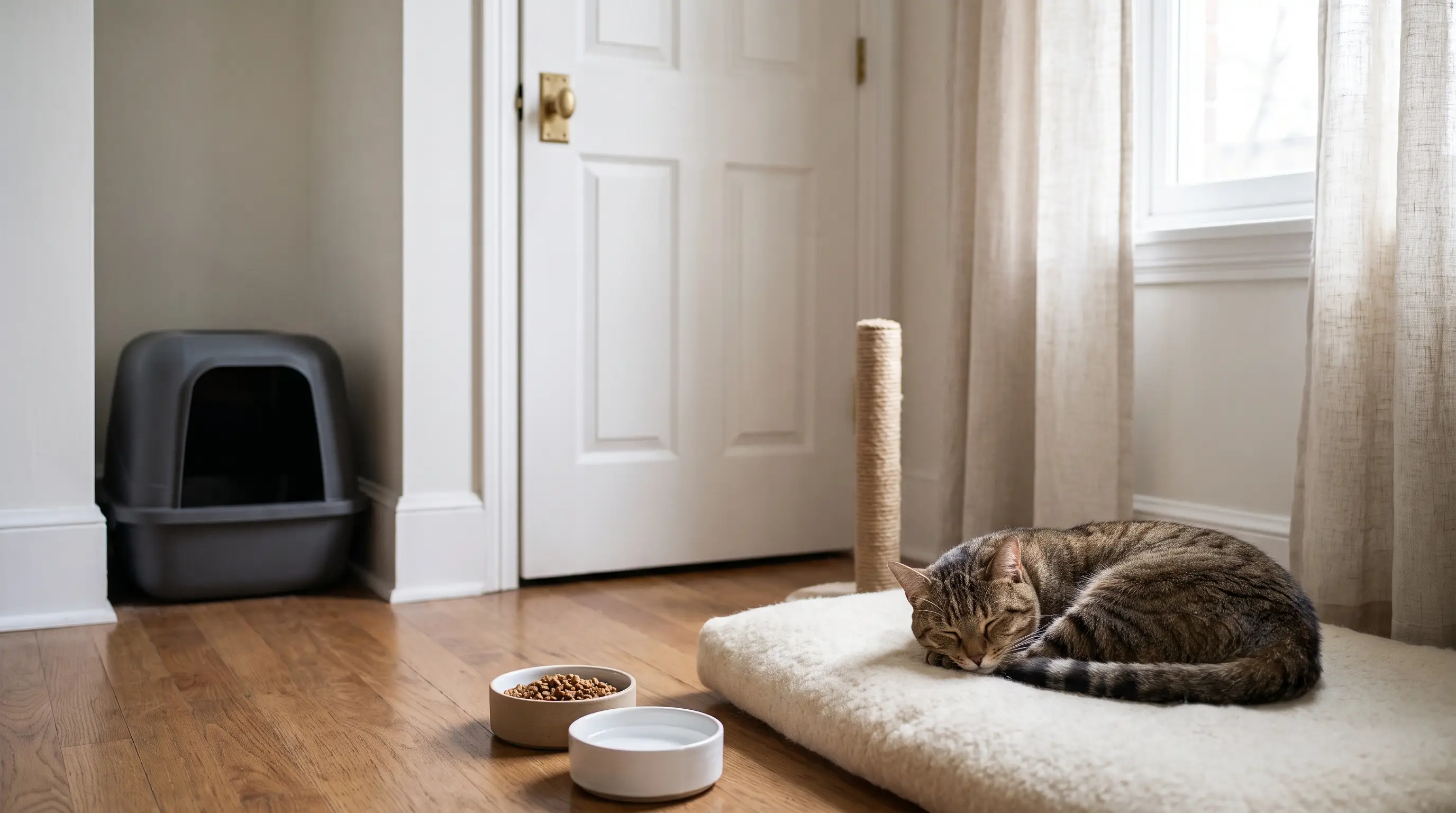
Set up one room before the new cat arrives, and keep the door shut. It needs everything: food and water, a litter box well away from the bowls, a bed, a scratching post and somewhere high or enclosed to hide. A spare room is ideal, a bathroom will do. This is not a punishment and it is not temporary storage — it is the new cat's whole territory for the first stretch, and having one safe place it fully owns is what lets it relax enough to be sociable later.
Leave it there for at least three or four days, and do not open the door to "let them have a look". Both cats will already know the other exists — they will smell it under the door and hear it move. That is the point. What you are avoiding is the two of them meeting before either has adjusted to the idea. Spend normal time with each cat separately, and if you have a new-cat checklist to work through, this is the week for it.
Swap scents before they ever meet
Scent is the introduction. Take a clean cloth or sock, rub it gently on one cat's cheeks and forehead where the scent glands are, and leave it near the other cat's food bowl — not in its bed, where an unfamiliar smell in the safest spot can backfire. Do it in both directions and swap the cloths every day or two, so each cat's smell keeps arriving fresh and ordinary rather than as a one-off event.
Then swap the cats. Shut the resident cat somewhere for an hour and let the new one explore the rest of the house alone, then put everyone back. The new cat learns the layout without a confrontation, and the resident cat comes back to a house that smells faintly of the newcomer with nothing bad having happened. Do this every day or two. You are looking for boredom: when a sniff of the other cat's cloth gets a shrug rather than a growl, that is your signal to move on.
Feed them on either side of a closed door
Now attach the other cat's smell to the best thing in a cat's day. Put both bowls near the same closed door, far enough back that each cat will actually eat, and feed at the same time. They will know exactly who is on the other side. Eating anyway is the lesson: the strange cat is present, and dinner still happened.
Over several days, move the bowls a little closer to the door each meal. If either cat stops eating, stares at the door, or eats and leaves fast, you have gone too close — move the bowls back to where they last ate calmly and stay there for a couple more days. This stage is worth not hurrying, because it is doing the real work. A cat that has eaten forty relaxed meals a metre from another cat has already built the association you want.
Let them see each other, briefly

First sight should be short, controlled and boring. Crack the door a few centimetres and wedge it so it cannot swing open, or use a baby gate or a screen. Let them look for a minute or two while you scatter treats or trail a wand toy on each side, then close it again and go back to normal. End it while it is still going well rather than waiting to see what happens — you want both cats to remember it as uneventful.
Repeat a few times a day, stretching the sessions as they get dull. Some staring is fine. A slow blink, a sniff, a cat that wanders off to sit down is exactly right. What you do not want is a hard stare that neither breaks, a low growl, a puffed tail or flattened ears — that is stress you can read on the body, and it means close the door and go back a stage.
Open the door, and stay in the room
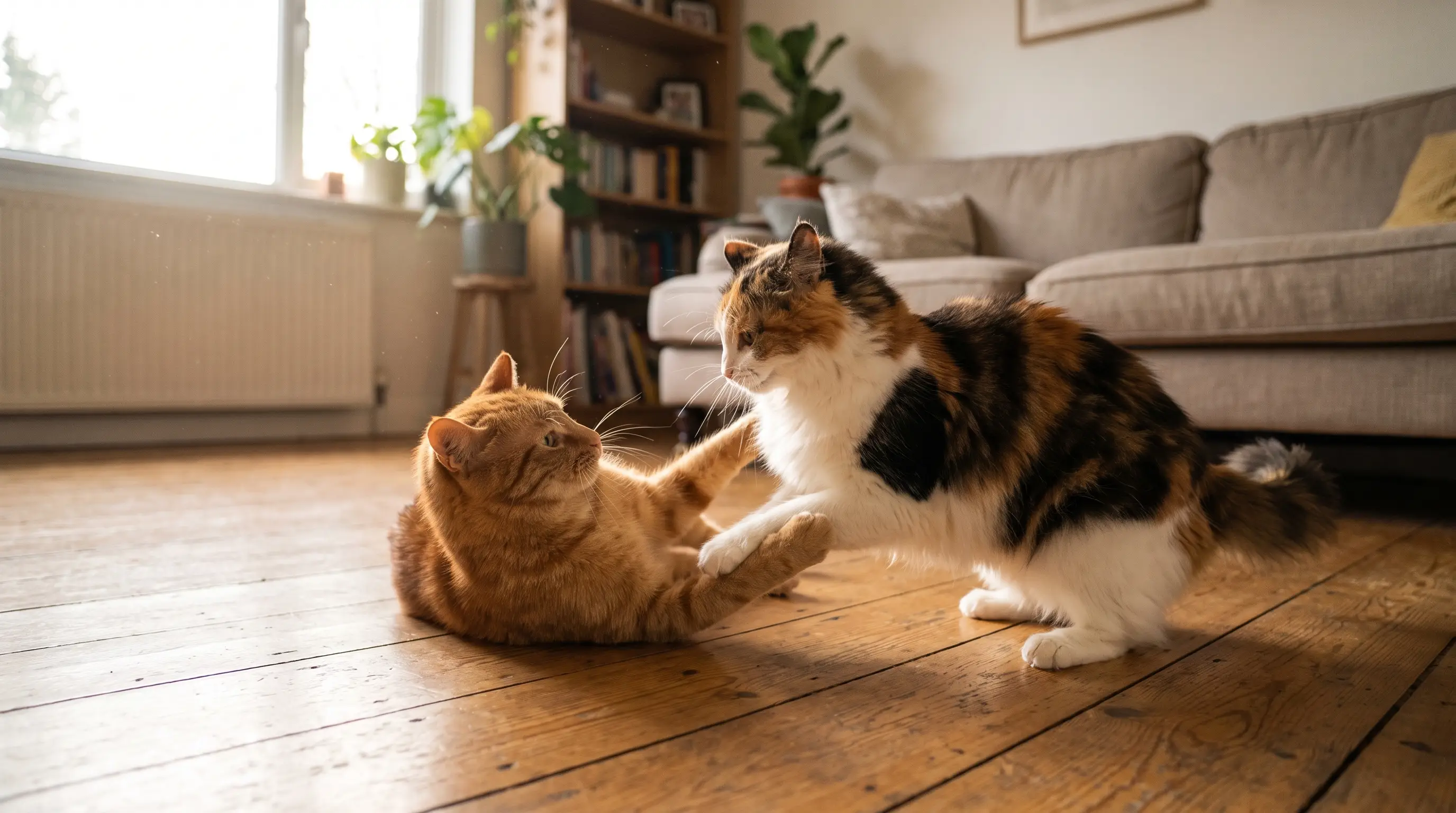
When the barrier sessions are consistently dull, open the door with both cats loose and stay there. Keep it to ten or fifteen minutes the first few times and give the room escape routes: more than one exit, a high shelf or cat tree, and nowhere that a cat can be cornered. Have a folded towel or a cushion within reach to drop between them if you need to break a stare, and never reach in with your hands.
Do not force interaction. Feed them, play with a wand toy each, and let them ignore each other if that is what they want — two cats occupying the same room without incident is a complete success at this stage. Build up the sessions over days and only leave them alone together once several long ones have passed without trouble. Where this lands, eventually, is the easy coexistence of the cats in a bonded pair, though genuine mutual grooming is a bonus and not something to expect.
When to back up a step
Going backwards is a normal part of this and not a failure. Back up one stage — not to the beginning — if you see any of: a real fight rather than a scuffle, sustained growling or hissing that does not settle within a session, one cat stopping eating, either cat urinating outside the box, hiding all day, or one cat blocking the other from the litter box, food or a doorway. That last one is quiet and easy to miss, and it is one of the clearest signs that the pair is not ready.
Sit at the previous stage for several more days before trying again. If nothing improves after a few weeks, or if either cat is losing weight or hiding constantly, that is a vet conversation rather than a training one, because pain and illness both look like aggression in cats. Two other things help more than people expect: get both cats neutered before you start, and add vertical space and a second set of bowls and litter boxes, since most "personality clashes" between cats are really arguments about resources. If you are still choosing a second cat, temperament matters more than looks — our cat breed profiles are a reasonable place to compare.
Common questions
How long does it take to introduce two cats?
Two to six weeks is normal in an ordinary home, and longer is common if either cat is nervous or older. The pace is set by the cats rather than the calendar: you move to the next stage when the current one has become boring, not after a fixed number of days.
Can I just let two cats meet and sort it out?
It is the most common way introductions fail. A resident cat reads a strange cat as an intruder in territory it already owns, so a face-to-face first meeting often starts with a hiss or a fight — and that first impression takes far longer to undo than the few weeks a gradual introduction costs.
What are the signs the introduction is going too fast?
A hard stare neither cat breaks, sustained growling or hissing, a puffed tail, flattened ears, one cat going off its food, urinating outside the litter box, hiding all day, or one cat blocking the other from food, the box or a doorway. Any of those means go back one stage for several days.
Should I swap the cats' bedding?
Swap a cloth rubbed on each cat's cheeks rather than bedding, and put it near the other cat's food bowl instead of in its bed. A strange smell in the place a cat feels safest can backfire; the same smell next to dinner does the opposite.
Do cats ever become friends after a bad first meeting?
Often, yes, but it takes longer. Go back to full separation and restart the protocol from the scent stage, moving more slowly than the first time. Many pairs that started badly end up coexisting comfortably, even if they never groom each other.
Will my cats need separate litter boxes?
Yes. The rule of thumb is one box per cat plus a spare, placed apart rather than in a row, so one cat cannot guard them all. The same goes for food, water and resting spots — most fights between cats are arguments about resources rather than personality.
See also
More in Cats
Single kitten syndrome: real, overstated, or both?
Rescues warn that a lone kitten becomes a biting, yowling tyrant, and some won't rehome singles at all. The evidence is thinner than the warnings — but the thing underneath the branding is real. An honest sort-out.
The new-cat checklist: what to set up first
The five essentials, one safe room and a cat-proofed home to set up before adoption day, so your new cat has somewhere calm to land from hour one.
Helping a shy rescue cat settle in
A shy rescue cat hiding for days is normal, not rejection. One quiet room, a hiding spot and patience settle almost any scared cat. Here is how.

Adopting a senior dog or cat
What to expect when you adopt an older dog or cat: the calm, the fast bond, the vet planning, and the honest trade-off of less time.
Adopting a bonded pair of cats
A bonded pair of cats is often easier than a single cat. Here's why two settle faster, keep each other company, and rarely mean double the work.

How to adopt a dog or cat from a shelter
A calm, step-by-step guide to adopting a dog or cat from a shelter or rescue, from where to search to the screening, the fee and the first days home.