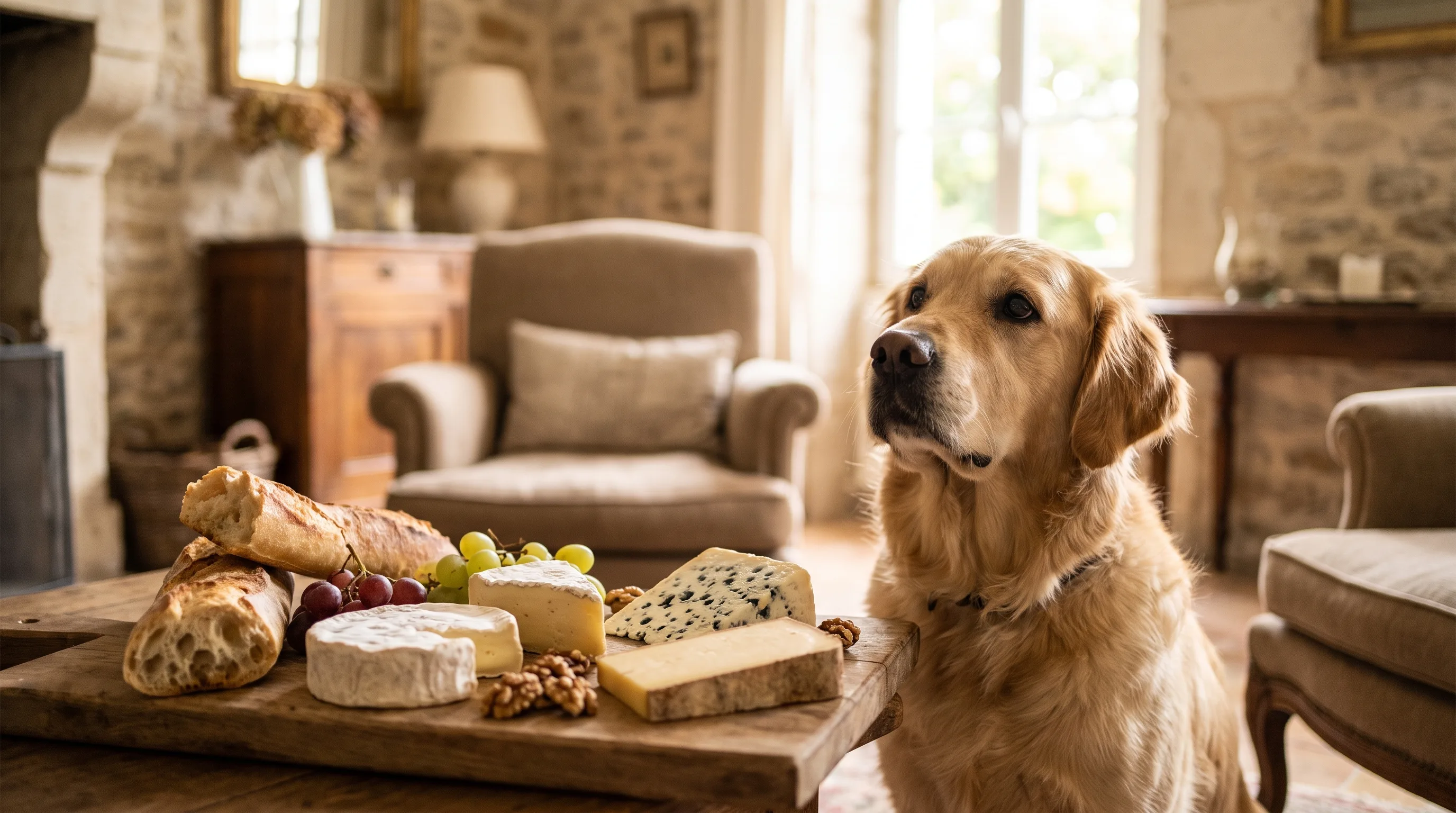
Can dogs eat cheese? French classics, put to the test
The French table is built on exactly the things a dog shouldn't have much of: rich cheese, cured meat, butter and chocolate. The base foods are rarely the danger — it's the salt, the fat, the mould and the chocolate that decide the verdict. Here's the honest answer on the classics, purely on what's safe for a dog, with the specific reason each is a yes, a no, or a small rare bite.
The clear nos: pain au chocolat, foie gras, saucisson
Pain au chocolat and anything chocolate is the simplest no: chocolate contains theobromine, which dogs can't process, and dark chocolate is the most dangerous. Foie gras is a no on fat alone — it's one of the richest foods there is, and a sudden hit of that much fat is a classic trigger for pancreatitis, a painful and serious inflammation of the pancreas. This is about toxicity, not ethics; even a taste is a bad idea for a dog.
Saucisson and other dry cured sausages are built on salt and often garlic, both problems for dogs — the salt in quantity, the garlic because it belongs to the allium family that damages red blood cells. If your dog gets into chocolate or a real amount of foie gras, call your vet; our list of foods dogs must never eat explains why.
Cheese: it depends which one
Cheese is the French question, and the answer splits. Blue cheeses — Roquefort above all — are a genuine no: the mould that veins them produces roquefortine C, which can cause tremors and seizures in dogs. Soft, very salty or very fatty cheeses are a poor idea too, mostly because most adult dogs are lactose-intolerant and cheese is rich.
A small cube of a hard cheese like comté or emmental, on the other hand, is low enough in lactose that many dogs tolerate it, and it works as a high-value training treat — the catch is the salt and fat, so keep it to a cube, not a wedge. The single rule worth remembering: no blue cheese ever, other cheeses only as a tiny occasional scrap.
If your dog has swiped a bit of ordinary cheese, it's not an emergency; a bit of Roquefort is worth a call to the vet.
Rich, not toxic: baguette, croissant, galette des rois
A few French staples won't poison a dog but earn a shrug. Plain baguette is harmless and pointless — just carbs, fine in a small bite, no benefit. A croissant is not toxic but very buttery, so it's a rare tiny bite at most, not a habit, because the fat adds up.
Galette des rois comes with two catches. The frangipane filling is almond, butter and sugar — almonds aren't toxic to dogs, but it's very rich — and the hidden fève (the little charm) is a real choking and gut-blockage hazard if a dog bolts a slice. So keep the galette to yourself, mostly because of the trinket.
Across the board, the French verdict is the same: the flour and plain cheese are rarely the danger. It's the chocolate, the fat, the salt and the blue-cheese mould that turn 'a bite of what I'm eating' into a bad idea.
Common questions
Can dogs eat cheese?
It depends. Blue cheeses like Roquefort are a firm no — their mould produces roquefortine C, which can cause tremors and seizures in dogs. A small cube of a hard cheese like comté is low in lactose and fine as an occasional treat, but keep it tiny because cheese is salty and fatty.
Can dogs eat chocolate or a pain au chocolat?
No. Chocolate contains theobromine, which dogs can't safely process, and dark chocolate is the most dangerous. A pain au chocolat counts. Contact your vet or a pet poison line with your dog's weight and roughly how much it ate.
Is foie gras dangerous for dogs?
Yes, avoid it. Foie gras is extremely high in fat, and a sudden large amount of fat is a common trigger for pancreatitis, a serious inflammation of the pancreas. This is a food-safety issue, not an ethical one — even a taste is a bad idea for a dog.
Can dogs eat saucisson?
Better not. Dry cured sausage is high in salt and often contains garlic, which is toxic to dogs and damages their red blood cells. A tiny scrap won't poison a dog, but it shouldn't be a regular treat, and garlicky types are best avoided entirely.
Can dogs eat baguette?
Plain baguette isn't toxic — it's just carbohydrate, so a small bite won't harm a healthy dog. It offers no real benefit, though, and anything with garlic butter or added salt is a different question. Treat it as harmless but pointless.
Can dogs eat galette des rois?
Better not. The frangipane is very rich (almond, butter and sugar), and more importantly the hidden fève is a genuine choking and intestinal-blockage hazard if a dog swallows a slice whole. Keep the galette for the humans.
See also
More in Dogs

Can dogs eat speculaas? Dutch treats, checked
Speculaas, drop, oliebollen, hagelslag — which Dutch classics are a hard no for dogs and which are just pointless. Honest verdicts, with the reason.
Can dogs eat panettone? Italian foods, put to the test
Panettone, gorgonzola, prosciutto, gelato — which Italian classics are dangerous for dogs and which are just a salty, sugary no. Honest verdicts with the reason.
Can dogs eat Brezel? German classics, checked
Brezel, Stollen, Wurst, Käsespätzle — which German staples are dangerous for dogs and which are just too salty or fatty. Honest verdicts, with the reason.

Can dogs eat turrón? Spanish classics, put to the test
Turrón, jamón, churros, tortilla — which Spanish classics are dangerous for dogs and which are just salty or sugary. Honest verdicts, with the reason.

How much to feed a puppy, by age and size
The bag's chart is a starting point, not an answer. How much a puppy really needs, how meals drop from four a day to two, and the large-breed rule that matters more than the amount.
Feeding a senior dog: what actually changes after 7
Most older dogs need fewer calories, not a special 'senior diet' — and they should not have their protein cut. What changes, what doesn't, and when a change in appetite is a vet visit.