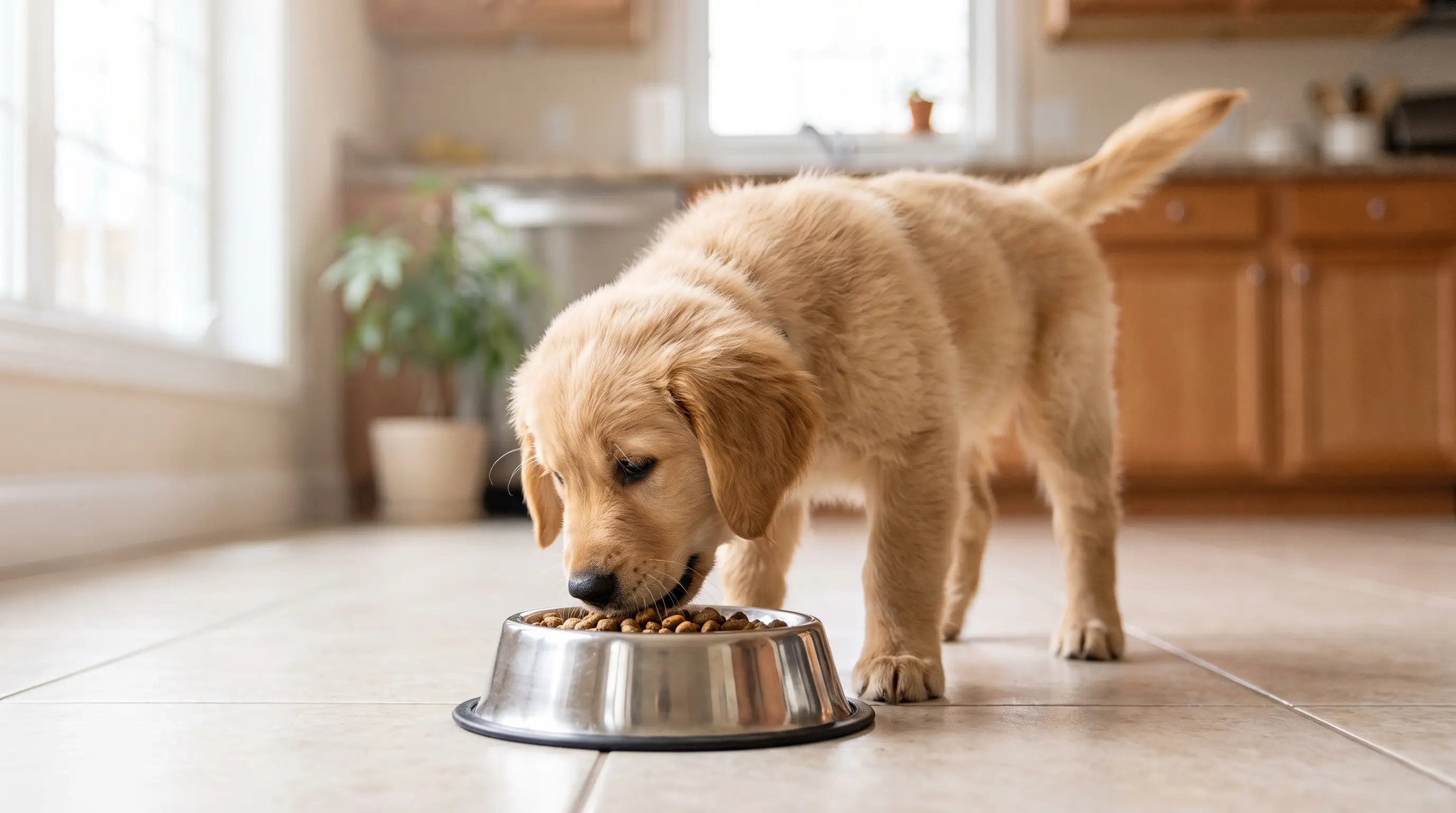
How much to feed a puppy, by age and size
How much to feed a puppy starts with the chart on the bag and ends with the puppy in front of you. The feeding guide printed on good puppy food is a sensible starting point, worked out from your puppy's age and its expected adult weight — but it is an average, and your puppy is not average. The amount matters, but for large-breed puppies how fast they grow matters more, and the honest guide to both is the puppy's own body rather than any table. Here is how to get it right.
Start with the bag, then adjust to the puppy
Every complete puppy food carries a feeding guide, and it is the right place to begin. It sets a daily amount from two numbers — your puppy's current age and its expected adult weight — and splits that across the day's meals. Weigh the food rather than scooping it by eye, because a rough scoop is how puppies quietly get too much or too little, and use the amount for the adult size your puppy is heading towards, not the size it is now.
Then treat that figure as a hypothesis to test, not a rule to obey. The printed guides tend to run generous, puppies vary in how much they need to hold a healthy weight, and the only way to know whether the number is right is to watch what it does to the puppy over a week or two. The chart gets you to the right neighbourhood; your puppy's body tells you the exact address.
How often: four meals a day down to two
Young puppies eat little and often because they cannot fit a day's energy into one or two meals and their blood sugar dips fast between them. A rough schedule most puppies fit: around four meals a day up to about four months, dropping to three meals from four to six months, and settling to two meals a day from around six months onwards, which is where most dogs stay for life.
Spreading food across the day also does two useful jobs beyond nutrition. It steadies a small puppy's energy and toilet habits, which makes house-training far more predictable, and it lets you actually see each meal — a puppy that suddenly leaves food is telling you something, and you only notice if meals are events rather than a bowl left down all day. Free-feeding a puppy hides exactly the signal you most want to see.
Puppy food, not adult food
Feed a food formulated for growth, not an adult maintenance food. Puppies need more energy and protein per mouthful than grown dogs, along with a carefully balanced level of calcium and phosphorus to build bone correctly, and that is exactly what a food labelled complete and balanced for growth or for all life stages provides. An adult food is built for a different job and can leave a growing puppy short on the very things it needs most.
This is the moment the label earns its keep, so it is worth knowing how to read one — our guide to the complete-and-balanced statement is the single most useful check, and how to read a pet food label covers the rest. Get the food right first; the amount is the easier half of the problem.
The large-breed rule that matters more than the amount
If your puppy will grow into a large or giant dog, this is the most important paragraph here: a big-breed puppy must not grow too fast. Overfeeding a large-breed puppy, or feeding it a food too rich in energy and calcium, pushes it to grow quicker than its developing joints can cope with, and that is a leading cause of painful orthopaedic problems — hip and elbow dysplasia and other developmental bone disease — that can shadow the whole of the dog's life.
The fix is straightforward and worth taking seriously. Feed a food specifically formulated for large-breed puppies, which controls the energy and calcium for exactly this reason, and keep your puppy lean rather than roly-poly, resisting the urge to fill out a gangly frame. A slightly slower, steadier growth curve builds a sounder adult dog. With big breeds, the goal is not the biggest puppy but the best-built one.
Let the puppy's body set the amount
The real measure is body condition, not the chart. Run your hands over your puppy's ribs: you should be able to feel them easily under a thin layer, without them being sharply visible, and you should see a waist behind the ribs when you look down. Feel more padding than that and cut the portion a little; feel every rib like a xylophone and add a little. Weigh your puppy regularly and expect steady climbing, adjusting the food to hold a lean condition as it grows.
Work it out for your puppy: our food calculator turns your puppy's weight, age and expected adult size into a daily amount in seconds — a sharper starting point than the range on the bag, which you then fine-tune by feel.
Most puppies move onto adult food at around twelve months, when growth largely finishes, while the big slow-maturing breeds stay on puppy food longer, often to eighteen months or two years. From there, our guide to how much to feed an adult dog takes over.
Common questions
How much should I feed my puppy?
Start with the feeding guide on your complete puppy food, which sets a daily amount from your puppy's age and its expected adult weight, and weigh the food rather than scooping it. Then adjust to your individual puppy using body condition — you should be able to feel its ribs easily under a thin layer and see a waist. The printed charts are a starting point that tends to run generous, not a fixed rule.
How often should a puppy eat?
Young puppies need frequent small meals: roughly four a day up to about four months, three from four to six months, and two a day from around six months, which is where most dogs stay for life. Little and often keeps a small puppy's energy and blood sugar steady, helps house-training, and lets you spot a lost appetite early — which is why scheduled meals beat leaving food down all day.
When can a puppy move to two meals a day?
Most puppies drop to two meals a day at around six months old, having gone from about four meals in early puppyhood to three between four and six months. There is no need to rush it — let the change follow your puppy's age and appetite. Two meals a day is the routine most adult dogs keep for the rest of their lives.
Should I feed my large-breed puppy differently?
Yes, and it matters more than the amount. Large and giant-breed puppies must not grow too fast, because rapid growth stresses developing joints and is a leading cause of hip and elbow dysplasia and other bone problems. Feed a food formulated for large-breed puppies, which controls energy and calcium, keep the puppy lean rather than chubby, and aim for steady rather than maximum growth.
Can I feed my puppy adult dog food?
It is better not to during growth. Puppies need more energy and protein and a carefully balanced calcium-to-phosphorus ratio than adult maintenance foods provide, so a food labelled complete and balanced for growth or all life stages is the right choice. Adult food can leave a growing puppy short on what it needs to build bone and body correctly.
When should I switch my puppy to adult food?
Most dogs move to adult food at around twelve months, when growth is largely complete. Large and giant slow-maturing breeds stay on puppy food longer, often until eighteen months to two years, because they keep growing. Match the switch to when your dog finishes growing rather than to a fixed date, and change over gradually across a week or so.
See also
More in Dogs
Feeding a senior dog: what actually changes after 7
Most older dogs need fewer calories, not a special 'senior diet' — and they should not have their protein cut. What changes, what doesn't, and when a change in appetite is a vet visit.

Foods dogs must never eat: the toxic list
The vet-checkable list of foods that poison dogs, ranked by real danger, plus exactly what to do in the first ten minutes.

How much to feed a dog: portions and the lean years
Feed to your dog's ideal weight, not its current weight. The food-pack number is a start, then adjust by ribs, waist and tuck.
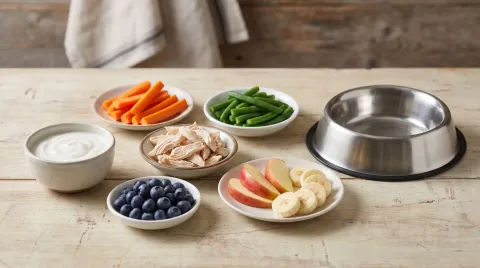
Human foods dogs can eat safely (and how much)
The yes-list of human foods that are safe for dogs, with real portions, the catches, and the one 10 percent rule that keeps treats from doing harm.
How to read a pet food label
The one line that matters most, why the first ingredient lies, and how to spot marketing words that mean nothing.

Treats without the weight gain: the 10% rule
The vet rule that stops treats making your cat or dog fat, and how to run the numbers in about a minute.