House training a puppy: the schedule that actually works
House training goes wrong far more often from missed supervision than from a puppy that will not learn. A puppy cannot hold its bladder for long, has no idea indoors is off-limits until you teach it, and needs the right moment rewarded again and again before the habit sets. Build the schedule around its age, watch it closely between outings, and reward outside the instant it goes, and most puppies are largely reliable within a few months. Here is the realistic version, not the one-week promise.
Why house training is a supervision problem, not a smart-dog problem
A puppy does not have full bladder control until somewhere around four to six months old, so accidents before that age are physical, not disobedient. House training really has two halves: preventing accidents through supervision and confinement, and rewarding the right choice so heavily that the puppy starts offering it on its own. Skip the first half and the second never gets a fair chance, because a puppy that is left to wander and make mistakes is also being left to practise going indoors.
Size and breed shift the timeline more than owners expect. Small and toy breeds like the Chihuahua have tiny bladders relative to how alert and quick they otherwise are, and often take longer to house train than a large, easily motivated breed like the Labrador Retriever. This is physical, not a difference in intelligence, and progress is rarely a straight line — a run of dry weeks followed by a wobble is completely normal and not a sign you have done something wrong.
Build the daily schedule around age, not the clock
As a rough guide, a puppy can hold its bladder for about one hour per month of age in the daytime, so a two-month-old needs a break roughly every two hours, a three-month-old every three, and so on, up to around eight hours as a healthy adult. Build outings around five fixed anchors rather than watching the clock alone: first thing on waking, within ten to fifteen minutes of every meal, after every nap, after every play session, and last thing before bed. Eating and drinking trigger the gut and bladder fast in a young puppy, which is why the after-meal window is the least forgiving one to miss.
Write the schedule down for the first couple of weeks and stick to it even when nothing seems urgent. Puppies that are taken out on a predictable rhythm, rather than only when they seem desperate, learn the pattern faster and have far fewer accidents in the meantime.
Take your puppy out, then reward outside — not back indoors
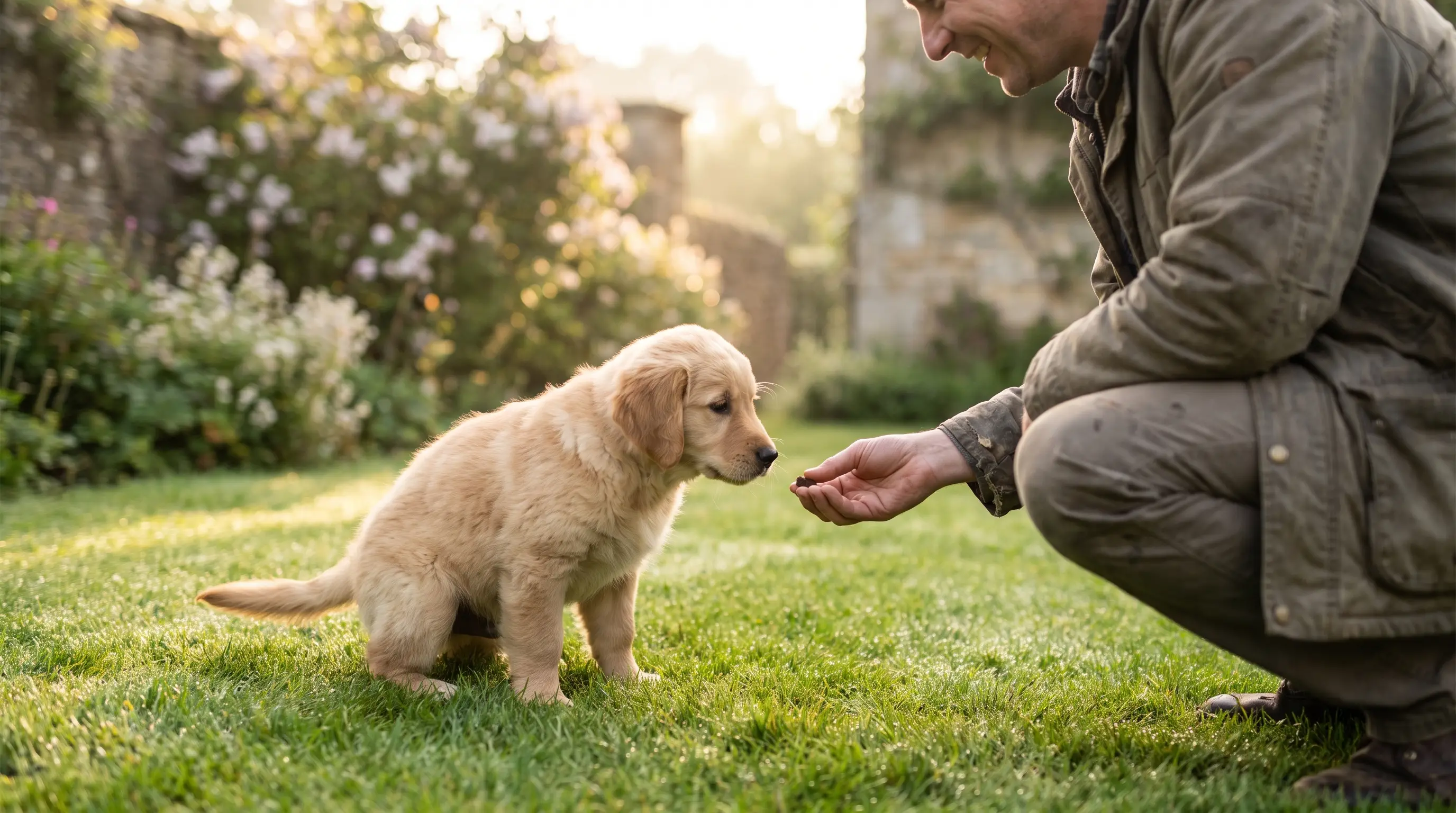
Go straight to the same spot on a lead every time; the familiar scent helps cue the puppy to go, and a consistent spot also makes cleanup easier. Stay boring while you wait — no play, minimal talking — because an exciting owner is a distraction from the job at hand. The instant your puppy finishes, reward with a treat and warm praise right there, outside, not after you are both back through the door. Rewarding too late teaches nothing, because a puppy connects consequences to what it is doing in the moment, not five seconds ago.
Say a consistent cue word — "toilet", "go", whatever you choose — quietly while your puppy is actually going, every single time. Repeated enough, most puppies learn to go more or less on request, which becomes genuinely useful on wet mornings and travel days later on.
Manage the space so accidents can't happen unsupervised
Between outings, either watch your puppy directly or confine it, because an unsupervised puppy in open house is an accident waiting to happen through no fault of its own. A single puppy-proofed room with baby gates, a playpen, or a crate sized so it can stand and turn around all work; a puppy will usually try hard not to soil the small space it sleeps in. If you are actively supervising, the "umbilical cord" method — a lead clipped to your belt so the puppy is always in view — catches the early signals before they turn into a mess.
Learn what your own puppy does right before it needs to go: sudden sniffing at the floor, circling, abruptly stopping play, or heading toward the usual door. Interrupt calmly with a cheerful "outside!" and go immediately rather than scolding, which only teaches the puppy to hide the behaviour from you next time.
Setbacks, accidents and when to call the vet
Clean every accident with an enzyme cleaner rather than an ordinary household product, because regular cleaners mask the smell without removing the scent markers that pull a puppy back to the same spot. Never punish an accident, and never rub a puppy's nose in it — by the time you find it, the puppy cannot connect the mess to the scolding, and rubbing its nose in it only teaches fear of you and of being watched, which can make a puppy start hiding to toilet instead of stopping.
A sudden run of accidents in a puppy that has been reliable for weeks is worth a vet visit before you assume it is behavioural. Straining, frequent small trips, blood in the urine or obvious discomfort can point to a urinary tract infection or another medical cause that needs treating, not more training. Once health is ruled out, go back a step in the schedule — shorter intervals, tighter supervision — rather than assuming the puppy has forgotten everything it knew.
Common questions
How long does it take to house train a puppy?
Most puppies are largely reliable indoors by four to six months with a consistent schedule, though full, no-accident reliability often takes closer to a year. Small and toy breeds commonly take longer than large breeds because of their smaller bladder relative to how alert they otherwise are.
How often should a puppy go outside to potty?
A rough guide is one hour per month of age in the daytime, so a two-month-old needs a break roughly every two hours. Build outings around waking, meals, naps and play sessions rather than the clock alone, since those moments trigger the need fastest.
Why does my house-trained puppy suddenly have accidents?
A sudden regression after weeks of reliability is often a medical issue, such as a urinary tract infection, and is worth a vet check before you assume it is behavioural. If health is clear, go back a step: shorter intervals and closer supervision usually restores the habit within days.
Should I use puppy pads or go straight outside?
Going straight outside from the start avoids teaching two different toilet locations, which can slow things down later. Puppy pads can make sense for very young puppies in high-rise flats or during illness, but plan to phase them out and move outside as soon as it is practical.
What age are puppies usually fully house trained?
Many puppies are mostly reliable by four to six months, once they have the bladder control to match, though full consistency with no wobbles often lands closer to a year old. Consistency in the schedule matters more than the puppy’s breed or size for how fast this goes.
See also
More in Dogs
How to stop a puppy biting and mouthing
Puppy biting is normal, not aggression — and how you respond in the first months decides whether it fades or hardens. The reward-based fixes that actually work.

How to stop a dog barking too much
Barking is communication, not defiance, and the fix depends entirely on which of four reasons is driving it. The reward-based method for each, and why shouting or a bark collar usually makes it worse.
How to socialize a puppy: the critical window, done right
A puppy's sensitive period for accepting new things as normal narrows sharply by around 16 weeks. What to expose it to, why every single experience has to end well, and where more is not automatically better.
Dog recall training: build a come that actually works
A recall you can trust in a real emergency, plus the everyday habits that quietly poison the word "come" until your dog ignores it.
Stop the pulling: loose-lead walking that works
Dogs pull because it pays off. Reward the side, stop dead the second the lead goes tight, skip the pain tools — the kind method that actually sticks.

How to crate train a puppy, step by step
Done right, a crate becomes the one place a puppy feels safest — not a cage. The reward-based method, the timing, and the mistakes that make a puppy hate it.