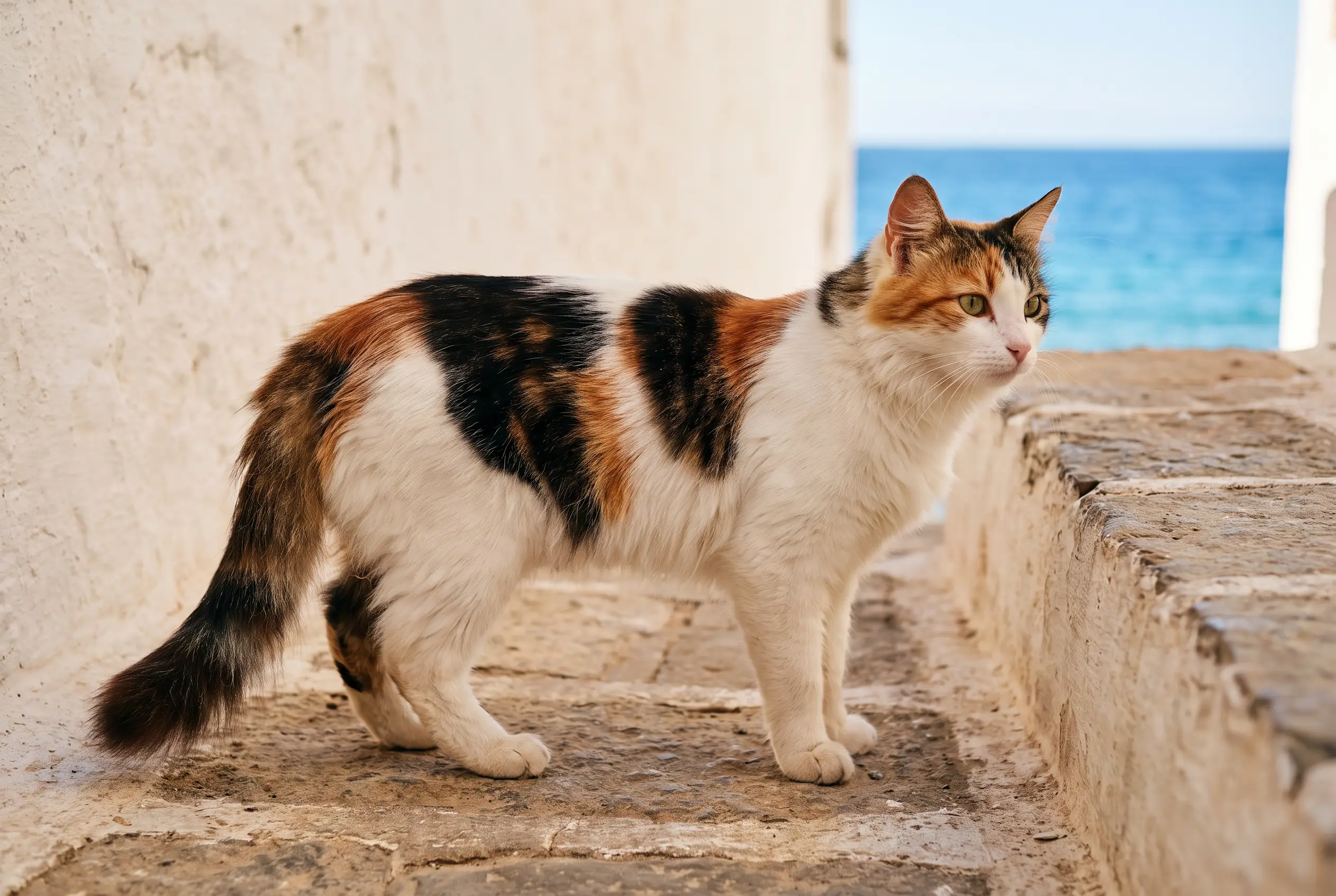
Aegean
The harbor cat of the Greek islands — bicolor, chatty, and still fishing for its own dinner.
Vital stats
| Size | Medium · lean, athletic build |
| Weight | 3–4.5 kg · males heavier — breed literature, not survey data |
| Life expectancy | 9–15 years — breed literature, not survey data |
| Energy | High — plays and fishes, needs daily engagement |
| Shedding | Seasonal — soft undercoat sheds hard in hot weather |
| Coat | Semi-long, soft, with an undercoat |
| Group | Shorthair |
| Origin | Greece |
Breed traits
Friendliness
Care
Mind
The Aegean by the numbers
The Aegean facts owners search for most — price, lifespan, weight, shedding and colours, in one place.
Less common, so expect a waitlist and some travel to a reputable breeder — which pushes the price up. Ongoing costs stay modest — it eats little and routine vet care sits at the lower end.
We don't quote a single figure: the real price swings with breeder, region, bloodline and health testing — and a rescue costs a fraction of a breeder's litter. Adopting is almost always the cheapest route.
Temperament
An Aegean in a house behaves like a cat that grew up expecting people around, not necessarily on a lap: affectionate, curious and quick to follow you from room to room, but rarely clingy. Expect a lot of talking, a soft, insistent running commentary whenever something interesting happens, especially around the kitchen sink or a dripping tap. Intelligent and playful well past kittenhood, it does better with toys it can chase or fish for than ones it bats once and ignores. Most take to other cats, dogs and children without much fuss, which tracks with a population that has spent generations sharing a harbor with everyone else.
Habits & quirks
Fishes for itself
The best-documented Aegean trait: cats that will wade into shallow water or a rock pool after fish, and that tolerate, sometimes seek out, a dip that most cats refuse. The strongest claims about this come from Greek breed-club material and travel writing rather than controlled study, but the underlying willingness to get wet is widely reported and easy to see in harbor cats today.
Wears the M
Most Aegeans show a dark tabby 'M' across the forehead, sitting inside the white-and-color pattern rather than replacing it, a small, checkable marker of the landrace look.
Always some white
White is not optional in the pattern. Every Aegean is bicolor or tricolor with white somewhere on the body, paired with black, red, gray or cream patches rather than presented as a solid colour.
Talks through the day
Vocal in a soft, conversational way, a running commentary at feeding time, at the door, and at anyone who stops to look at it. Island cats used to attention from fishermen and tourists come by this naturally.
Care
| Grooming | The soft semi-long coat has an undercoat that lets go hard once the weather turns hot. A weekly brush is enough most of the year, more often through the seasonal shed. |
| Health | There's no breed-specific DNA panel to run, because there's no registry standard defining the breed's ancestry in the first place. Natural selection on the islands is credited with a hardy population, but that's an observation, not a health study. A new owner still wants the ordinary things: a full vet check, core vaccines, and, if you're buying from a Greek breeding line, a look at the parents' hearts rather than taking hardiness on faith. |
| Water access | The fishing instinct is real enough that a garden pond or a full bath is worth supervising rather than assuming the cat will stay out of it, the same caution that applies to the Turkish Van and Turkish Angora. |
| Play & company | Not bred for a job, but shaped by circumstance to be busy and social. Daily play, especially anything that mimics catching something, and company rather than a day alone in an empty flat, keep it settled. |
Life expectancy
This breed has a typical life expectancy of 9–15 years — breed literature, not survey data.
Similar breeds
Breeds with a similar build and background — worth a look if this one isn't quite the fit.
Common questions
Can I buy an Aegean cat outside Greece?
Rarely. There's no international registry pedigree and the only organized breeding effort is Greek, so most people outside Greece who want one are looking at an import from a small Greek breeder rather than a local litter. It isn't a breed you'll find through TICA or CFA breeder listings.
Is my Greek rescue cat actually an Aegean?
Very possibly the same population, functionally. The Aegean landrace is the ordinary free-living cat of Greek harbors and islands, a bicolor or tricolor cat with white, green eyes and often that tabby forehead mark, and a street or shelter cat matching that description from Greece is the cat the breed name describes. It just won't come with papers, because there's no registry issuing any.
How is the Aegean different from the Turkish Van and Turkish Angora?
All three are eastern Mediterranean cats with a reputation for liking water, which is where the confusion starts. The Van is a bigger cat from Lake Van in Turkey, chalk-white with colour usually limited to the head and tail. The Angora is finer-boned, from Ankara, and most often a single solid colour rather than patched. The Aegean is a Greek island cat that's always bicolor or tricolor with white mixed through the coat, and unlike the other two, no major registry recognizes it at all.
Does the Aegean shed a lot?
Moderately. The Aegean sheds a fair amount, steadily through the year with heavier seasonal patches. A weekly brush keeps most of the loose hair off your floors and clothes.
Are Aegean cats hypoallergenic?
No cat breed is truly hypoallergenic, and the Aegean isn't one of the easier ones. The trigger is Fel d 1, a protein in a cat's saliva and skin that ends up on the coat during grooming and then spreads on loose hair and dander — and this breed sheds enough to move plenty of it around. If someone at home is allergic to cats, this is a hard breed to live with; spend real time around one first.
Are Aegean cats good with children?
Usually yes. The Aegean is a sociable cat that tends to tolerate the noise and handling of family life better than most, which is why it comes up so often for homes with kids. It still needs somewhere high and quiet to retreat to, and children need teaching that a cat walking away is allowed to.
How much grooming does a Aegean need?
A weekly comb is usually enough for the Aegean, with a second pass during a seasonal moult. That keeps loose hair off your furniture and cuts down on hairballs, since everything the cat doesn't shed onto the sofa it swallows while washing.