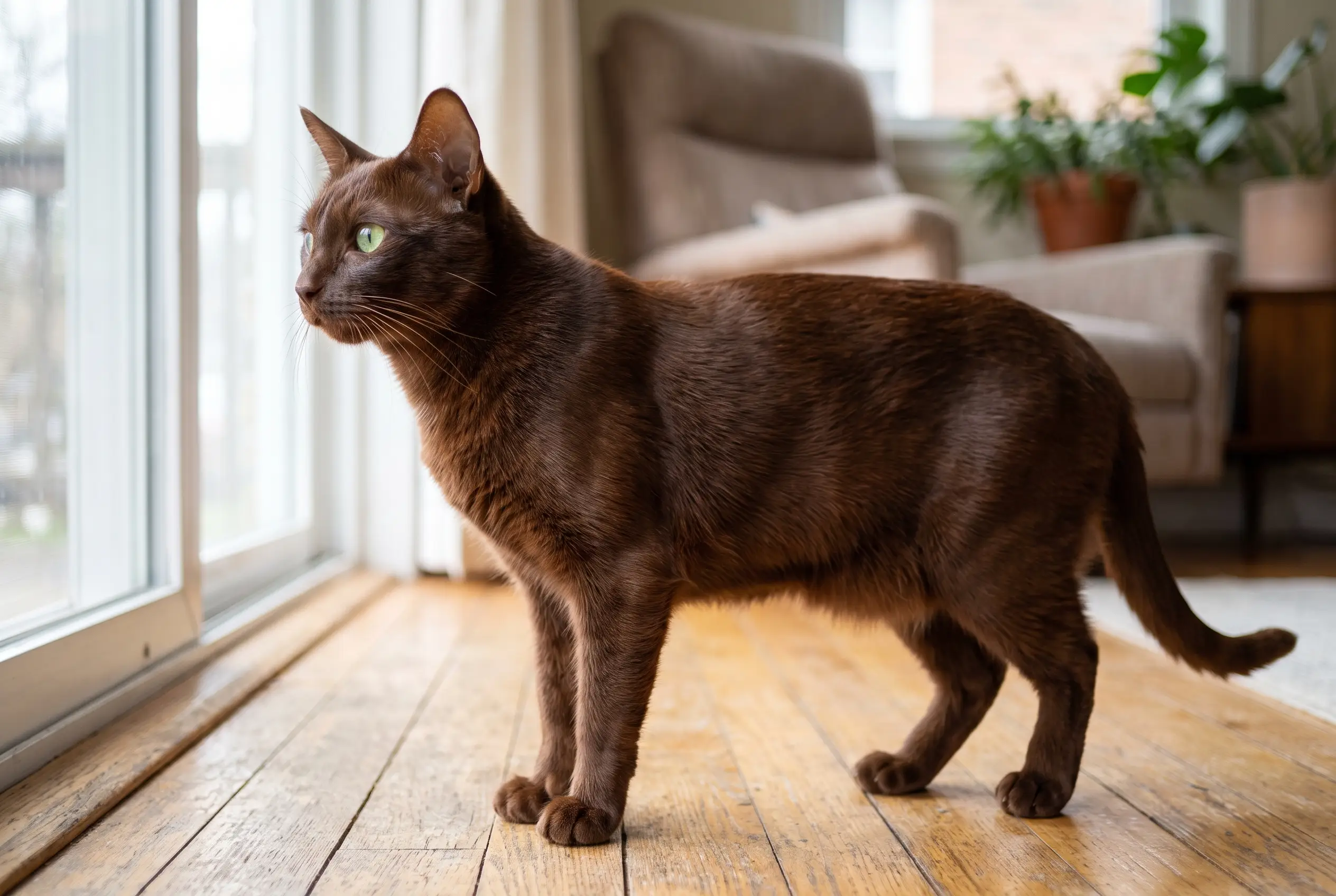
Havana Brown
A rounded chocolate muzzle built like a corn cob, and a paw that taps your arm when it wants you to notice.
Vital stats
| Size | Small to medium · moderate build, never extreme |
| Weight | 2.7–4.5 kg · males heavier — breed literature; the CFA standard sets no weight |
| Life expectancy | 12–15 years — breed literature, not survey data |
| Energy | Moderate — playful and curious, not the nonstop motion of its Siamese relatives |
| Shedding | Low · short coat, no undercoat |
| Coat | Short to medium, smooth, lustrous; solid rich chocolate brown (lavender exists as an AOV colour class) |
| Group | Shorthair |
| Origin | United Kingdom |
Breed traits
Friendliness
Care
Mind
The Havana Brown by the numbers
The Havana Brown facts owners search for most — price, lifespan, weight, shedding and colours, in one place.
Less common, so expect a waitlist and some travel to a reputable breeder — which pushes the price up. Ongoing costs stay modest — it eats little and routine vet care sits at the lower end.
We don't quote a single figure: the real price swings with breeder, region, bloodline and health testing — and a rescue costs a fraction of a breeder's litter. Adopting is almost always the cheapest route.
Temperament
A Havana Brown wants to be included, not admired from across the room. It follows a chosen person from room to room, sits in on whatever's happening at the counter or the desk, and when it wants something it doesn't yowl for it the way its Siamese relatives do — it reaches out and taps an arm, a hand, a cheek, once or twice, then waits. Owners and breed clubs report this so consistently that it reads as a real, inherited habit rather than a trained trick. It investigates drawers, bags and anything left open with its paws before its nose, and will pick up and carry small objects. Some individuals greet visitors readily; plenty size a stranger up first and decide later. Left alone for a working day it copes better than an Oriental or a Siamese would, but it still wants a house where somebody is usually home.
Habits & quirks
Taps instead of talking
Rather than the loud Siamese-style yowl, a Havana Brown reaches out and pats an arm, hand or cheek to get attention. Breeders list it as a real, inherited trait, not something owners teach.
Investigates with its paws
Open drawers, shopping bags and anything left on a counter get patted through rather than sniffed past, and owners regularly report Havana Browns retrieving and carrying off small objects.
Wears a head no other breed does
In profile the nose and chin form an almost straight line, and from above the muzzle narrows sharply behind the whiskers — the corn-cob shape CFA's standard weighs most heavily of any single feature.
Shows a ghost pattern as a kitten
Faint tabby markings are normal in Havana Brown kittens and young adults and fade into the solid adult coat; the CFA standard explicitly allows for them rather than treating them as a fault.
Care
| Grooming | The short, undercoat-free coat asks for almost nothing — a weekly wipe with a damp cloth or a rubber mitt keeps it glossy. There's no undercoat to blow, so skip anything meant for a double coat. |
| Health screening | Ask for a DNA test for progressive retinal atrophy — the same rdAc mutation screened for in Siamese and Oriental Shorthair lines — and for the breeder's honest answer on amyloidosis in the pedigree: it damages kidneys and liver, has no genetic test, and tends to surface in middle age. Ask what the older cats behind a kitten's pedigree actually died of, not just what the parents tested clear for. |
| Teeth | Gingivitis turns up early in Havana Brown lines, the same pattern seen in Oriental Shorthairs and Siamese. Start brushing as a kitten and have gums checked at every annual visit rather than waiting for a smell you can't ignore. |
| Finding a breeder | This is one of the rarest breeds CFA registers, with worldwide cattery counts in the low teens rather than hundreds, so a real waiting list is normal, not a sales tactic. Some litters will include F1 or F2 outcross kittens rather than straight pedigree ones: under CFA's 2019 programme an F1 (from a domestic, Siamese or Oriental cross) can't show as a Havana Brown itself, only its brown offspring, bred back to a registered Havana Brown, can. |
Life expectancy
This breed has a typical life expectancy of 12–15 years — breed literature, not survey data.
Similar breeds
Breeds with a similar build and background — worth a look if this one isn't quite the fit.
Common questions
Is a Havana Brown just a chocolate Oriental?
Depends which side of the Atlantic you mean. In Britain and most of Europe, yes: GCCF registers the Havana as a colour of Oriental Shorthair, bred to the same extreme wedge head as every other Oriental. In North America, no — CFA and TICA's Havana Brown is a separate, closed breed with its own moderate head shape, the distinctive corn-cob muzzle, and none of the Oriental's extreme type. Same 1950s English roots, two different cats today.
What's the 'corn-cob' head everyone mentions?
It's breeders' shorthand for what CFA's standard actually asks for: a head longer than wide, narrowing to a rounded muzzle with a sharp break behind the whiskers, and a profile where the nose and chin form an almost straight vertical line. It's the feature judges weigh most heavily, and it's also why the whiskers and nose leather have to be brown — a black nose or the wrong whisker colour disqualifies a show cat outright.
Why is the Havana Brown so hard to find?
Because the gene pool genuinely is tiny. A 2008 genetic survey placed it among the least diverse cat breeds studied, and CFA has run a regulated outcross programme to unregistered black or blue domestic shorthairs, Siamese and Oriental Shorthairs since 2019 specifically to fix that. Expect very few breeders worldwide and a real wait, not a marketing line.
Does the Havana Brown shed a lot?
Not much. The Havana Brown is a low-shedding breed, so loose hair around the home stays minimal. It still needs regular grooming, but you won't be fighting drifts of fur.
Are Havana Brown cats hypoallergenic?
No cat breed is truly hypoallergenic. The trigger is Fel d 1, a protein in a cat's saliva and skin that transfers to the coat during grooming and then travels on loose hair and dander — so a cat that sheds less, like the Havana Brown, spreads less of it around the house, but still produces it. If someone at home reacts to cats, spend real time with this breed before deciding, and no breeder should promise you an allergy-free cat.
Are Havana Brown cats good with children?
Usually yes. The Havana Brown is a sociable cat that tends to tolerate the noise and handling of family life better than most, which is why it comes up so often for homes with kids. It still needs somewhere high and quiet to retreat to, and children need teaching that a cat walking away is allowed to.
How much grooming does a Havana Brown need?
Very little. The Havana Brown handles its own coat and a comb once a week or so is plenty — mostly to catch loose hair before the cat swallows it. Claws, teeth and ears still want the usual checks, which is the part people skip on an easy-coated cat.