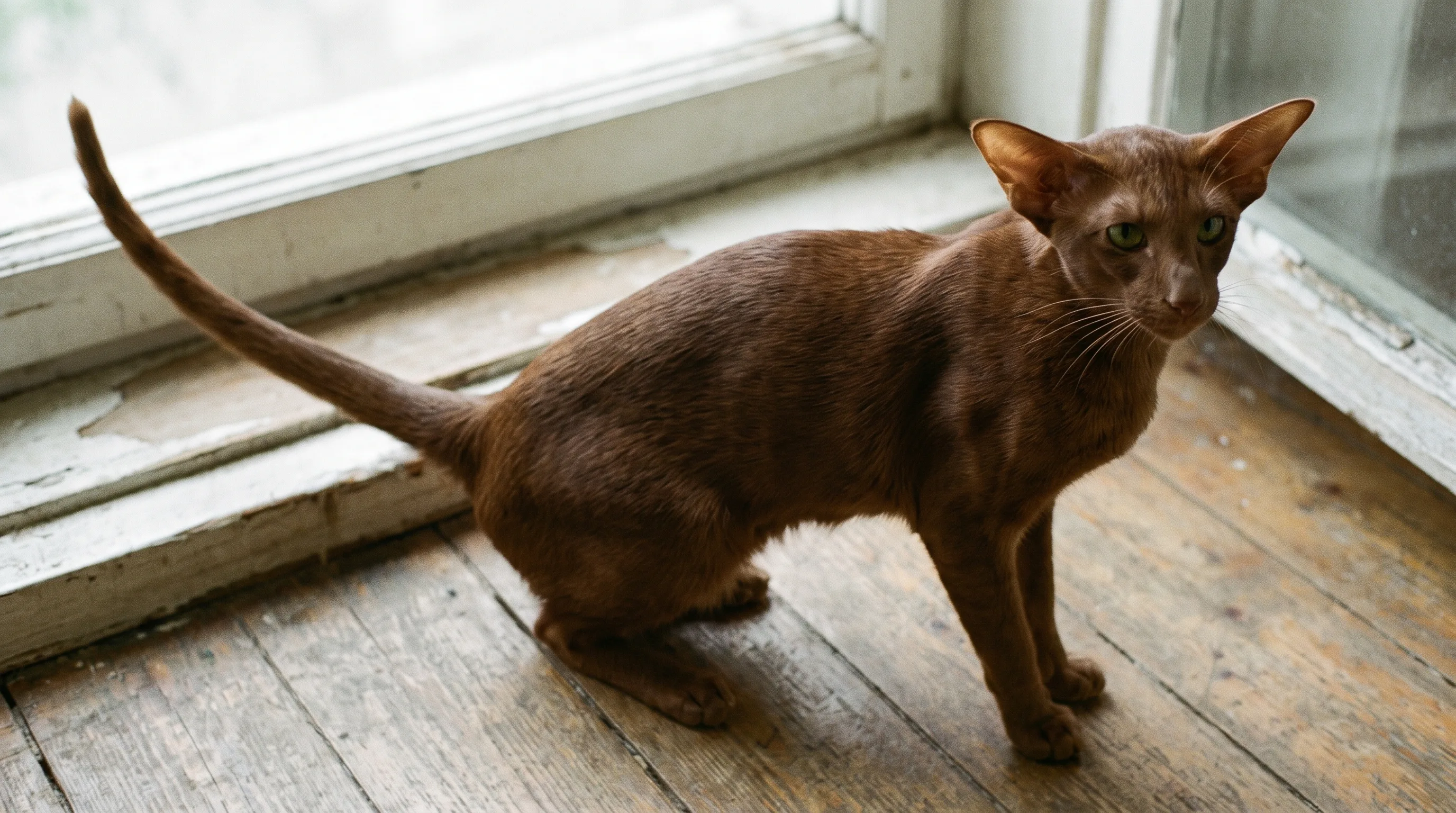
Oriental Shorthair
A Siamese in every colour but pointed — and just as sure you should be listening.
Vital stats
| Size | Small to medium · long, tubular, fine-boned |
| Weight | 2.5–5 kg · males heavier |
| Life expectancy | 12–15 years |
| Energy | Very high — climbing and talking all day |
| Shedding | Very low, short close coat |
| Coat | Very short, fine, glossy; 300+ colours and patterns |
| Group | Shorthair |
| Origin | United Kingdom |
Breed traits
Friendliness
Care
Mind
The Oriental Shorthair by the numbers
The Oriental Shorthair facts owners search for most — price, lifespan, weight, shedding and colours, in one place.
Widely bred, so you can usually find a litter from a registered breeder without a long wait. Ongoing costs stay modest — it eats little and routine vet care sits at the lower end.
We don't quote a single figure: the real price swings with breeder, region, bloodline and health testing — and a rescue costs a fraction of a breeder's litter. Adopting is almost always the cheapest route.
Temperament
Orientals are Siamese in temperament as well as build, which means an opinionated, athletic, permanently involved cat. They shout — a hard, carrying voice used freely and often in answer to you — they climb everything, they open cupboards, and they attach to one or two people with real intensity. They're clever enough to learn fetch, tricks and harness walking, and bored enough without them to redecorate. With other active cats and cat-friendly dogs they do well. Alone in a flat from morning to evening they do badly: this is one of the breeds most prone to overgrooming and separation problems, and two cats is the honest recommendation rather than a nicety.
Habits & quirks
Answers you
Not background noise: a genuine two-way habit. Speak to an Oriental and it replies, at volume, and it will keep the exchange going longer than you meant to.
Climbs to eye level and above
Doors, shelves, the top of the fridge, your shoulders. Vertical space is where this cat lives, and anything not fixed down will eventually be tested.
Opens things
Cupboard doors, handles, bags, bin lids. Long fine paws plus a lot of persistence — child locks are a normal Oriental household purchase.
Sleeps under, not on
The short coat carries almost no insulation, so an Oriental goes into the bed rather than onto it, and finds the warmest person in the house.
Care
| Grooming | Close to nothing — a weekly rub with a hand or a rubber mitt. Spend the time on teeth instead: Oriental and Siamese lines are prone to gingivitis and early periodontal disease, and daily brushing started in kittenhood pays for itself. |
| Health screening | The Siamese inheritance is the thing to ask about: progressive retinal atrophy (DNA test for the rdAc mutation), systemic amyloidosis affecting the liver, and hypertrophic cardiomyopathy, screened by scan. Ask what the older cats in the line died of, not just what the parents tested clear for. |
| Company | The real cost of the breed. An Oriental left alone all day gets loud, then destructive, then overgrooms itself bald along the belly and legs. Two cats, or a household where somebody is usually in, isn't a preference here. |
| Warmth and climbing | A thin coat on a lean frame means a cat that feels the cold — provide covered beds and warm spots. Provide height too: tall, secure cat furniture is what keeps an Oriental off your shelves. |
Life expectancy
This breed has a typical life expectancy of 12–15 years.
Similar breeds
Breeds with a similar build and background — worth a look if this one isn't quite the fit.
Common questions
What's the difference between an Oriental and a Siamese?
Colour, and nothing else that matters. Same body, same head, same voice, same temperament — the Oriental simply isn't restricted to the pointed pattern, so it comes in solid, tabby, tortie, smoke, silver and everything else, in over three hundred combinations. Some registries even allow pointed kittens from Oriental litters to be registered as Siamese.
Is the Oriental Bicolor a separate breed?
Not in most places. It is an Oriental carrying white spotting, and the major registries treat it as a colour division within the breed rather than as a breed of its own. If a breeder presents it as a distinct rare breed at a distinct price, that's a sales position rather than a registry one.
Are they as loud as people say?
Yes. The Oriental voice is the Siamese voice — hard, nasal, carrying, and used to start conversations rather than only to ask for things. Plenty of owners love it. If you work from home on calls, or you have close neighbours and thin walls, take it seriously before you buy.
Does the Oriental Shorthair shed a lot?
Not much. The Oriental Shorthair is a low-shedding breed, so loose hair around the home stays minimal. It still needs regular grooming, but you won't be fighting drifts of fur.
Are Oriental Shorthair cats hypoallergenic?
No cat breed is truly hypoallergenic. The trigger is Fel d 1, a protein in a cat's saliva and skin that transfers to the coat during grooming and then travels on loose hair and dander — so a cat that sheds less, like the Oriental Shorthair, spreads less of it around the house, but still produces it. If someone at home reacts to cats, spend real time with this breed before deciding, and no breeder should promise you an allergy-free cat.
Are Oriental Shorthair cats good with children?
Usually yes. The Oriental Shorthair is a sociable cat that tends to tolerate the noise and handling of family life better than most, which is why it comes up so often for homes with kids. It still needs somewhere high and quiet to retreat to, and children need teaching that a cat walking away is allowed to.
How much grooming does a Oriental Shorthair need?
Very little. The Oriental Shorthair handles its own coat and a comb once a week or so is plenty — mostly to catch loose hair before the cat swallows it. Claws, teeth and ears still want the usual checks, which is the part people skip on an easy-coated cat.