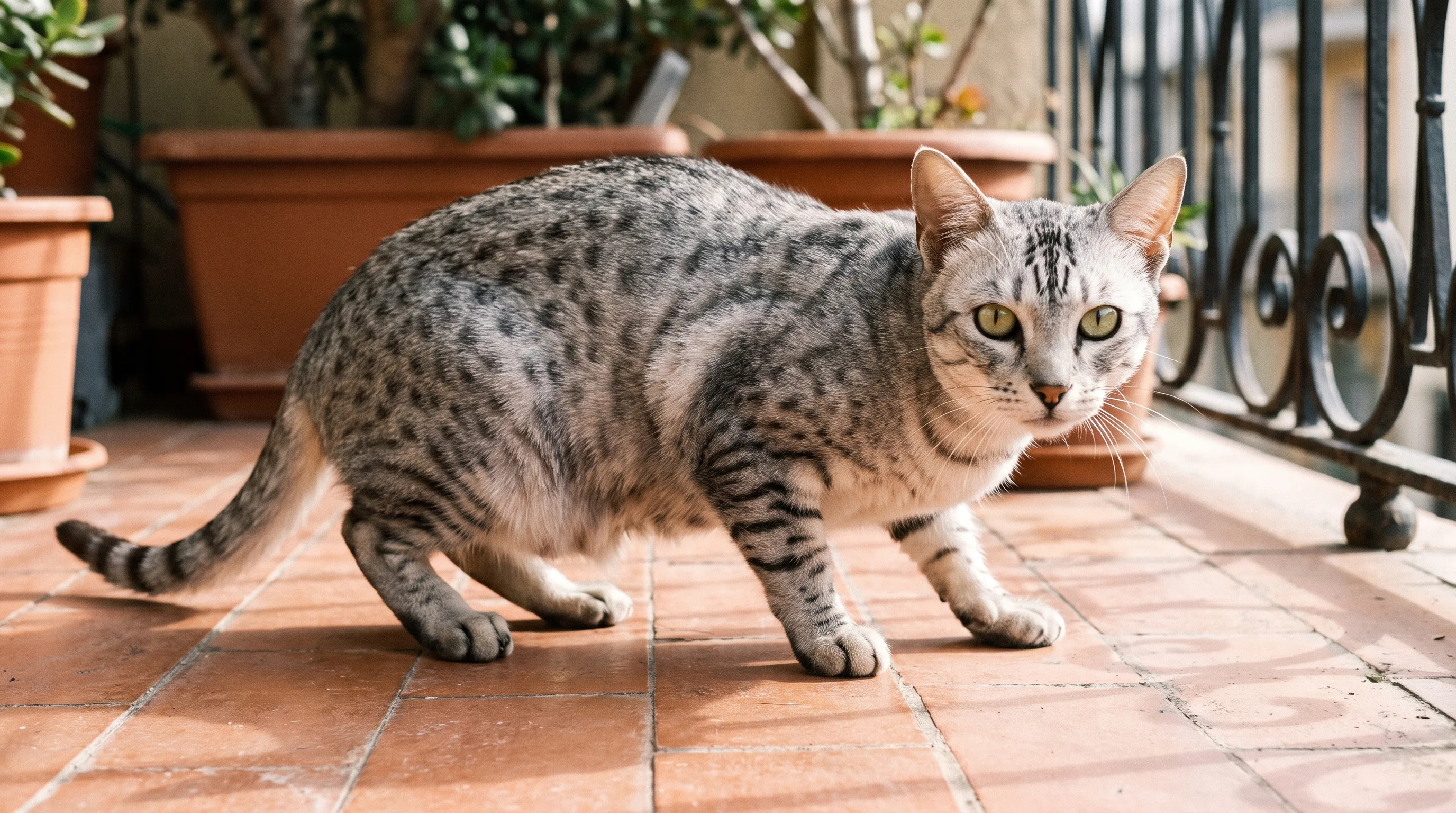
Egyptian Mau
Spotted by nature, not by design — and quick enough to prove it.
Vital stats
| Size | Small to medium · lean, muscular |
| Weight | 2.5–5 kg · males heavier |
| Life expectancy | 12–15 years |
| Energy | High — explosive rather than constant |
| Shedding | Low, fine short coat |
| Coat | Short, fine, glossy; naturally spotted |
| Group | Shorthair |
| Origin | Egypt |
Breed traits
Friendliness
Care
Mind
The Egyptian Mau by the numbers
The Egyptian Mau facts owners search for most — price, lifespan, weight, shedding and colours, in one place.
Less common, so expect a waitlist and some travel to a reputable breeder — which pushes the price up. Ongoing costs stay modest — it eats little and routine vet care sits at the lower end.
We don't quote a single figure: the real price swings with breeder, region, bloodline and health testing — and a rescue costs a fraction of a breeder's litter. Adopting is almost always the cheapest route.
Temperament
Maus are devoted to their own household and cautious with everyone else. Inside the family they're affectionate, talkative in chirps and trills, and physically demonstrative — kneading, tail-wagging with excitement, and a habit of standing on their back legs to see better. With visitors they usually leave the room. This is a sensitive breed that notices changes: new furniture, a new schedule, a raised voice. Give a Mau a settled routine, slow introductions and somewhere high to watch from, and you get a confident cat. Rush it and you get one that lives under the bed. They keep a strong hunting drive, need real play, and many are enthusiastic about water.
Habits & quirks
Wags its tail when happy
Not the warning flick other cats give — a fast quivering tail held upright, usually with kneading and a chirp. It reads as canine and it means the opposite of annoyed.
Stands up to look
Maus rise on their hind legs to get a better line of sight, using the loose belly flap that gives them their stride.
Hunts for real
A high prey drive and the speed to use it. Indoor Maus need substitute prey — wand toys, thrown objects, something that moves unpredictably every day.
Takes against surprises
Loud households, unannounced visitors and rearranged furniture all register. A Mau that has vanished usually reappears when the room is quiet again.
Care
| Grooming | Minimal. A weekly comb through the fine coat is enough, and the spots need nothing at all. Never clip a Mau's coat — the spots are on the skin as well as the hair, but the coat's texture is part of the breed and it grows back badly. |
| Health screening | The small founding population left its mark. Ask about hypertrophic cardiomyopathy (screened by scan), pyruvate kinase deficiency (DNA test), patellar luxation, and the rarer leukodystrophy and leukocyte adhesion deficiency that have been recorded in the breed. |
| Temperament management | Half of caring for a Mau is not startling it. Introduce new people and animals slowly, keep feeding and play at predictable times, and give it a high perch in the busiest room so it can watch without being reachable. |
| Exercise | Short, intense and daily. A Mau doesn't potter — it sprints, stalks and then sleeps. Two wand sessions and a window with birds outside cover most of what it needs. |
Life expectancy
This breed has a typical life expectancy of 12–15 years.
Similar breeds
Breeds with a similar build and background — worth a look if this one isn't quite the fit.
Common questions
Is the Egyptian Mau really descended from the cats of ancient Egypt?
The look is genuinely old — spotted cats appear on Egyptian art thousands of years back — but the modern breed was rebuilt in the 20th century from a handful of cats, and genetic studies place its main ancestry in Europe and North America rather than showing an unbroken Egyptian line. The honest version: an ancient pattern, a modern breed.
Are they the only spotted domestic cat?
The only one whose spots occur naturally rather than being bred in. Bengals, Ocicats, Savannahs and Serengetis all get their spotting from deliberate breeding programmes, some involving wild species. The Mau's came with it.
Are Egyptian Maus good family cats?
For a settled household, yes — they bond deeply and are playful well into adulthood. For a loud one with a stream of visitors, less so. They're among the more sensitive breeds, and a Mau that spends its life hiding from the doorbell isn't having a good time.
Does the Egyptian Mau shed a lot?
Not much. The Egyptian Mau is a low-shedding breed, so loose hair around the home stays minimal. It still needs regular grooming, but you won't be fighting drifts of fur.
Are Egyptian Mau cats hypoallergenic?
No cat breed is truly hypoallergenic. The trigger is Fel d 1, a protein in a cat's saliva and skin that transfers to the coat during grooming and then travels on loose hair and dander — so a cat that sheds less, like the Egyptian Mau, spreads less of it around the house, but still produces it. If someone at home reacts to cats, spend real time with this breed before deciding, and no breeder should promise you an allergy-free cat.
How much grooming does a Egyptian Mau need?
Very little. The Egyptian Mau handles its own coat and a comb once a week or so is plenty — mostly to catch loose hair before the cat swallows it. Claws, teeth and ears still want the usual checks, which is the part people skip on an easy-coated cat.
Stories featuring this breed
All stories →
How cats domesticated themselves
No one set out to tame the cat. It walked into the grain stores of the first farmers about 10,000 years ago and stayed — barely changed from the wildcat it still is.

Where do wildcats live? The two-species map
Since 2017 the wildcat is two species, not one. Here is where each lives, why the US bobcat isn't one, and where the map is still being drawn.