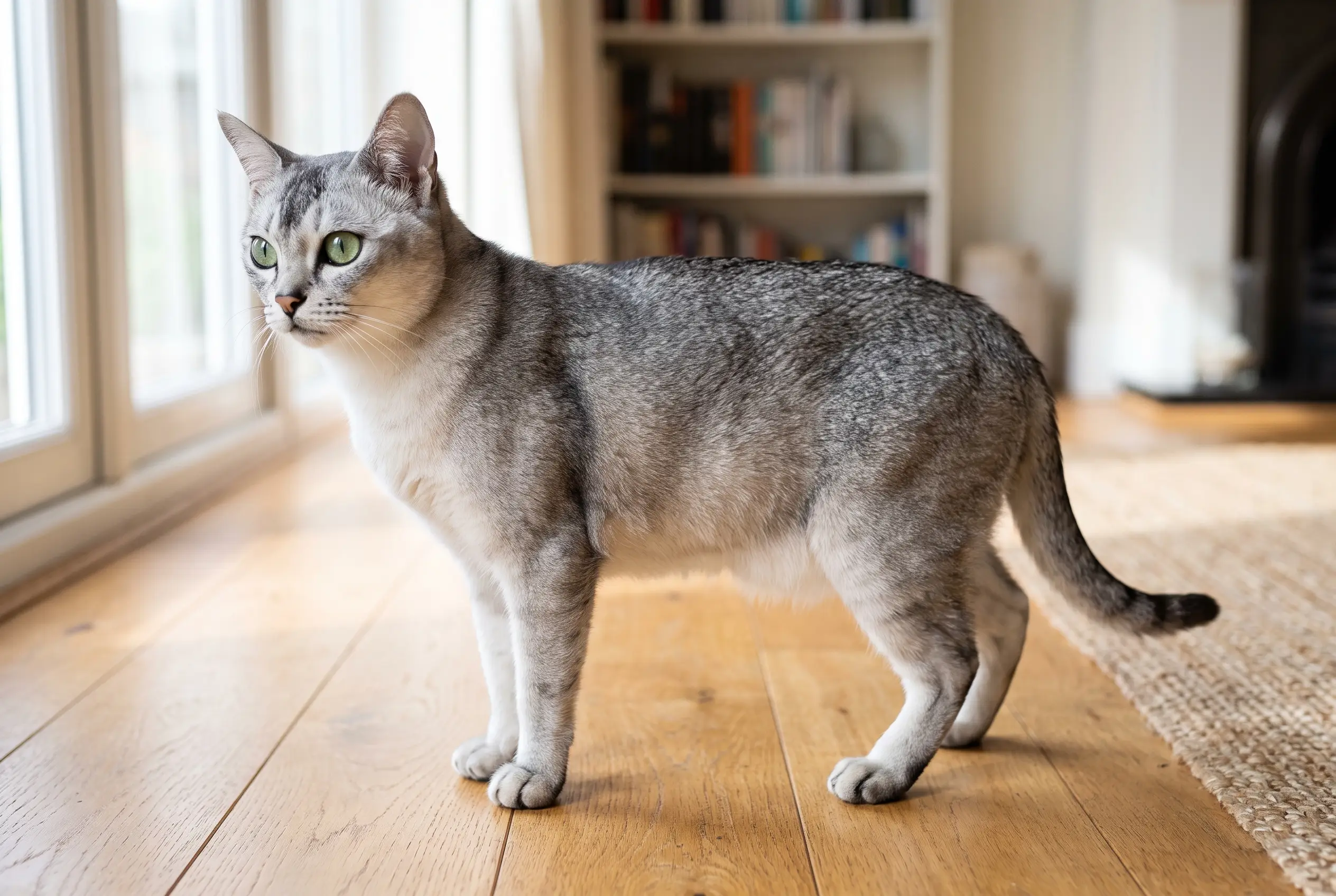
Burmilla
A door left open by accident in 1981 produced a cat with a shimmering coat and dark-rimmed green eyes that never wash off.
Vital stats
| Size | Medium · muscular, moderately foreign build |
| Weight | 3.5–7 kg · males heavier |
| Life expectancy | 15–18 years — breed-club figure, not survey data |
| Energy | Moderate to high — playful, without the Burmese's nonstop demands |
| Shedding | Low to moderate, most noticeable at the seasonal coat change |
| Coat | Short, fine, dense, close-lying; shaded or tipped silver |
| Group | Shorthair |
| Origin | United Kingdom |
Breed traits
Friendliness
Care
Mind
The Burmilla by the numbers
The Burmilla facts owners search for most — price, lifespan, weight, shedding and colours, in one place.
Less common, so expect a waitlist and some travel to a reputable breeder — which pushes the price up. Ongoing costs stay modest — it eats little and routine vet care sits at the lower end.
We don't quote a single figure: the real price swings with breeder, region, bloodline and health testing — and a rescue costs a fraction of a breeder's litter. Adopting is almost always the cheapest route.
Temperament
Burmillas keep the Burmese habit of following people from room to room and greeting whoever comes through the door, but without the constant narration — the voice is a soft, occasional chirp rather than a running commentary. They play hard as kittens and stay playful well into adulthood, working a toy or a moving hand with real focus, then settling for a long stretch on a lap or a windowsill. Independence is moderate: a Burmilla left alone for a working day copes better than a Burmese would, but it still wants the household to include it, and a cat ignored for weeks at a stretch will start following the vacuum cleaner just for the company. They do well with sensible children, other cats and dogs that aren't overbearing, and they rarely hide from visitors the way a nervous cat would.
Habits & quirks
Wears its own make-up
The rims around the eyes, nose and lips are always a shade darker than the coat — a dark eyeliner effect the standard calls 'make-up'. It's there on every correctly marked Burmilla, kitten or adult, and breeders judge it as closely as the coat itself.
Takes two years to settle its eye colour
Kittens are born with a yellowish cast in the eyes that clears gradually; the pure green the standard asks for often doesn't finish setting until the cat is around two years old.
Coat that reads as light, not coloured
Shaded Burmillas carry colour on the top quarter to half of each hair; tipped ones carry it on as little as the top eighth. Either way the pale undercoat does most of the work, so the cat looks lit from within rather than dyed one colour.
Talks, but doesn't perform
The voice is soft and occasional — a chirp or a short comment rather than the Siamese-family yowl. Owners tend to notice it more as a habit of talking back than as noise.
Care
| Grooming | A comb once a week lifts loose hair and keeps the close-lying coat glossy; there's no undercoat dense enough to mat. Bathing before a show is normal practice among breeders, to bring out the shine in the tipping. |
| Health screening | Ask for three results in writing: a DNA test for Burmese hypokalaemia (a WNK4 mutation causing episodic muscle weakness, inherited from the Burmese side), a DNA test for PKD1 (polycystic kidney disease, inherited from the Persian side), and the breeder's answer on Burmese head defect, a lethal skull malformation that a DNA test also screens for. |
| Eyes | Kitten eyes often look yellow-green rather than the standard's clear green; that's normal, and it settles by about age two. Persistent tearing or redness afterward is not normal and is worth a vet visit. |
| Company | Less demanding than a Burmese, but not a cat for an empty house all day. A Burmilla wants to be somewhere in the household's line of sight, and does best with another animal or a person home for a good part of the day. |
Life expectancy
This breed has a typical life expectancy of 15–18 years — breed-club figure, not survey data.
Similar breeds
Breeds with a similar build and background — worth a look if this one isn't quite the fit.
Common questions
Is a Burmilla just an 'Asian' cat with a different name?
In the UK, yes, in the sense that GCCF files it under one Asian breed group alongside the Asian Self, Asian Smoke and Asian Tabby — all built on the same Burmese-type standard and differing only in coat colour and pattern. Burmilla is specifically the shaded and tipped silver (or golden) variety within that group. Other registries such as TICA and CFA give it its own breed name outright rather than filing it as a variety, which is why the same cross gets described differently depending on which registry the cattery shows under.
Is the Burmilla the same cat as the Tiffanie, or the Chantilly-Tiffany?
Not the same as either, for different reasons. The Tiffanie is the semi-longhaired member of the same Asian group — same standard, same 1981 ancestry, just the long-coat gene expressed. The Chantilly-Tiffany is unrelated: an American longhair breed with its own separate history, and the name overlap with Tiffanie is coincidence, not kinship.
How much grooming does a Burmilla actually need?
Not much. A weekly comb covers it — there's little undercoat, so the coat doesn't mat the way a Persian's does, and the tipping doesn't need special products to keep its shimmer. Most of the grooming time in this breed goes to ears and teeth rather than the coat.
Does the Burmilla shed a lot?
Moderately. The Burmilla sheds a fair amount, steadily through the year with heavier seasonal patches. A weekly brush keeps most of the loose hair off your floors and clothes.
Are Burmilla cats hypoallergenic?
No cat breed is truly hypoallergenic, and the Burmilla isn't one of the easier ones. The trigger is Fel d 1, a protein in a cat's saliva and skin that ends up on the coat during grooming and then spreads on loose hair and dander — and this breed sheds enough to move plenty of it around. If someone at home is allergic to cats, this is a hard breed to live with; spend real time around one first.
Are Burmilla cats good with children?
Usually yes. The Burmilla is a sociable cat that tends to tolerate the noise and handling of family life better than most, which is why it comes up so often for homes with kids. It still needs somewhere high and quiet to retreat to, and children need teaching that a cat walking away is allowed to.