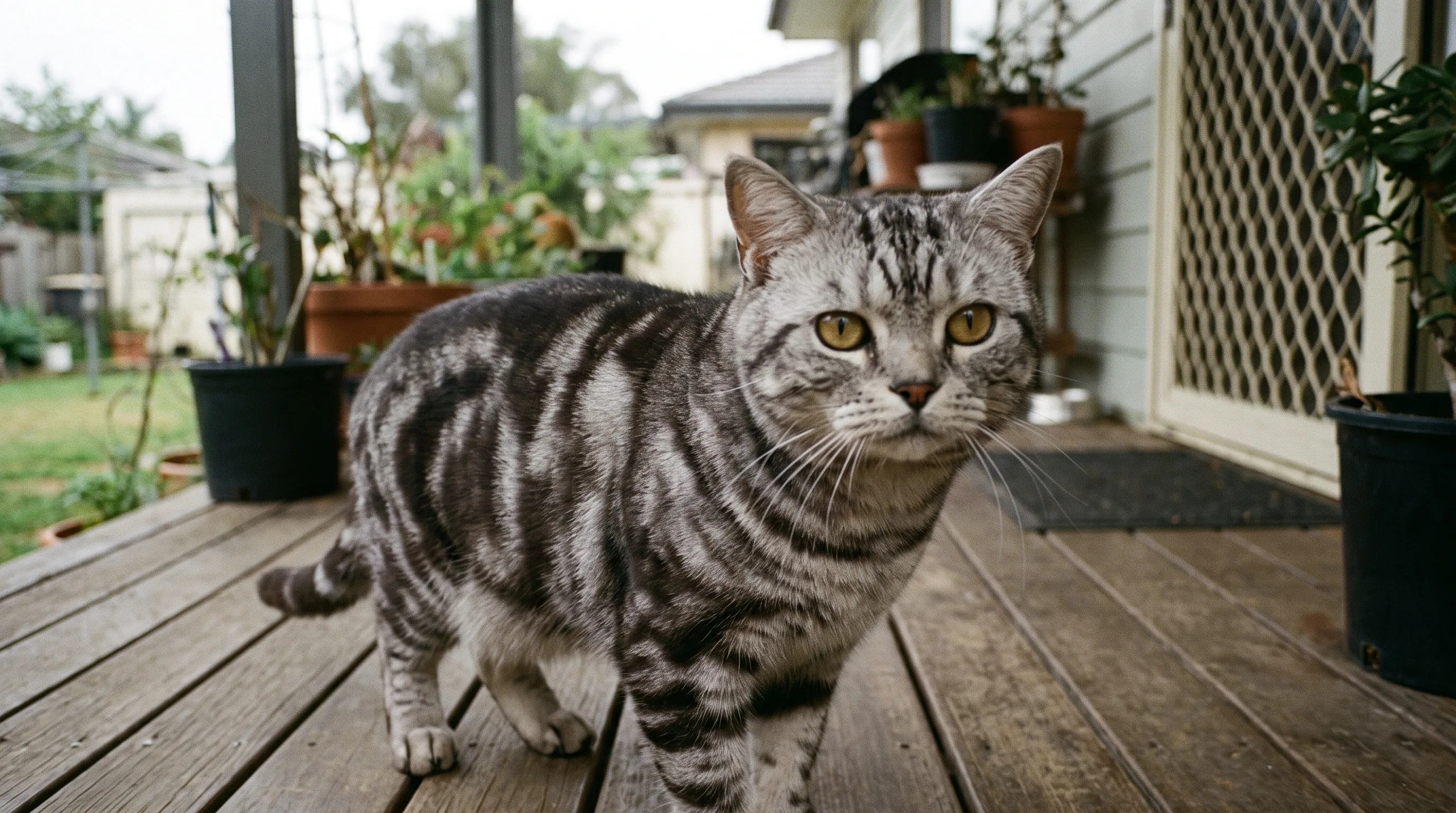
American Shorthair
The working cat that stayed a working cat, then had its portrait taken.
On these lists: Family cats · Low-maintenance cats · Cats for seniors
Vital stats
| Size | Medium to large · square, muscular, hard-bodied |
| Weight | 3.5–5 kg females · 5–7 kg males |
| Life expectancy | 15–20 years |
| Energy | Moderate — active in bursts, then settled |
| Shedding | Moderate, heavier in spring and autumn |
| Coat | Short, dense, hard-textured; 80+ colours and patterns |
| Group | Shorthair |
| Origin | United States |
Breed traits
Friendliness
Care
Mind
The American Shorthair by the numbers
The American Shorthair facts owners search for most — price, lifespan, weight, shedding and colours, in one place.
Widely bred, so you can usually find a litter from a registered breeder without a long wait. Ongoing costs stay modest — it eats little and routine vet care sits at the lower end.
We don't quote a single figure: the real price swings with breeder, region, bloodline and health testing — and a rescue costs a fraction of a breeder's litter. Adopting is almost always the cheapest route.
Temperament
American Shorthairs are the easy ones. They're friendly without being clingy, tolerant of children and dogs, and content to be in the room with you rather than on you. They keep the working cat's competence — good hunters, sure-footed, unbothered by household noise — and they handle a working day alone better than most pedigree breeds, which makes them a sensible choice for a busy household. They play well into adulthood but don't demand it, and they're quiet: a soft chirp rather than a running commentary. The one thing to watch is that placid nature plus a good appetite is a straight road to an overweight cat.
Habits & quirks
Still hunts
Centuries of paid work left instincts intact. Indoor cats need a substitute — wand toys, thrown objects, puzzle feeders — because the drive doesn't go away just because the mice have.
Sits nearby, not on you
Affection is proximity rather than contact. An American Shorthair picks the other end of the sofa and considers that time together.
Copes with change
New furniture, visitors, a new pet: this breed absorbs disruption better than most, which is why it turns up so often in family homes.
Keeps its own coat
The hard, dense coat sheds seasonally but is close to self-maintaining, and most cats keep it clean without help.
Care
| Grooming | A comb once a week, twice during the spring and autumn moults. The texture is hard rather than soft, so it doesn't mat, and bathing is almost never necessary. |
| Weight — the real risk | This is the breed's commonest health problem and it is entirely preventable. A calm, food-motivated cat in a warm house will put on weight quietly. Feed measured meals rather than free-feeding, check the ribs monthly, and keep two short play sessions in the daily routine. |
| Health screening | Hypertrophic cardiomyopathy is the main inherited concern; ask for a cardiologist's scan on the parents. Hip dysplasia has also been reported in the breed. Otherwise this is one of the sturdier pedigree cats, and 15–20 years is a realistic expectation. |
| Enrichment | Undemanding, not indifferent. A scratching post that takes a full stretch, a window with something happening, and daily play keep the hunting drive occupied and the weight down at the same time. |
Life expectancy
This breed has a typical life expectancy of 15–20 years.
Similar breeds
Breeds with a similar build and background — worth a look if this one isn't quite the fit.
Common questions
Is an American Shorthair just a moggy with papers?
It came from the same stock, and then diverged. A century of selective breeding fixed a specific build — square body, broad head, hard dense coat — and a predictable temperament, which a random shorthair doesn't guarantee. A shelter tabby can be every bit as good a cat; what a pedigree buys you is knowing roughly what you'll get.
What about the 'American Longhair'?
No major registry recognises it as a breed. The name gets used loosely for longhaired cats of American Shorthair type and for Persian × American Shorthair crosses, and cats sold under it are not registrable with CFA or TICA. If you want that look with a real standard behind it, the Maine Coon or the British Longhair are the honest answers.
Are they good with children?
Among the best. They're sturdy enough not to be hurt by ordinary handling, patient rather than reactive, and they'd rather walk away than scratch. Give the cat a high shelf it can retreat to and teach children to let it go, and the arrangement generally looks after itself.
Does the American Shorthair shed a lot?
Moderately. The American Shorthair sheds a fair amount, steadily through the year with heavier seasonal patches. A weekly brush keeps most of the loose hair off your floors and clothes.
Are American Shorthair cats hypoallergenic?
No cat breed is truly hypoallergenic, and the American Shorthair isn't one of the easier ones. The trigger is Fel d 1, a protein in a cat's saliva and skin that ends up on the coat during grooming and then spreads on loose hair and dander — and this breed sheds enough to move plenty of it around. If someone at home is allergic to cats, this is a hard breed to live with; spend real time around one first.
How much grooming does a American Shorthair need?
Very little. The American Shorthair handles its own coat and a comb once a week or so is plenty — mostly to catch loose hair before the cat swallows it. Claws, teeth and ears still want the usual checks, which is the part people skip on an easy-coated cat.