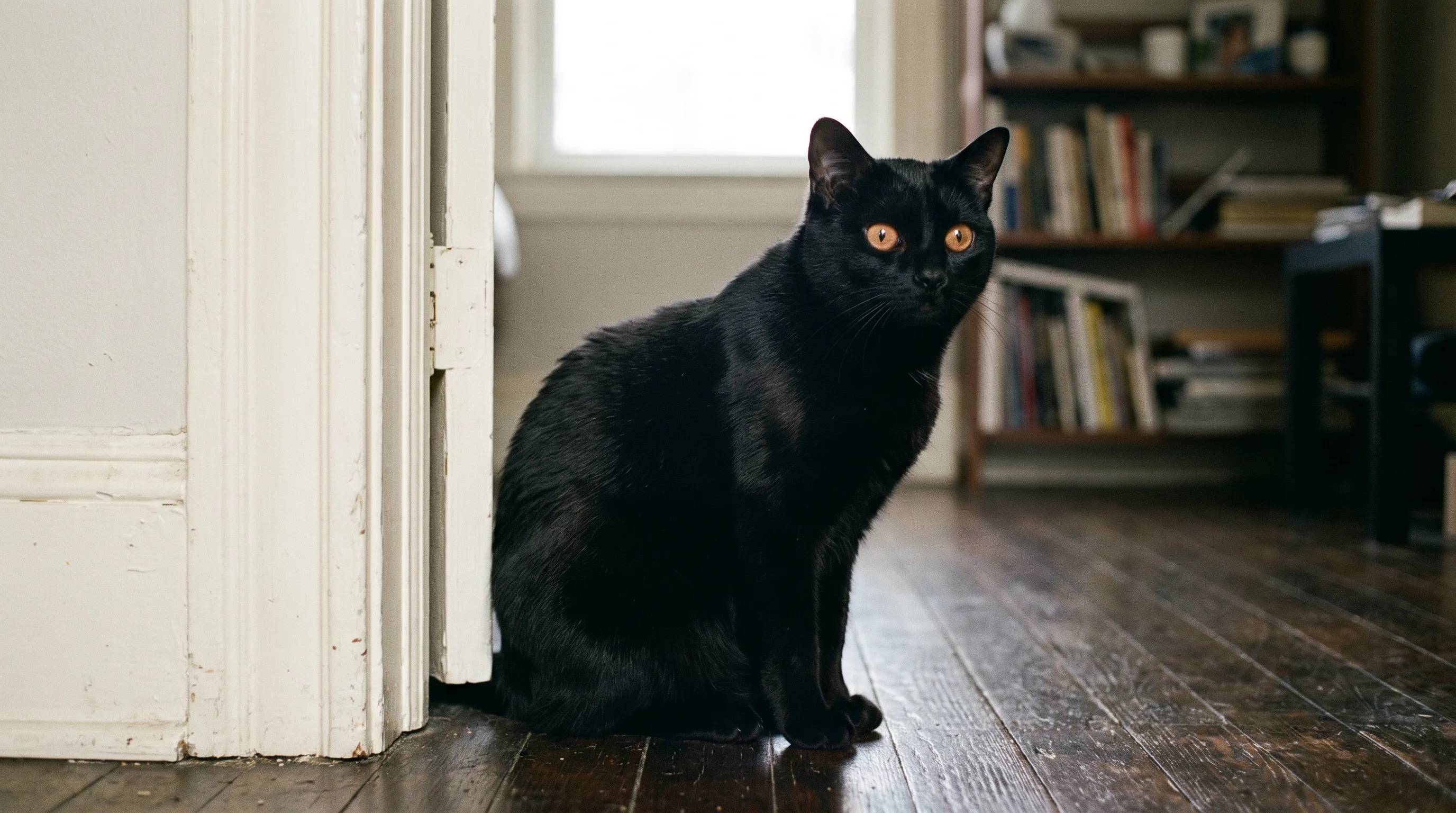
Bombay
A house panther, built on purpose — black to the roots, copper-eyed, and permanently on your lap.
On these lists: Low-maintenance cats · Cats for seniors
Vital stats
| Size | Medium · compact, muscular, heavy for its size |
| Weight | 3.5–5 kg · males heavier |
| Life expectancy | 12–16 years |
| Energy | Moderate to high — plays hard, then sleeps on you |
| Shedding | Very low, short close coat |
| Coat | Very short, fine, satin; solid black only |
| Group | Shorthair |
| Origin | United States |
Breed traits
Friendliness
Care
Mind
The Bombay by the numbers
The Bombay facts owners search for most — price, lifespan, weight, shedding and colours, in one place.
Widely bred, so you can usually find a litter from a registered breeder without a long wait. Ongoing costs stay modest — it eats little and routine vet care sits at the lower end.
We don't quote a single figure: the real price swings with breeder, region, bloodline and health testing — and a rescue costs a fraction of a breeder's litter. Adopting is almost always the cheapest route.
Temperament
Bombays want to be involved in everything and are physically insistent about it. They meet visitors at the door, climb into laps uninvited, follow their person from room to room, and sleep under the covers rather than on top of them. They keep the Burmese habit of going soft when picked up, and many will tolerate being carried around the house. They're bright — fetch, harness walks and puzzle feeders all land — and they use a soft, low voice constantly. The cost is dependence: a Bombay left alone all day is a bored, vocal, unhappy cat. They do best in a household with someone in, or with a second cat that matches their energy.
Habits & quirks
Finds the warmest spot
Under the duvet, on the laptop, against the radiator. A short single coat means a Bombay is always slightly cold and always planning around it.
Greets everyone
Doorbell means company, and a Bombay generally believes company has come to see it specifically. Very few are shy.
Goes limp when lifted
Straight from the Burmese: most Bombays relax completely when picked up, and a fair number ask to be carried.
Turns rusty in the sun
A black coat sitting in a sunny window can bleach to a brownish cast. It is cosmetic, it grows out, and it is the one thing show breeders mind.
Health
The Bombay was built on the Burmese, and several registries still allow Burmese outcrossing, so its health follows the Burmese closely. Two things to ask a breeder about directly: the Burmese head defect, a fatal malformation of the skull that has appeared in Bombay lines, and hypertrophic cardiomyopathy, the heart condition screened by ultrasound scan. Because some Bombays have a shorter, flatter face, it's also worth asking about excessive tearing and any noisy breathing in the line. Diabetes risk looks lower than in the Burmese itself, which is good news, but the same advice applies: keep the cat lean. Buy from a breeder who screens and talks openly about what runs in their cats, and you've covered the ground that matters.
Nutrition
| Grooming | The least demanding coat there is. A weekly wipe with a chamois or a rubber mitt lifts loose hair and brings the shine up. Everything else — teeth, claws, ears — matters more. |
| Health screening | The Burmese ancestry carries through. Ask about the Burmese head defect, a lethal craniofacial malformation that has appeared in Bombay lines, and about hypertrophic cardiomyopathy, screened by scan. Excessive tearing and, in flatter-faced individuals, noisy breathing are also worth asking about. |
| Weight | Dense, food-motivated and often less active than it seems under the coat. Feed measured meals rather than free-feeding, and check the ribs monthly — a black cat's outline is genuinely hard to read. |
| Company | The real commitment. This is not a cat that occupies itself. If everyone is out during the day, plan for a second cat from the start, ideally another Burmese-type. |
Cats are obligate carnivores, so a Bombay needs a complete food built on animal protein. This breed is dense, heavy for its size and more food-motivated than it lets on, and it's often less active under that sleek coat than it looks, a combination that puts weight on quietly. Feed measured meals rather than a bowl that's always full, count treats in the day's total, and check the ribs by hand once a month, because the outline of an all-black cat is genuinely hard to read by eye. Lean towards wet food or a wet-and-dry mix for the moisture, keep fresh water available, and keep the cat lean; it's the same call that lowers its cousin the Burmese's diabetes risk.
Kitten guide
A Bombay kitten is confident, sociable and physical, and it inherits the Burmese need for company, so the early choices matter. Feed a complete kitten food little and often while it grows, keeping to the breeder's food at first to avoid a stomach upset. Think hard about company from the outset: this is not a cat that entertains itself, and if the house is empty all day, a second kitten is kinder than one raised alone. Handle it plenty, because most Bombays go soft when picked up and many ask to be carried, and let it meet children, dogs and visitors early, which this outgoing breed generally enjoys. A weekly wipe with a soft cloth from kittenhood keeps that patent-leather shine and makes handling a normal part of life.
Training
Bombays are bright, confident and easy to train. Fetch, harness walks, name recognition and puzzle feeders all land, and they enjoy the involvement. Litter training is rarely a problem with a clean, quiet tray. Give a sturdy scratching post and some climbing space, and rotate a few puzzle feeders to keep a food-motivated mind busy. The one thing training can't substitute for is company: a Bombay meets visitors at the door, follows its person around the house and does badly left alone all day, and a bored one becomes a loud, unhappy one. Plan for company, a person about or a second cat of similar energy, and channel the cleverness into games, and this is one of the most sociable, straightforward cats you can share a house with.
Life expectancy
Bombays live 12–16 years. Where a Bombay lands in that range comes down to breeding and weight. Because the breed leans on the Burmese, buying from a breeder who screens for heart disease and is open about the head defect in their lines is the first thing that moves the number. The second is keeping the cat lean, which is easy to get wrong on a dense, food-motivated cat whose shape is hidden under a black coat, and it's exactly why the monthly rib-check matters. Add yearly vet visits as the cat ages, a safe indoor or supervised life, and the company this breed needs to stay content, and the top of that range is a fair target.
Similar breeds
Breeds with a similar build and background — worth a look if this one isn't quite the fit.
Common questions
Is a Bombay just a black cat?
No, though a black moggy can look identical. A Bombay is a specific pedigree: black to the roots with black skin, nose and pads, copper or gold eyes rather than green, a very short satin coat, and a compact heavy body from its Burmese ancestry. Plenty of black shelter cats are lovely and none of that makes them Bombays — but if you like the look, a shelter is a perfectly good place to find it.
Do Bombays have Burmese health problems?
Some of them. The breed was built on the Burmese and several registries still allow Burmese outcrossing, so the Burmese head defect and hypertrophic cardiomyopathy are the two to ask a breeder about directly. Diabetes risk appears to be lower than in the Burmese itself, but keeping the cat lean is still the right call.
Are they good with children and dogs?
Usually excellent. They're sturdy, confident and actively sociable, and they tend to treat a calm dog as a heat source. The standard rules apply — the cat needs a route out — but a Bombay is one of the easier breeds for a full house.
Does the Bombay shed a lot?
Not much. The Bombay is a low-shedding breed, so loose hair around the home stays minimal. It still needs regular grooming, but you won't be fighting drifts of fur.
Are Bombay cats hypoallergenic?
No cat breed is truly hypoallergenic. The trigger is Fel d 1, a protein in a cat's saliva and skin that transfers to the coat during grooming and then travels on loose hair and dander — so a cat that sheds less, like the Bombay, spreads less of it around the house, but still produces it. If someone at home reacts to cats, spend real time with this breed before deciding, and no breeder should promise you an allergy-free cat.
How much grooming does a Bombay need?
Very little. The Bombay handles its own coat and a comb once a week or so is plenty — mostly to catch loose hair before the cat swallows it. Claws, teeth and ears still want the usual checks, which is the part people skip on an easy-coated cat.