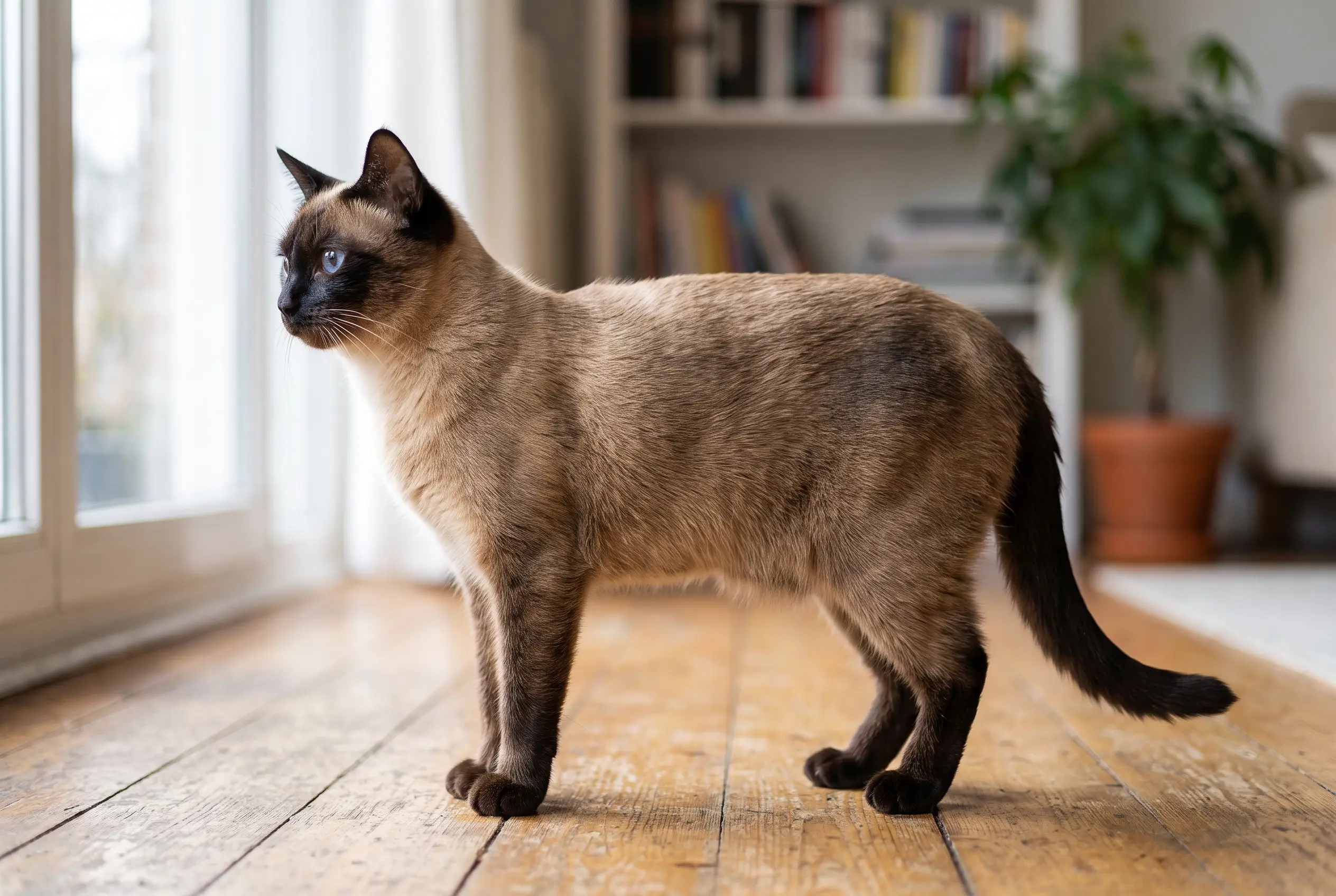
Thai
The Siamese before the wedge got sharper, kept that way on purpose.
Vital stats
| Size | Medium to slightly large · rounder head, sturdier bone than the show Siamese |
| Weight | 3.2–5.4 kg · males heavier, females smaller and finer-boned |
| Life expectancy | 12–16 years |
| Energy | High — athletic, curious, opens cabinets and doors |
| Shedding | Low · short single coat |
| Coat | Very short to short, silky, close-lying |
| Group | Shorthair |
| Origin | Thailand |
Breed traits
Friendliness
Care
Mind
The Thai by the numbers
The Thai facts owners search for most — price, lifespan, weight, shedding and colours, in one place.
Less common, so expect a waitlist and some travel to a reputable breeder — which pushes the price up. Ongoing costs stay modest — it eats little and routine vet care sits at the lower end.
We don't quote a single figure: the real price swings with breeder, region, bloodline and health testing — and a rescue costs a fraction of a breeder's litter. Adopting is almost always the cheapest route.
Temperament
The Thai has the Siamese personality without the Siamese's reputation for being highest-maintenance: sociable to the point of shadowing you room to room, quick to learn, and constantly narrating its opinion of your choices. TICA's own breed literature compares living with one to living with a small child — it will get into cupboards, drawers and anything left open, tap you with a paw for attention, and land on your shoulder to make a point face to face. The voice is the same instinct as the Siamese's but usually pitched down a register: chatty rather than a yowl, a running commentary rather than a demand. It bonds hard to its household and does badly left alone all day; a second cat or a genuinely present owner is the actual requirement, not a nice-to-have. Expect a cat that wants to help with everything you're doing, whether or not that help is wanted.
Habits & quirks
A spade, not a triangle
TICA's standard calls for a muzzle 'like a tapering garden spade,' rounded at the tip with a slight inward curve at the cheekbones — not the unbroken straight line from ear tip to chin bred into the modern show Siamese.
Lower, smaller ears
The standard sets the ear angle at 35 degrees off vertical, about ten minutes to and from the hour on a clock face — noticeably smaller and lower-set than the large, flared ears that define the contemporary Siamese head.
Talks instead of demands
Still a colourpoint with the family instinct for narration, but breed literature describes the voice as 'chatty' rather than the loud, insistent yowl the modern Siamese is known for.
Built like a small panther, not a tube
The standard explicitly disqualifies a tubular, rock-hard Siamese-style body: it wants a torso that's long and lithe with a deeper chest and flatter sides, moderately boned rather than fine or extreme.
Care
| Grooming | The short, silky coat sheds little and needs almost nothing: a weekly hand-pass or rubber brush is enough, with no undercoat to speak of. |
| Health | Shares the Siamese line's documented risks: progressive retinal atrophy, systemic amyloidosis affecting the liver and kidneys, dental disease, and a tendency toward asthma and respiratory sensitivity. The Thai's less extreme head hasn't been shown in any published study to lower these rates — ask a breeder for eye and health screening on both parents rather than assuming the moderate build is protective. |
| Company | Bonds hard and doesn't do well alone for a full working day. If the household is empty most of the time, plan on a second cat or real interaction morning and evening. |
| Play & mind | Athletic and quick to learn; it will open doors and cabinets whether or not you've given it something better to do. Puzzle feeders, wand play and vertical space keep the mischief pointed somewhere useful. |
Life expectancy
This breed has a typical life expectancy of 12–16 years.
Similar breeds
Breeds with a similar build and background — worth a look if this one isn't quite the fit.
Common questions
Is a Thai cat just a Siamese?
Genetically and historically, yes — same royal Siamese root, same colourpoint gene. Since the 1950s they've been two separate breeding programmes: the modern Siamese was bred toward an extreme wedge head, huge ears and a tubular body, while Thai breeders deliberately kept the rounder head, smaller ears and sturdier frame the breed had before that. Registries now treat them as two distinct, recognized breeds, not a purebred and a variant.
What's the difference between a registered Thai and a 'traditional' or 'applehead Siamese' advertised online?
A registered Thai has a TICA, WCF or FIFe pedigree tracing to an approved breeding programme, with a written standard a judge scores it against. 'Traditional Siamese,' 'old-style Siamese' and 'applehead Siamese' are marketing terms with no fixed meaning and no registry behind them — TICA's own literature says explicitly that the Thai is not the same thing as any of those labels. A kitten sold under one of those names, with no papers, could be a genuine Thai-type cat or could be an unregistered mixed-breed cat with a rounder head and no health screening at all. Ask which registry, ask for the pedigree, and be wary if the answer is just the name itself.
Are Thai cats rare?
Registered ones are. The breed only reached TICA championship status in 2010 and FIFe full recognition in 2017, and CFA still doesn't recognize it, so the pool of breeders working from documented pedigrees is small compared to the Siamese. Cats sold as 'traditional' or 'old-style' without papers are common; cats with an actual Thai pedigree are not.
Does the Thai shed a lot?
Not much. The Thai is a low-shedding breed, so loose hair around the home stays minimal. It still needs regular grooming, but you won't be fighting drifts of fur.
Are Thai cats hypoallergenic?
No cat breed is truly hypoallergenic. The trigger is Fel d 1, a protein in a cat's saliva and skin that transfers to the coat during grooming and then travels on loose hair and dander — so a cat that sheds less, like the Thai, spreads less of it around the house, but still produces it. If someone at home reacts to cats, spend real time with this breed before deciding, and no breeder should promise you an allergy-free cat.
Are Thai cats good with children?
Usually yes. The Thai is a sociable cat that tends to tolerate the noise and handling of family life better than most, which is why it comes up so often for homes with kids. It still needs somewhere high and quiet to retreat to, and children need teaching that a cat walking away is allowed to.
How much grooming does a Thai need?
Very little. The Thai handles its own coat and a comb once a week or so is plenty — mostly to catch loose hair before the cat swallows it. Claws, teeth and ears still want the usual checks, which is the part people skip on an easy-coated cat.