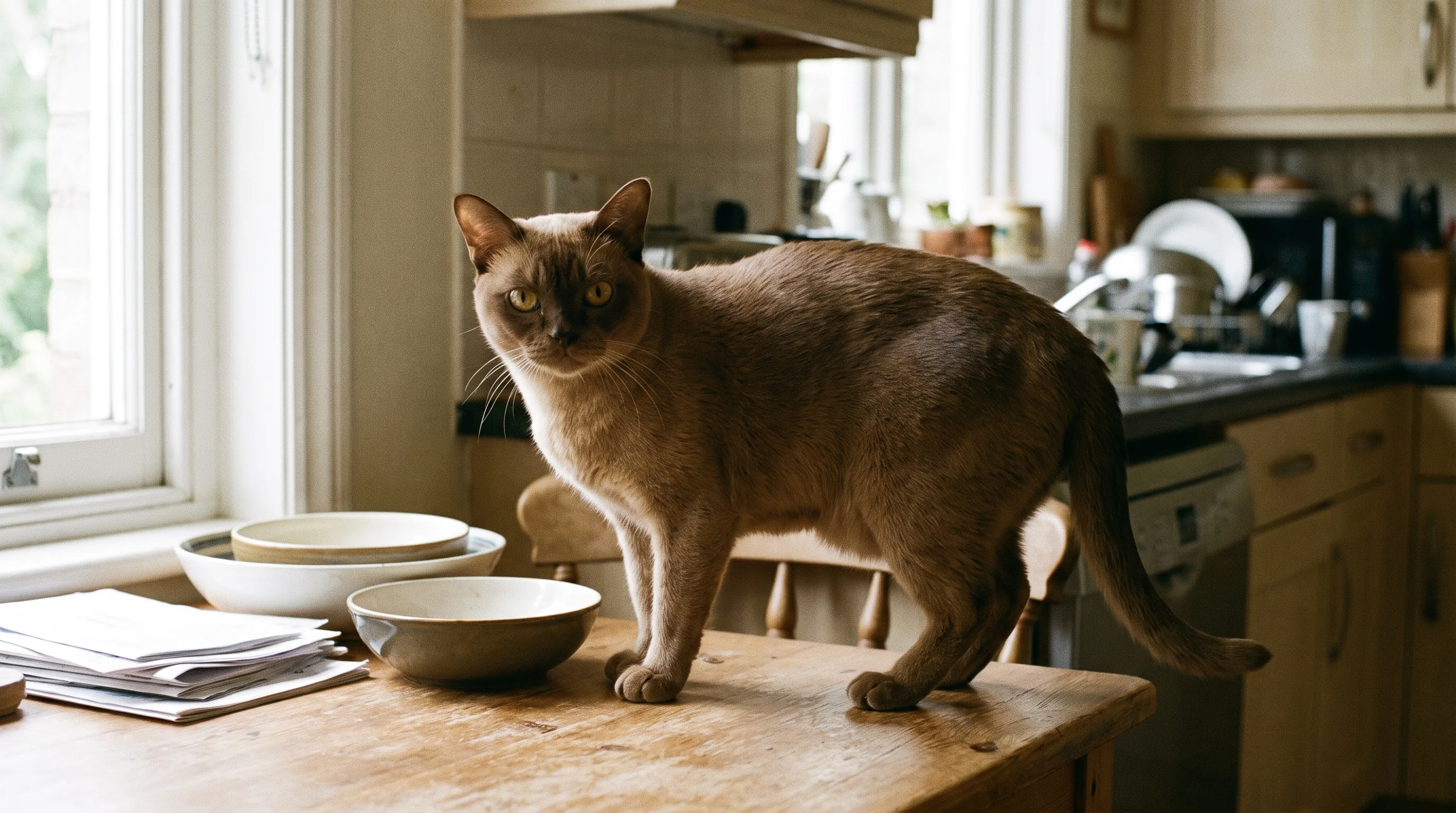
Burmese
A small cat with the density of a brick and the manners of a dog.
Vital stats
| Size | Small to medium · compact, muscular |
| Weight | 3.5–5.5 kg · males heavier |
| Life expectancy | 14–18 years |
| Energy | High — kitten-like for years |
| Shedding | Very low, coat is short and close |
| Coat | Very short, satin, glossy; solid colours |
| Group | Shorthair |
| Origin | Myanmar |
Breed traits
Friendliness
Care
Mind
The Burmese by the numbers
The Burmese facts owners search for most — price, lifespan, weight, shedding and colours, in one place.
Widely bred, so you can usually find a litter from a registered breeder without a long wait. Ongoing costs stay modest — it eats little and routine vet care sits at the lower end.
We don't quote a single figure: the real price swings with breeder, region, bloodline and health testing — and a rescue costs a fraction of a breeder's litter. Adopting is almost always the cheapest route.
Temperament
Burmese are the least cat-like cats in the room, in the way people usually mean that as a compliment. They come to the door, climb into a lap uninvited, ride on a shoulder, and want to be carried. They keep playing well past the age when most cats have retired to the radiator, and they'll learn fetch, leash walks and their own name. The voice is soft and low, nothing like the Siamese, but they use it constantly. This is a cat with almost no independence in it, and that is a real commitment: a Burmese alone all day is a miserable animal, and the breed is prone to overgrooming and separation problems when the house empties out. Take a pair, or take a different breed.
Habits & quirks
Wants carrying
Many Burmese go limp and settle when picked up, and will ask for it. Among cats this is close to unique, and it is the single trait owners mention first.
Talks in a low voice
A soft, rasping conversation rather than a yowl. Constant, but easy to live with — a Burmese in the next room sounds like someone muttering.
Opens things
Cupboard doors, handbags, the bin. They are among the more mechanically curious cats and will work a problem for as long as it takes.
Follows heat and people
The short coat carries no insulation, so a Burmese finds the warmest occupied spot in the house and colonises it, usually under a duvet.
Health
The Burmese is a long-lived cat, but it comes with two breed-specific conditions and one everyday risk to plan around. Ask a breeder about both inherited problems in writing. Burmese hypokalaemia, a mutation that causes episodes of muscle weakness, has a DNA test and turns up mostly in European lines; the Burmese head defect, a fatal malformation of the skull, sits in some American lines. The everyday risk is diabetes: in Australia and Europe the breed's rate runs around four times that of cats in general, roughly one in fifty against one in a hundred and eighty. That one is largely in your hands, because a lean cat on measured meals is far less likely to develop it, so it's worth mentioning the breed to your vet at every check-up.
Nutrition
| Grooming | The easiest coat in cats. A rubber mitt or a hand once a week lifts what little comes loose; there's no undercoat and nothing to mat. Check ears and teeth instead — that's where the time goes. |
| Health screening | Two breed-specific tests matter. Burmese hypokalaemia (a WNK4 mutation causing episodic muscle weakness) has a DNA test and mostly affects European lines; Burmese head defect, a lethal craniofacial malformation, sits in some American lines. Ask for both answers in writing. |
| Diabetes risk | In Australia and Europe the breed's diabetes rate is roughly four times the general cat population — around 1 in 50 against 1 in 180. Keep a Burmese lean, feed measured meals rather than a full bowl, and mention the breed to your vet at every check. |
| Company | Not optional. Burmese are among the least self-sufficient cats there are; if the house is empty from morning to evening, two cats is the honest minimum and a second Burmese is the usual answer. |
Cats are obligate carnivores, and for a Burmese the way you feed matters more than usual because of the breed's diabetes risk. Feed a complete food in measured meals rather than leaving a full bowl down, keep an eye on the carbohydrate load, and count treats inside the day's total, because a lean Burmese is a much safer bet against diabetes than a heavy one. The breed is dense and food-motivated and will ask convincingly for more, so trust the scales and the rib-check over the pleading. Wet food or a wet-and-dry mix helps with hydration, since cats drink little by nature, and fresh water should always be available. Mention the diabetes risk to your vet so weight and blood sugar get watched over the years.
Kitten guide
A Burmese kitten is outgoing and physical from the start and stays kitten-like for years, so expect the energy to last well past the first birthday. Feed a complete kitten food in small, frequent meals while it grows, and keep to the breeder's food at first to settle the stomach. The most important decision comes early: this is one of the least self-sufficient cats there is, and if your house is empty all day, two kittens is the honest answer rather than one lonely one. Handle it often, because Burmese love it and many will go limp and ask to be carried, and introduce it calmly to children, dogs and other cats, all of which it tends to take in its stride. Get the company right at the kitten stage and you avoid the separation problems that dog this breed later.
Training
Burmese are clever, people-focused and genuinely trainable. They'll learn their name, fetch, walk on a harness and work a puzzle feeder, and they enjoy the attention that comes with it. Litter habits look after themselves given a clean, quiet tray. The interesting challenge is a mechanically curious cat that opens cupboard doors, handbags and bins and will keep at a problem until it wins, so latch away anything you'd rather it didn't reach. What no amount of training fixes is the need for company: a Burmese left alone all day tends to overgroom, shout and protest around the litter tray, and the fix is a second cat and more time together, not correction. Give it enrichment and companionship and you have one of the easiest, most rewarding cats to live with.
Life expectancy
Burmese live 14–18 years. Fourteen to eighteen years is a long run for a cat, and the Burmese earns it partly through hybrid vigour and partly through how it's kept. The two levers that matter most are screening and weight. Buy from a breeder who tests for hypokalaemia and is open about the head defect in their lines, and keep the cat lean, because the breed's raised diabetes risk is the main thing standing between an average lifespan and a long one. Measured meals, a yearly vet check that flags the breed, and enough company to keep the cat content rather than stressed will carry most Burmese towards the top of that range.
Similar breeds
Breeds with a similar build and background — worth a look if this one isn't quite the fit.
Common questions
What's the difference between American and European Burmese?
Type, not temperament. The American (contemporary) Burmese has a rounder head, a shorter muzzle and a more compact body; the European (traditional) is longer in the face and more moderate all through. CFA registers the American, GCCF and FIFe the European, and they aren't bred together. The health risks differ too, which matters more than the looks.
Are Burmese good with dogs and children?
Unusually so. They're sturdy, they don't startle easily, and they actively seek out company — a Burmese will often adopt the family dog. Children need the normal rules about letting a cat leave, but this breed tolerates handling better than almost any other.
Is it true they can't be left alone?
It's not a marketing line. Burmese bond hard and cope badly with long solitary days: overgrooming, yelling and litter-tray protests are the usual signs. If nobody is home during the day, plan on two cats from the start rather than adding a companion later.
Does the Burmese shed a lot?
Not much. The Burmese is a low-shedding breed, so loose hair around the home stays minimal. It still needs regular grooming, but you won't be fighting drifts of fur.
Are Burmese cats hypoallergenic?
No cat breed is truly hypoallergenic. The trigger is Fel d 1, a protein in a cat's saliva and skin that transfers to the coat during grooming and then travels on loose hair and dander — so a cat that sheds less, like the Burmese, spreads less of it around the house, but still produces it. If someone at home reacts to cats, spend real time with this breed before deciding, and no breeder should promise you an allergy-free cat.
How much grooming does a Burmese need?
Very little. The Burmese handles its own coat and a comb once a week or so is plenty — mostly to catch loose hair before the cat swallows it. Claws, teeth and ears still want the usual checks, which is the part people skip on an easy-coated cat.