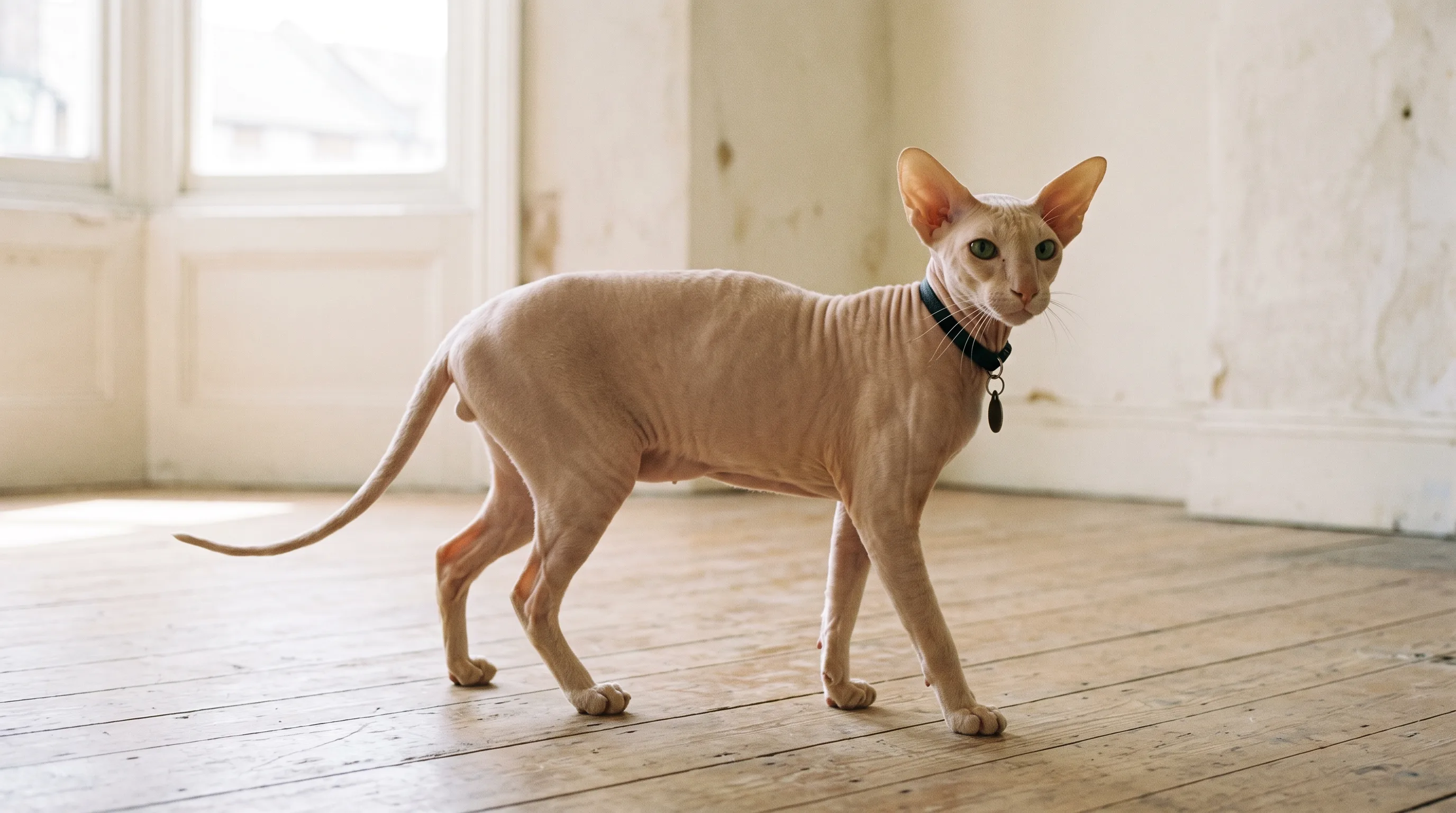
Peterbald
The bald gene on an Oriental frame: long, loud, and permanently attached to you.
Vital stats
| Size | Small to medium · long, slender, fine-boned |
| Weight | 3–5 kg · males heavier |
| Life expectancy | 12–15 years |
| Energy | Very high — busy from morning to night |
| Shedding | None to minimal |
| Coat | Five types: bald, flock, velour, brush, straight |
| Group | Hairless |
| Origin | Russia |
Breed traits
Friendliness
Care
Mind
The Peterbald by the numbers
The Peterbald facts owners search for most — price, lifespan, weight, shedding and colours, in one place.
Less common, so expect a waitlist and some travel to a reputable breeder — which pushes the price up. Ongoing costs stay modest — it eats little and routine vet care sits at the lower end.
We don't quote a single figure: the real price swings with breeder, region, bloodline and health testing — and a rescue costs a fraction of a breeder's litter. Adopting is almost always the cheapest route.
Temperament
Peterbalds took the Oriental's need to be involved and lost the coat that would have made distance bearable. They are on you: shoulders, lap, under the covers, in the bathroom. They talk constantly in a Siamese-adjacent voice, they learn fetch and harness walking without much effort, and they will open anything they can hook a claw into. With other cats and dogs they're usually delighted, and a second animal helps, both for company and for warmth. What they cannot do is be alone. A Peterbald in an empty flat all day gets loud, then destructive, then withdrawn. This is a breed for people who are home.
Habits & quirks
Talks all day
The Oriental voice survived the outcross intact. Peterbalds comment, question and complain, and they expect a reply — a quiet household this is not.
Sleeps under the covers
Bald skin plus a fine frame means very little heat retention. Most Peterbalds go under a duvet at night rather than on it, and stay there.
Uses its paws
Long, narrow feet with unusually long toes make this one of the more dextrous cats: handles, latches, cupboards and bags all get opened.
Changes over its first years
Flock, velour and brush kittens usually lose most of their covering by two years old. The straight-coated variety keeps its coat and is essential for breeding.
Care
| Skin routine | A weekly wipe or a mild bath, plus the ears and nail beds, which collect dark waxy residue. Skin oils that would normally travel through a coat sit on the surface instead and will mark pale bedding and clothes. |
| Warmth | Not optional. Keep the house comfortable, provide covered beds, jumpers if the cat accepts them, and a heat source. A Peterbald that is cold gets hunched and quiet, which is easy to mistake for illness. |
| Sun protection | Bare skin burns. Limit time in direct sun through glass, and keep a Peterbald indoors or shaded at midday. Pale, unpigmented cats are most at risk. |
| Health screening | The Donskoy line brings an association with feline ectodermal dysplasia, so ask about teeth in the breeder's lines — missing or malformed teeth are the practical consequence. Ask also for a cardiologist's echo for hypertrophic cardiomyopathy, and about the Oriental side's early gingivitis. |
Life expectancy
This breed has a typical life expectancy of 12–15 years.
Similar breeds
Breeds with a similar build and background — worth a look if this one isn't quite the fit.
Common questions
Is a Peterbald just a bald Oriental?
That's close to the truth. It's an Oriental Shorthair in body type carrying the Donskoy's dominant hair-losing gene, and Oriental and Siamese outcrossing is still permitted in the breed. What that gives you is Oriental temperament and structure with hairless-cat care requirements — a combination worth being sure about before you buy.
Why do some Peterbalds have a coat?
Because the gene expresses in degrees. Ultra-bald cats are born naked; flock and velour cats have a fine covering that mostly disappears by two; brush cats keep a wiry uneven coat; and straight-coated cats never had the gene at all. All are Peterbalds by pedigree, and the straight-coated ones are what keeps the breeding programme viable.
Are they hypoallergenic?
No, and hairless breeds are often worse rather than better. Fel d 1 comes from saliva and skin, and with no coat to hold it, it transfers straight onto furniture, bedding and you. Anyone buying for allergy reasons should spend several hours with an adult first.
Does the Peterbald shed a lot?
Not much. The Peterbald is a low-shedding breed, so loose hair around the home stays minimal. It still needs regular grooming, but you won't be fighting drifts of fur.
Are Peterbald cats good with children?
Usually yes. The Peterbald is a sociable cat that tends to tolerate the noise and handling of family life better than most, which is why it comes up so often for homes with kids. It still needs somewhere high and quiet to retreat to, and children need teaching that a cat walking away is allowed to.
How much grooming does a Peterbald need?
A weekly comb is usually enough for the Peterbald, with a second pass during a seasonal moult. That keeps loose hair off your furniture and cuts down on hairballs, since everything the cat doesn't shed onto the sofa it swallows while washing.