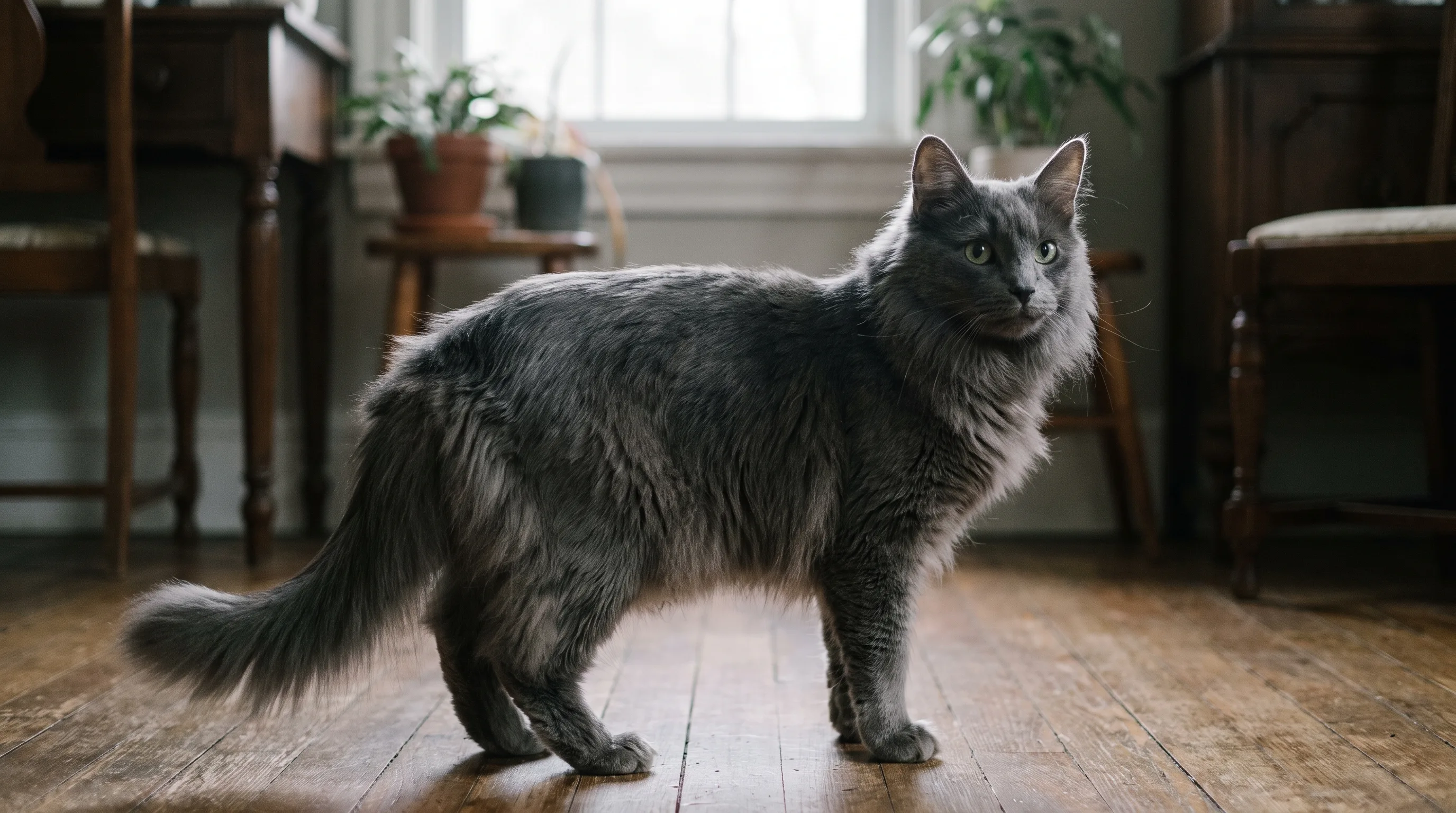
Nebelung
A Russian Blue that grew its coat out — and kept every ounce of the reserve.
Vital stats
| Size | Small to medium · long, fine-boned, elegant |
| Weight | 3–5 kg · males heavier |
| Life expectancy | 11–18 years |
| Energy | Moderate — playful in private, still with guests |
| Shedding | Moderate, worst at the seasonal change |
| Coat | Semi-long, fine double coat; blue with silver tipping |
| Group | Longhair |
| Origin | United States |
Breed traits
Friendliness
Care
Mind
The Nebelung by the numbers
The Nebelung facts owners search for most — price, lifespan, weight, shedding and colours, in one place.
Less common, so expect a waitlist and some travel to a reputable breeder — which pushes the price up. Ongoing costs stay modest — it eats little and routine vet care sits at the lower end.
We don't quote a single figure: the real price swings with breeder, region, bloodline and health testing — and a rescue costs a fraction of a breeder's litter. Adopting is almost always the cheapest route.
Temperament
Nebelungs choose a person and give that person everything: following, sleeping against, greeting, talking quietly. Everyone else gets watched from a doorway. This is one of the most genuinely reserved pedigree breeds — a Nebelung meeting a stranger usually leaves the room, and will stay gone for the length of the visit. They dislike sudden change: new furniture, a new schedule, a house full of people. Within their own routine they're playful, gently mischievous and quite trainable, and they keep that into old age. A calm adult household suits them; a loud one with a stream of visitors does not, and forcing the issue produces a cat that lives under the bed.
Habits & quirks
Vanishes for visitors
Not shy of you, wary of everyone else. A Nebelung hears the doorbell and is gone, and will reappear once the house is quiet. Guests often leave believing there is no cat.
Picks one person
The bond is narrow and intense. That person gets followed to every room, slept against, and talked to; the rest of the household gets polite tolerance.
Keeps to a schedule
Meals, play and bedtime at the same times each day matter more to this breed than to most. A Nebelung with a disrupted routine sulks visibly.
Talks softly
A small, hoarse voice used sparingly and mostly to its own person. Nothing like the Oriental breeds.
Care
| Grooming | Twice a week with a comb through the ruff and the pantaloons, daily during the seasonal moult. The coat is fine rather than woolly, so it doesn't mat easily, but the undercoat comes out in quantity twice a year. |
| Slow introductions | The single most useful thing you can do for a Nebelung. Introduce new people, animals and rooms over days rather than minutes, let the cat approach first, and never corner it to make a point. Confidence built slowly holds; confidence forced doesn't. |
| Health screening | No breed-specific inherited disease is documented, which reflects both the Russian Blue's own robustness and how few Nebelungs exist. Ask for a cardiologist's echo for hypertrophic cardiomyopathy anyway, and ask how closely related the parents are — with a small population, that number matters as much as any test. |
| Weight and play | Moderate energy plus a coat that hides the outline. Keep two short play sessions a day — Nebelungs play readily when nobody they distrust is watching — and judge condition by feeling the ribs. |
Life expectancy
This breed has a typical life expectancy of 11–18 years.
Similar breeds
Breeds with a similar build and background — worth a look if this one isn't quite the fit.
Common questions
Is a Nebelung just a long-haired Russian Blue?
That is precisely what it is, and the breed doesn't pretend otherwise. The long coat is a recessive that has always appeared occasionally in Russian Blue litters. TICA, WCF and LOOF register the Nebelung as its own breed with its own standard; CFA does not recognise it. Russian Blue outcrossing remains permitted, which is why the two look so alike.
Are they suitable for a family with young children?
Usually not, and it's worth being honest about. Nebelungs are gentle and they don't scratch, but they are genuinely unsettled by noise, grabbing and unpredictability, and a cat that spends its life hiding isn't having a good life. Calm older children who understand 'leave it alone' are fine; toddlers generally aren't.
Why is my Nebelung so different when guests are here?
Because that's the breed, not a fault in your cat. The wariness with strangers is written into the standard's description of the temperament. It doesn't reflect on you, it rarely improves much with age, and the kindest response is to give the cat a room it can be left alone in when people come.
Does the Nebelung shed a lot?
Moderately. The Nebelung sheds a fair amount, steadily through the year with heavier seasonal patches. A weekly brush keeps most of the loose hair off your floors and clothes.
Are Nebelung cats hypoallergenic?
No cat breed is truly hypoallergenic, and the Nebelung isn't one of the easier ones. The trigger is Fel d 1, a protein in a cat's saliva and skin that ends up on the coat during grooming and then spreads on loose hair and dander — and this breed sheds enough to move plenty of it around. If someone at home is allergic to cats, this is a hard breed to live with; spend real time around one first.
How much grooming does a Nebelung need?
A weekly comb is usually enough for the Nebelung, with a second pass during a seasonal moult. That keeps loose hair off your furniture and cuts down on hairballs, since everything the cat doesn't shed onto the sofa it swallows while washing.