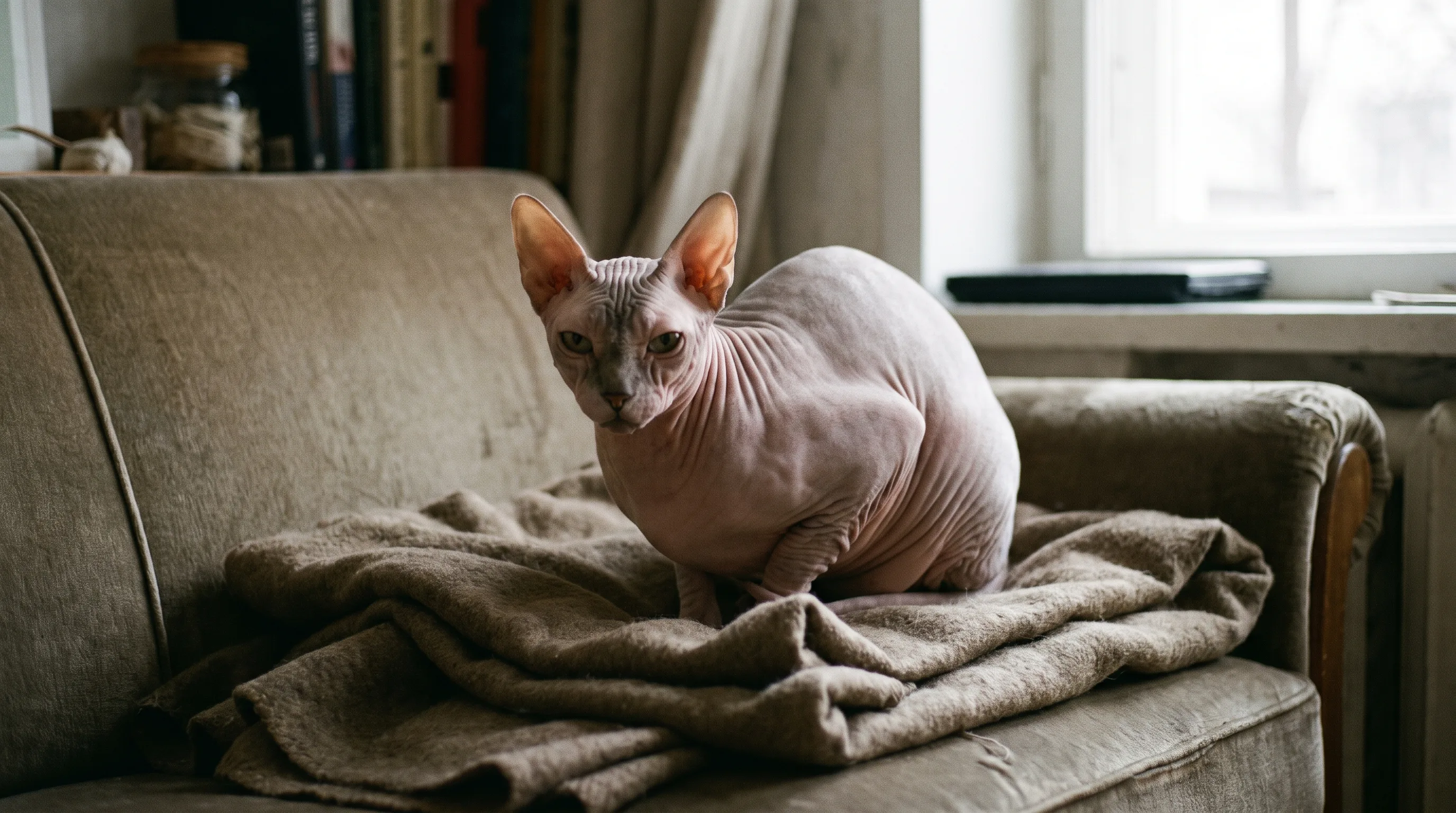
Donskoy
Bald by a dominant gene, warm to the touch, and wrinkled in all the places that matter.
Vital stats
| Size | Medium to large · muscular, solid |
| Weight | 3.5–5 kg females · 5–7 kg males |
| Life expectancy | 12–15 years |
| Energy | Moderate to high — active, then under a blanket |
| Shedding | None to minimal |
| Coat | Hairless to downy; four types (bald, flock, velour, brush) |
| Group | Hairless |
| Origin | Russia |
Breed traits
Friendliness
Care
Mind
The Donskoy by the numbers
The Donskoy facts owners search for most — price, lifespan, weight, shedding and colours, in one place.
Less common, so expect a waitlist and some travel to a reputable breeder — which pushes the price up. Ongoing costs stay modest — it eats little and routine vet care sits at the lower end.
We don't quote a single figure: the real price swings with breeder, region, bloodline and health testing — and a rescue costs a fraction of a breeder's litter. Adopting is almost always the cheapest route.
Temperament
Donskoys are sociable, unbothered and physically affectionate. They greet visitors, follow their people around, and get under a duvet or a jumper at the first opportunity, which is as much about temperature as about affection. They're intelligent and quick to learn — many will fetch, most work out door handles, and they take to a routine well. They tend to get on with dogs and other cats, and a second animal is genuinely useful here, because the Donskoy seeks out warm bodies. The voice is soft and used moderately. What they aren't is low-maintenance: this is a cat with a weekly care routine, not a cat you leave to itself.
Habits & quirks
Gets under things
Duvets, jumpers, the space behind a radiator. A hairless cat loses heat fast, and a Donskoy will find the warmest enclosed spot in the house within a day of arriving.
Sweats, in a way
The skin produces oil and a waxy residue that would normally be spread through a coat. Without one it sits on the surface, leaves marks on pale fabric, and needs washing off.
Tans and burns
Skin colour deepens with sun exposure and fades again in winter. It also burns — a Donskoy in a sunny window needs shade or shorter sessions, not a windowsill all afternoon.
Changes coat with the seasons
Flock, velour and brush cats can gain or lose their thin covering over the year and with hormones. The same cat can look almost furry in winter and bare by July.
Care
| Skin, not fur | The grooming routine is a weekly wipe or bath with a mild, cat-safe shampoo, plus attention to the skin folds, the nail beds and the ears, which produce a lot of dark wax. Skip it and you get greasy skin, blocked pores and marked bedding. |
| Warmth and sun | Keep the house comfortable and provide covered beds and blankets. In summer the reverse applies: sunburn is a real risk on unpigmented skin, so limit sunny windows and never let a Donskoy outside uncovered at midday. |
| Teeth — ask first | The dominant hairless gene is associated with feline ectodermal dysplasia, and dental problems are the practical result: missing, malformed or early-lost teeth are common in the breed. Ask the breeder directly about the teeth in their lines and about how the parents were paired, and budget for veterinary dental care. |
| Feeding | No coat means a higher metabolic cost to stay warm, so a Donskoy usually eats more for its size than a coated cat. Feed to condition, and check the body by hand — with no fur, weight change is easy to see and easy to act on. |
Life expectancy
This breed has a typical life expectancy of 12–15 years.
Similar breeds
Breeds with a similar build and background — worth a look if this one isn't quite the fit.
Common questions
Is the Donskoy the same as a Sphynx?
No. They look similar and they are not related: the Sphynx's hairlessness is recessive and Canadian in origin, the Donskoy's is dominant and Russian. The Donskoy also has more elastic, more wrinkled skin, is often larger and heavier, and frequently has no whiskers. Crossing the two is not done in serious breeding.
What are the four coat types?
Rubber bald cats are born bald and stay that way. Flock cats have a fine chamois-like covering that usually disappears within a couple of years. Velour cats are born with a thin coat and a bald patch on the head, and lose most of it. Brush cats keep a wiry, patchy coat and often never go fully bald — they're not show cats in most registries but they're valuable in breeding programmes.
Are they hypoallergenic?
No. No coat is not the same as no allergen: Fel d 1 comes from saliva and skin, and a hairless cat spreads it directly onto every surface it sits on. Some allergy sufferers do better, some do worse. Spend hours with an adult before you commit.
Does the Donskoy shed a lot?
Not much. The Donskoy is a low-shedding breed, so loose hair around the home stays minimal. It still needs regular grooming, but you won't be fighting drifts of fur.
Are Donskoy cats good with children?
Usually yes. The Donskoy is a sociable cat that tends to tolerate the noise and handling of family life better than most, which is why it comes up so often for homes with kids. It still needs somewhere high and quiet to retreat to, and children need teaching that a cat walking away is allowed to.
How much grooming does a Donskoy need?
A weekly comb is usually enough for the Donskoy, with a second pass during a seasonal moult. That keeps loose hair off your furniture and cuts down on hairballs, since everything the cat doesn't shed onto the sofa it swallows while washing.