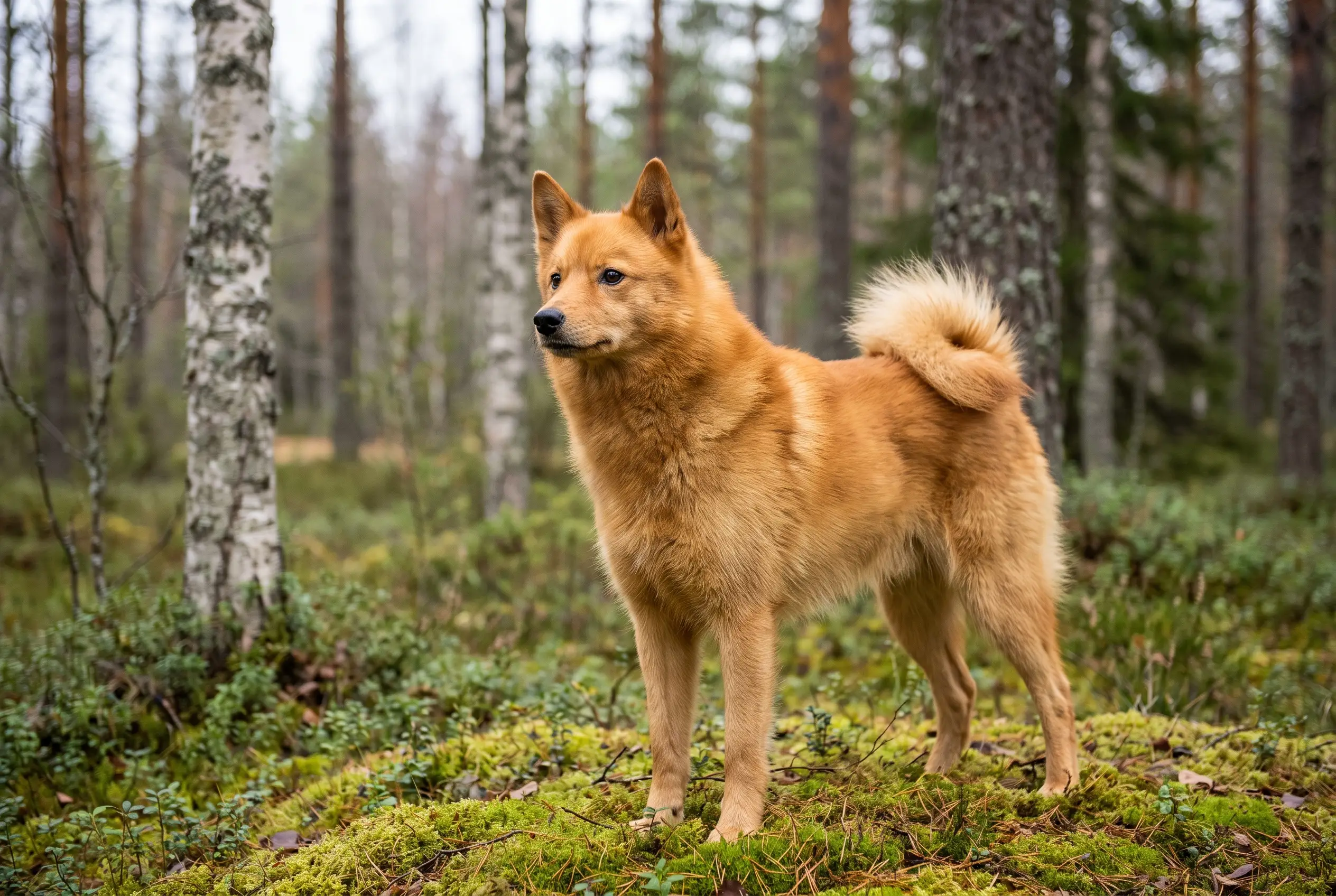
Finnish Spitz
A fox-red flame of the northern forests — and it hunts with its voice.
Vital stats
| Size | Small–medium · 39–50 cm |
| Weight | 9–14 kg |
| Life expectancy | 13–15 years |
| Energy | High — 60–90 min/day |
| Shedding | Heavy, seasonal blows |
| Coat | Dense double coat · glowing red-gold |
| Group | Non-Sporting · FCI №49 / AKC |
| Origin | Finland |
| FCI group | 5 — Spitz and primitive types · FCI 49 |
Breed traits
Friendliness
Care
Mind
The Finnish Spitz by the numbers
The Finnish Spitz facts owners search for most — price, lifespan, weight, shedding and colours, in one place.
Widely bred, so you can usually find a litter from a registered breeder without a long wait. Ongoing costs stay modest — it eats little and routine vet care sits at the lower end. Its coat also needs a professional groom every few weeks — a real line in the budget.
We don't quote a single figure: the real price swings with breeder, region, bloodline and health testing — and a rescue costs a fraction of a breeder's litter. Adopting is almost always the cheapest route.
Temperament
Bred to range the forest alone, find a grouse and bark at the treetop until the hunter caught up, the Finnish Spitz is self-reliant, sharp-eyed and conversational. It bonds warmly with its family but sees commands as proposals worth considering. Live with one and you learn to negotiate — and to appreciate a dog with opinions.
Habits & quirks
The commentary
Doorbells, birds, distant dogs, your late arrival home: all receive vocal coverage.
Cat mode
It washes its paws, dislikes rain, and sits somewhere elevated where it can judge the room.
Treetop watch
On walks its gaze goes up — squirrels and birds hold far more interest than anything at ground level.
Selective obedience
It hears you perfectly; it is simply weighing whether your idea beats its current one.
Health
The Finnish Spitz is a hardy dog with no widely documented breed-specific problems — a working spitz shaped by centuries of hunting in a hard northern climate, and generally sound for it. There is no breed-wide health survey to lean on, so the sensible approach is the ordinary one: buy from a breeder who health-tests their line, keep the dog lean and fit, and stay on top of the everyday things — teeth, ears and nails. The thick double coat is built for cold, not heat, so watch him in warm weather and give him shade and water.
Nutrition
| Training | Start young, keep sessions short and rewarding, and manage barking from puppyhood — repetition bores this breed instantly. |
| Exercise | An hour or more of walks and free play daily; a securely fenced garden, as the hunting instinct is alive and well. |
| Grooming | Weekly brushing normally, daily during the dramatic seasonal moults; the coat is self-cleaning and should never be clipped. |
| Containment | Recall around birds and squirrels is a lifelong project — long lines and secure fences are wise defaults. |
This is an active hunting breed that does 60 to 90 minutes a day, so feed to the dog in front of you: a working Finnish Spitz and a couch companion do not need the same bowl. Weigh the meals, count training treats in the daily total, and keep him lean enough to feel the ribs under that dense coat — extra weight is the last thing an agile forest dog needs.
Puppy guide
A Finnish Spitz puppy is bright, busy and vocal from the start, and the first year sets the adult. Socialize him widely and gently, start short reward-based training early, and manage the barking from day one — it is the breed's job, not a fault, but a puppy who learns the house has rules grows into an easier adult. Keep hard exercise light while the joints are still forming, and let a young dog's body grow before you ask a lot of it.
Training
Clever but self-employed, the Finnish Spitz learns fast and questions faster — it hears every command and simply weighs whether your idea beats its own. Keep sessions short, varied and rich with food, because dull repetition bores this breed instantly. Two things need lifelong work: recall, since a nose and eye tuned to birds and squirrels will override you the moment prey appears, and barking, which you manage rather than cure. Long lines and secure fences are wise defaults.
Life expectancy
Finnish Spitzes live 13–15 years. The Finnish Spitz is a hardy, long-lived spitz, and you keep one at the top of its range the ordinary way: a lean weight, real daily exercise, tested parents and attention to teeth and ears as the years add up. In warm weather remember the coat was built for a Finnish winter — shade, water and sense in the heat keep an old dog comfortable.
Similar breeds
Breeds with a similar build and background — worth a look if this one isn't quite the fit.
Breeds that look like this
Common questions
Do Finnish Spitz bark a lot?
Yes — barking is what the breed was developed to do, and no training will make it quiet. Committed management helps, but close-quarters flats are a poor match.
Are Finnish Spitz good family dogs?
For families who respect an independent dog, yes: they're playful, gentle with children and deeply loyal. Just don't expect retriever-style obedience.
Are Finnish Spitz easy to train?
They're clever but self-employed — quick to learn, quick to question. Short, varied, food-rich sessions succeed where drill-style repetition fails.
Does the Finnish Spitz shed a lot?
Yes — the Finnish Spitz is a heavy shedder, dropping hair year-round or in big seasonal moults. Brush it several times a week and expect regular vacuuming; it isn't the coat for you if loose fur is a dealbreaker.
Is the Finnish Spitz hypoallergenic?
Not really. No dog is truly hypoallergenic, and the Finnish Spitz's shedding coat releases plenty of the dander that sets off allergies. If someone at home is allergic, this isn't the easiest breed to live with — spend time around one first.