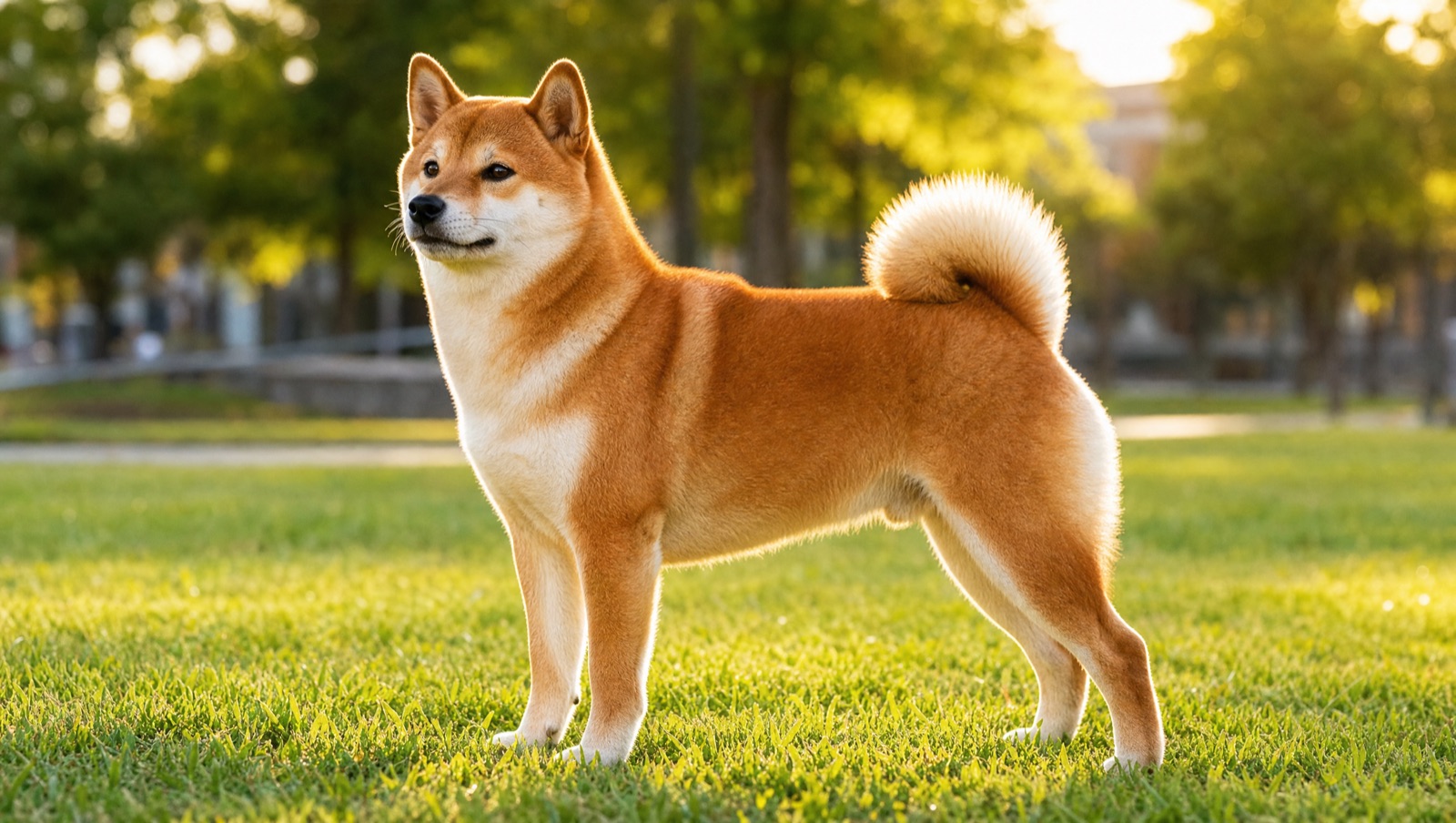
Shiba Inu
Japan's little mountain fox — immaculate, self-possessed and entirely its own dog.
Vital stats
| Size | Small · 35–41 cm |
| Weight | 8–10 kg |
| Life expectancy | 13–16 years |
| Energy | Moderate-high — 60 min/day |
| Shedding | Heavy, seasonal blows |
| Coat | Plush double coat · red, sesame, black-and-tan, cream urajiro |
| Group | Non-sporting · FCI №257 / AKC |
| Origin | Mountain regions of Honshu, Japan |
| FCI group | 5 — Spitz and primitive types · FCI 257 |
Breed traits
Friendliness
Care
Mind
The Shiba Inu by the numbers
The Shiba Inu facts owners search for most — price, lifespan, weight, shedding and colours, in one place.
Less common, so expect a waitlist and some travel to a reputable breeder — which pushes the price up. Ongoing costs stay modest — it eats little and routine vet care sits at the lower end.
We don't quote a single figure: the real price swings with breeder, region, bloodline and health testing — and a rescue costs a fraction of a breeder's litter. Adopting is almost always the cheapest route.
Temperament
Bred to flush birds and small game through steep mountain scrub, the Shiba worked at a distance from its hunter — and it still keeps that distance on principle. Expect a bold, alert, fastidiously clean companion that loves its family on its own schedule, meets commands with a cost-benefit analysis, and never, ever begs.
Habits & quirks
The Shiba scream
Baths, nail trims and mild inconveniences may be protested at operatic volume.
Cat mode
Washes its paws and face daily and side-steps puddles with visible distaste.
The side-eye
Requests are acknowledged with a look that says the matter is under review.
Perimeter audit
Tests gates, fences and open doors methodically — freedom is a standing project.
Health
The Shiba Inu is a tough, healthy little dog, but two things are worth raising with a breeder: the knees and the eyes. Patellar luxation — a kneecap that slips out of place — turns up in small breeds, and eye conditions including progressive retinal atrophy (PRA) run in some lines, so buy from someone who tests and can show you the results. Beyond that, a Shiba mostly keeps himself in order — clean, careful and hardy — and the biggest favour you can do his health is to keep him lean and let him move.
Nutrition
| Containment | A secure garden and a lead outside it — off-lead recall is unreliable in this breed for life. |
| Grooming | Weekly brushing normally, daily during the two spectacular annual coat blows. |
| Socialisation | Start early and keep it positive; Shibas default to aloofness with strangers and rivalry with dogs. |
| Training | Reward-based and interesting or nothing — repetition and force simply harden the resolve. |
Shibas are easy keepers with tidy appetites, which is a blessing and a small trap — it is easy to let a compact dog quietly put on weight. Feed measured meals rather than leaving food down, count treats into the day's total, and keep the outline you want: ribs you can feel, a clear waist, no roll along the back. A lean Shiba moves like the alert, agile dog he is meant to be, and it keeps needless load off those knees.
Puppy guide
A Shiba puppy is bold, bright and independent from day one, and early socialisation is the thing that pays off for the rest of his life. Introduce him to lots of people, dogs and places while he is young and keep every experience positive — a Shiba's default with strangers is polite aloofness, and you want that rather than wariness. Fit a secure garden before he arrives and use a lead everywhere outside it, because the strong prey drive and independent streak mean recall is never fully reliable. Get him used to gentle brushing and handling early, so grooming and the vet are never a fight.
Training
A Shiba trains nothing like an eager-to-please retriever, and if you go in expecting one you will both be frustrated. This is a clever, independent dog that asks what's in it for me — so training has to be reward-based, short and genuinely interesting, or he simply switches off. Repetition bores him and force backfires completely, hardening the stubborn streak the breed is known for. Keep sessions varied, pay well, and treat recall as a lifelong work in progress rather than a solved problem. Work with the Shiba's self-respect instead of against it and he will surprise you.
Known health issues
No breed is problem-free. These are the conditions most worth knowing about for this breed — with what a good breeder screens for and what an owner watches. General guidance, not a substitute for your vet.
Slipping kneecap
A kneecap that slips out of place, common in small breeds and usually manageable. Good breeders screen: Vet-checked knees on the parents. Watch for: An occasional skip or hop on a back leg.
Inherited eye disease
Progressive retinal atrophy and cataracts run in several breeds and can dim or take sight over time. Good breeders screen: Eye-tested parents and, where available, a DNA test for PRA. Watch for: Night-time bumping, cloudy eyes, or hesitation in dim light.
Life expectancy
Shiba Inus live 13–16 years. Shibas are a long-lived, hardy little breed, and keeping one at the top of that range is refreshingly simple: keep him lean, keep him active, and start from parents tested for the knees and the eyes. Stay on top of the coat, the teeth and the yearly check-up, and a well-bred Shiba stays a spry, self-possessed companion well into old age.
Popular Shiba mixes
Poo-Shi
The Shiba's spirit in a lower-shedding coat; a smart, lively cross with an independent streak and a mind of its own.
Shiba Husky
Two independent, high-prey-drive breeds combined: striking, energetic and not one for an off-lead park.
Shiba Corgi
A bold, foxy little dog on short legs; bright and full of character, and a heavier shedder than the size suggests.
Pom-Shi
A tiny, spirited spitz cross with a big personality and a lot of coat; lively, alert and often vocal.
Similar breeds
Breeds with a similar build and background — worth a look if this one isn't quite the fit.
Compare this breed
Breeds that look like this
Common questions
Are Shiba Inus good for first-time owners?
They can be, for owners who research the independence honestly and commit to training and secure containment. Anyone wanting an eager-to-please velcro dog should look elsewhere.
What is the Shiba scream?
A piercing, dramatic vocalisation some Shibas produce when handled against their wishes — at the groomer, the vet or bath time. It sounds alarming but is protest, not pain.
Do Shiba Inus like to cuddle?
Mostly on their own terms — many enjoy sitting near you rather than on you, offering affection in brief, chosen moments. The bond is deep; the delivery is catlike.
Does the Shiba Inu shed a lot?
Yes — the Shiba Inu is a heavy shedder, dropping hair year-round or in big seasonal moults. Brush it several times a week and expect regular vacuuming; it isn't the coat for you if loose fur is a dealbreaker.
Is the Shiba Inu hypoallergenic?
Not really. No dog is truly hypoallergenic, and the Shiba Inu's shedding coat releases plenty of the dander that sets off allergies. If someone at home is allergic, this isn't the easiest breed to live with — spend time around one first.
Is the Shiba Inu good with children?
They can be. The Shiba Inu is reasonably sociable and can be good with children in the right home, especially when socialised early. Supervise around young kids and teach dog and child to respect each other.
Is the Shiba Inu easy to train?
They can be a challenge. The Shiba Inu is intelligent but independent, and would rather make its own decisions than take orders. Reward-based training and patience work best; expect recall in particular to take time.