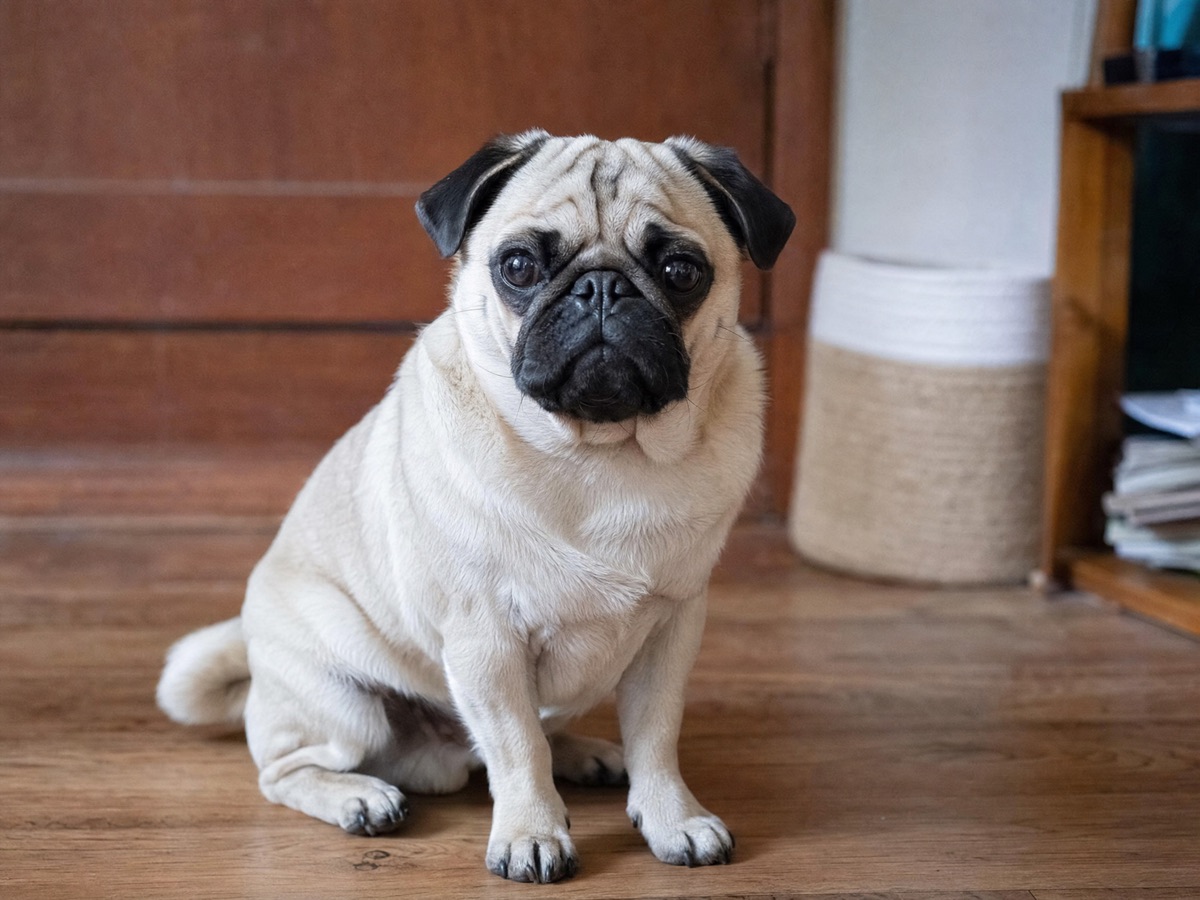
Pug
Multum in parvo — 'a lot of dog in a small space', wrinkles and all.
On these lists: Dogs for apartments · Small dogs
Vital stats
| Size | Small · 25–33 cm |
| Weight | 6–8 kg |
| Life expectancy | 13–15 years |
| Energy | Low–moderate — 20–40 min/day |
| Shedding | High, year-round |
| Coat | Short double coat · fawn, black |
| Group | Toy · FCI №253 / AKC |
| Origin | China |
| FCI group | 9 — Companion and Toy Dogs · FCI 253 |
Breed traits
Friendliness
Care
Mind
The Pug by the numbers
The Pug facts owners search for most — price, lifespan, weight, shedding and colours, in one place.
Widely bred, so you can usually find a litter from a registered breeder without a long wait. Ongoing costs stay modest — it eats little and routine vet care sits at the lower end.
We don't quote a single figure: the real price swings with breeder, region, bloodline and health testing — and a rescue costs a fraction of a breeder's litter. Adopting is almost always the cheapest route.
Temperament
Bred for two thousand years to do exactly one job — delight its people — the Pug is affectionate, even-tempered and reliably funny, a born clown with a dignified streak. Expect a shadow at your heel, a warm weight in your lap, and a personality far larger than the dog it comes in.
Habits & quirks
The head tilt
Ask a Pug anything and the whole face tips sideways in earnest consideration.
Snoring in surround sound
The flat face comes with a soundtrack — naps are rarely silent.
The Pug run
Sudden ecstatic laps of the living room, tail unfurling at top speed.
Professional supervisor
Whatever you're doing — cooking, typing, bathing — a Pug will be watching from close range.
Health
The Pug is a charming, comical companion, and its health is shaped above all by that flat face. Brachycephalic airways (BOAS) make Pugs prone to overheating and breathing trouble, and the same flat face puts the eyes forward and exposed, so eye injuries and problems are common. The breed also carries patellar luxation in the knees and gains weight very easily. Keep your Pug cool, lean and out of the midday heat, watch the eyes, and choose breeders selecting for open nostrils and a longer muzzle.
Nutrition
| Health | Avoid heat and over-exertion — brachycephalic airways make Pugs prone to overheating; keep a close eye on eyes too. |
| Feeding | Portion strictly. Pugs gain weight easily, and extra kilos make breathing markedly worse. |
| Grooming | Clean facial folds regularly to prevent infection, and expect surprising amounts of shed hair. |
| Exercise | Two or three short, gentle walks daily in cool hours — never in midday heat. |
Portion a Pug strictly, because this is a breed that gains weight at the sight of a biscuit and pays for it in its breathing. Every extra kilo makes a flat-faced dog work harder for air, so weigh the meals, count treats into the daily total, and keep ribs you can feel under the coat. The pleading face is world-class; the scoop is still yours to hold.
Puppy guide
A Pug puppy is affectionate, funny and glued to you from the start, which makes the early bond effortless. The care is mostly about protecting the body the breed comes in: keep him cool and never let him overheat, start cleaning the facial folds early so it becomes routine, and keep exercise gentle in the cool hours while the joints are forming. Choose a breeder selecting for open nostrils and a longer muzzle — it's the single biggest thing you can do for a healthy Pug.
Training
Pugs are affectionate, food-motivated little clowns, and that shameless wish to please makes them easy to train on rewards — as long as the treats are counted, since the breed gains weight so readily. Keep sessions short, gentle and fun, and never work a flat-faced dog hard in the heat. They can be a touch stubborn, but a Pug will do almost anything for your attention and a crumb of something tasty.
Known health issues
No breed is problem-free. These are the conditions most worth knowing about for this breed — with what a good breeder screens for and what an owner watches. General guidance, not a substitute for your vet.
Breathing trouble (BOAS)
Flat-faced breeds are prone to obstructed airways — the full story is here. Good breeders screen: Airway-graded parents (RFG 0–3); open nostrils. Watch for: Snoring, easy tiring, and overheating in warm weather.
Slipping kneecap
A kneecap that slips out of place, common in small breeds and usually manageable. Good breeders screen: Vet-checked knees on the parents. Watch for: An occasional skip or hop on a back leg.
Tends to gain weight
A hearty appetite and easy weight gain that quietly shortens life and worsens joints if unchecked. Good breeders screen: Not a genetic test — a management point to plan for. Watch for: Keep ribs easy to feel; measure meals and go easy on treats.
Worried about a symptom right now? Flat faces, hard breathing: the truth about brachycephalic dogs
Life expectancy
Pugs live 13–15 years. A Pug's years turn on weight and breathing more than anything else. Keep your dog lean — extra weight is the fastest way to make a flat-faced dog's breathing worse — keep him out of heat and over-exertion, clean the folds and watch the eyes, and choose a breeder selecting for open nostrils and a longer muzzle. A lean, well-bred, cool-kept Pug has the best shot at a long, comfortable life.
Popular Pug mixes
Puggle
A popular, playful mix with a longer muzzle than a Pug, which often means easier breathing. Fond of food and a good nose-led walk.
Pugapoo
A small, lively, lower-shedding cross with a fun, affectionate nature. Coat and muzzle length vary from puppy to puppy.
Jug
A lively, bold little mix with more drive and energy than a Pug alone. The terrier side often brings a longer muzzle and a busier dog.
Pug-Zu
A small, devoted companion bred purely for laps and company. Two flat-faced parents mean real care in the heat and around the eyes.
Bugg
A compact, affectionate, comical companion with a big personality. Both parents are flat-faced, so keep him cool and watch his breathing.
Similar breeds
Breeds with a similar build and background — worth a look if this one isn't quite the fit.
Breeds that look like this
Common questions
Are Pugs good apartment dogs?
Yes — small, affectionate and low-energy, they suit flats well. Keep them cool and lean, and never over-exert them in heat.
Do Pugs have breathing problems?
Many do — the flat face causes brachycephalic airway issues. Choose breeders selecting for open nostrils and longer muzzles, and avoid heat and obesity.
Can Pugs be left alone?
For short periods, yes, but they're companion dogs to the core and dislike solitude. Long, regular absences tend to produce an unhappy, vocal Pug.
Does the Pug shed a lot?
Moderately. The Pug sheds a fair amount, steadily through the year with heavier seasonal patches. A weekly brush keeps most of the loose hair off your floors and clothes.
Is the Pug hypoallergenic?
Not really. No dog is truly hypoallergenic, and the Pug's shedding coat releases plenty of the dander that sets off allergies. If someone at home is allergic, this isn't the easiest breed to live with — spend time around one first.
Is the Pug good with children?
Generally yes. The Pug is a friendly, people-loving breed that usually does well with children when raised and socialised well. As with any dog, teach children to be gentle and supervise around toddlers.
Is the Pug easy to train?
Reasonably. The Pug is trainable with consistency and rewards, though it isn't the quickest study. Keep sessions short and positive, and be patient with the basics like recall.
Stories featuring this breed
All stories →
What selective breeding actually does to an animal
Choosing which animals have babies is the most powerful force in a pet’s biology. A Soviet fox experiment shows how fast it works — and how much it costs.
Flat faces, hard breathing: the truth about brachycephalic dogs
A pug's snore is a warning, not a feature. What BOAS is, which breeds it affects, and what a responsible owner and breeder actually do about it.