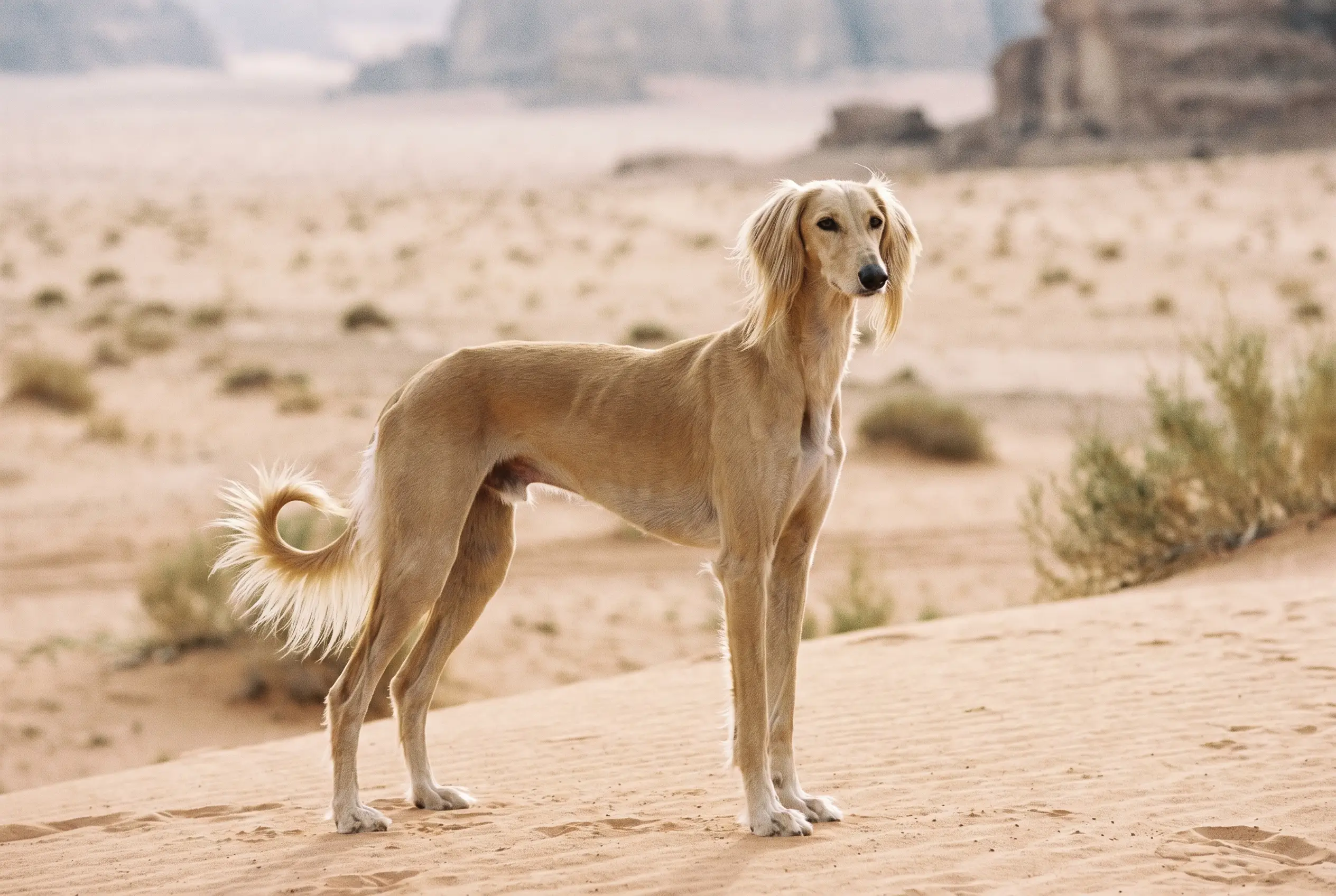
Saluki
The desert wind made flesh — grace, speed and millennia of pedigree.
Vital stats
| Size | Large · 58–71 cm |
| Weight | 16–29 kg |
| Life expectancy | 12–14 years |
| Energy | Moderate-high — daily runs with sprint bursts |
| Shedding | Low |
| Coat | Smooth or feathered · cream, fawn and many colours |
| Group | Hound · FCI №269 / AKC |
| Origin | Fertile Crescent, Middle East |
| FCI group | 10 — Sighthounds · FCI 269 |
Breed traits
Friendliness
Care
Mind
The Saluki by the numbers
The Saluki facts owners search for most — price, lifespan, weight, shedding and colours, in one place.
Less common, so expect a waitlist and some travel to a reputable breeder — which pushes the price up. Plan for steady ongoing costs — mid-range food, routine vet care and insurance.
We don't quote a single figure: the real price swings with breeder, region, bloodline and health testing — and a rescue costs a fraction of a breeder's litter. Adopting is almost always the cheapest route.
Temperament
Bred by Bedouin to course gazelle across open desert, the Saluki pairs explosive speed with rare endurance — and a temperament of quiet, dignified reserve. It bonds deeply but undemonstratively, greets strangers with polite indifference, and spends most of the day in elegant repose, saving everything for the run.
Habits & quirks
The 60 km/h sofa dog
Two speeds only: flat-out gallop and horizontal on the softest surface available.
Selective hearing
Hears you perfectly; is simply weighing your request against a distant pigeon.
Cat manners
Grooms itself fastidiously and offers affection on its own precise terms.
Sun worshipper
Thin-coated and low on body fat, it will find the one warm patch in any room.
Health
The Saluki is a naturally healthy, long-lived sighthound, and most of its care comes down to respecting a very lean build. With a thin coat and almost no body fat, it feels the cold and the hard floor: give it a padded bed and a coat for cold, wet walks. As a deep-chested breed it is sensible to feed calm, unhurried meals and know the signs of bloat, just in case. And its safety is a matter of containment — sight of something running overrides every command, so a fence and a lead are not optional.
Nutrition
| Exercise | A daily walk plus regular chances to sprint in a large, securely fenced space. |
| Containment | Off-lead freedom is only safe behind fences — sight of prey overrides every command. |
| Comfort | Little body fat means padded beds are essential and cold, wet weather calls for a coat. |
| Grooming | The smooth coat needs almost nothing; feathered ears and tails want a weekly comb. |
A Saluki is built to be light — a little of the last ribs showing over that lean frame is right, not a sign to feed more. Give good, measured meals to keep the muscle without the padding, and as a deep-chested dog, feed calmly and let it rest afterwards rather than running on a full stomach. The weight that looks almost too slim to an owner used to broader breeds is the healthy one for a Saluki, and it is what keeps that famous speed and endurance where they belong.
Puppy guide
A Saluki puppy is a gentle, reserved creature that grows leggy and fast, so the early days are about warmth, calm and steady socialisation rather than hard exercise. Keep movement easy and low-impact while the long limbs are growing, and introduce strangers and new places kindly, since the breed stays naturally aloof. Give it a warm, padded bed of its own from the start, and begin recall early — but plan your fences and leads around the fact that it will never fully beat a running rabbit.
Training
Salukis are clever and deeply independent, and they were never bred to take orders — they hunted gazelle for themselves, out of earshot. Train gently and with rewards, keep sessions short, and read their reserve as dignity rather than defiance. Recall is the honest limit: the moment prey moves, a Saluki is gone at speed and simply cannot hear you, so off-lead freedom belongs behind secure fences and the lead stays on anywhere near roads.
Life expectancy
Salukis live 12–14 years. Salukis are among the longer-lived, sounder sighthounds, and keeping one at the top of that range is mostly comfort and common sense: a lean weight, a warm coat and padded bed for that thin-skinned frame, calm meals with awareness of bloat, and safe, fenced space to run flat out. Give it those and a Saluki spends a long life doing its two favourite things in turn — galloping like the wind, then folding onto the softest spot in the house.
Similar breeds
Breeds with a similar build and background — worth a look if this one isn't quite the fit.
Breeds that look like this
Common questions
How fast is a Saluki?
Among the fastest of all breeds, capable of well over 60 km/h — and unusually able to hold speed over distance. That is exactly why one must never be loose near roads.
Are Salukis affectionate?
Yes, but in a quiet, catlike way — they attach deeply to their family while staying reserved with strangers. Expect devotion, not exuberance.
Can a Saluki live with cats?
Sometimes, if raised together indoors, but the chase instinct never disappears — especially outdoors. Small fleeing animals will always be read as prey.
Does the Saluki shed a lot?
Not much. The Saluki is a low-shedding breed, so loose hair around the home stays minimal. It still needs regular grooming, but you won't be fighting drifts of fur.
Is the Saluki hypoallergenic?
No dog is truly hypoallergenic, but the Saluki comes closer than most: its low-shedding coat releases less of the dander that triggers allergies. Many allergy sufferers manage well with this breed, but spend time around one before committing.
Is the Saluki good with children?
They can be. The Saluki is reasonably sociable and can be good with children in the right home, especially when socialised early. Supervise around young kids and teach dog and child to respect each other.
Is the Saluki easy to train?
They can be a challenge. The Saluki is intelligent but independent, and would rather make its own decisions than take orders. Reward-based training and patience work best; expect recall in particular to take time.
Stories featuring this breed
All stories →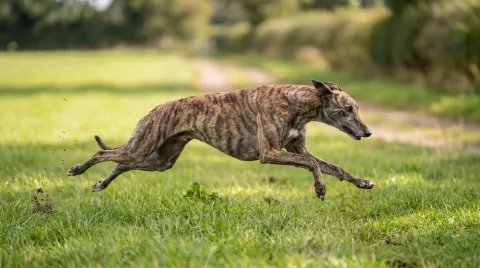
The fastest dog breeds, and how fast they really go
The Greyhound hits about 72 km/h — second only to the cheetah, and the winner over any real distance. Honest top speeds for the sighthounds and the surprises, plus how fast a Dobermann actually is.
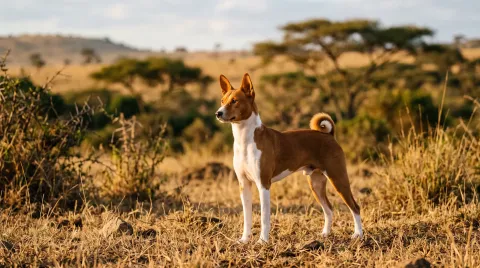
Which dog breeds are actually ancient?
Genetics keeps naming the same handful of breeds as “ancient” — but that word means isolated from the Victorian breed factory, not unchanged since antiquity.

National dog breeds: how a dog becomes a country's symbol
A nation doesn't just adopt a breed. Somewhere there's paperwork, a patron country, and an official standard. Here's the machinery, and the cases that actually hold up.