
National dog breeds: how a dog becomes a country's symbol
A national dog is usually two things at once: a genuine piece of a country's history, and an administrative fact filed in Belgium. Before a breed can stand for a nation on the world stage, a nation has to sign for it. Get that order right and most of the confusion about "country of origin" clears up.
The paperwork behind "country of origin"
Every internationally recognised breed belongs, on paper, to exactly one country. The Fédération Cynologique Internationale runs this as a patronage system: one member country is the patron of each breed, it authors the official standard together with the FCI's commissions, and that document becomes the reference every affiliated show judge and breeder works from. As of 2026 the FCI lists 364 recognised breeds and 101 members and contract partners, one body per country, coordinated from its headquarters in Thuin, Belgium.
This is the part most "national dog" lists skip. The country stamped on a breed is not a neutral finding about where the dog came from. It is the result of a country claiming patronage and getting it ratified. Sometimes that matches the deep history and sometimes it plainly doesn't, which is the whole subject of breeds named after the wrong country. The registry is a filing cabinet, not a DNA test. If you want the genetics instead, that's which breeds are genuinely old, and it rarely lines up neatly with the flags.
National symbolism sits one layer above the patronage paperwork. A patron country owns the standard; a national dog is a separate, usually louder claim made by a government, a culture, or both. The strongest cases have some formal act behind them. The weakest are lovely stories nobody can source. Both circulate as if they carry the same weight, so it's worth sorting them. You can see the machinery in one place at the registries overview, and the raw list of who's recognised at breeds.
Japan and the Akita: a legally protected monument
The clearest case of a state formally elevating a dog is Japan. The Akita was designated a Natural Monument, Tennen Kinenbutsu, in July 1931, the first dog breed granted that legal status in Japan. Natural Monument protection is the same category Japan uses for notable landscapes and species, so the Akita isn't a national dog by sentiment alone. It's written into a conservation framework.
That matters because it explains why the Akita reads as a treasure rather than just a popular pet. The designation came at a moment when several Japanese native breeds were being deliberately recovered and standardised, and the Akita was the flagship of that effort. When people ask why the Akita is a "national treasure", the honest answer is administrative before it is romantic: a specific 1931 protection, applied to a specific breed, for reasons of cultural conservation. The affection came bundled with, and partly because of, the legal status.
Mexico and the Xoloitzcuintli
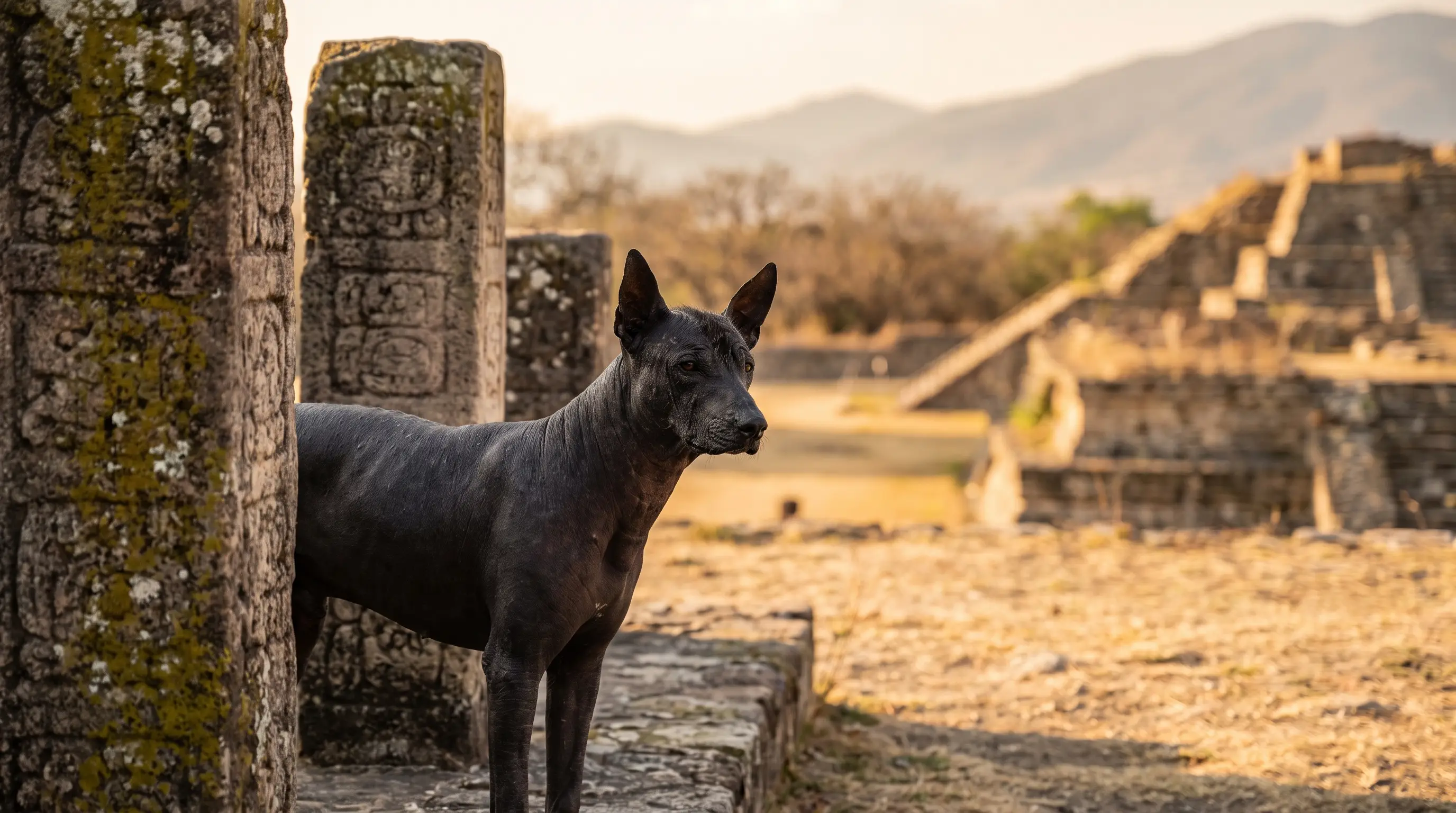
Mexico's national dog is the Xoloitzcuintli, and this is one national claim with real archaeological depth behind it. The hairless Xolo is documented across Mesoamerica for more than three thousand years, turning up as ceramic effigies in Aztec, Maya and Colima contexts, where it carried funerary and spiritual meaning rather than being merely a companion. Calling it the first dog of the Americas is a reasonable shorthand for how far back its presence runs.
The Xolo is a good test of how these claims should be reported. Its national-dog status in Mexico is well established and widely cited. A separate, more specific claim, that it was named an emblem of Mexico City in a particular year, is one I'd leave alone, because the sources disagree on the date and a wrong year is worse than none. The deep antiquity is solid; the municipal ceremony is fuzzy. It's also a reminder that the oldest-looking breeds are often closer to regional village dogs than to the tidy pedigrees the show ring implies, and that the modern breed is a reconstruction of an ancient type.
Turkmenistan and the Alabai
Turkmenistan gives the most explicit modern example of a state manufacturing a national dog on purpose. The country created a national holiday for the Alabai, its variety of the Central Asian Shepherd, folding the livestock-guarding dog into official national identity alongside its famous Akhal-Teke horse. This is government symbolism you can point at: a designated day, state ceremonies, the dog treated as an emblem of the nation.
It's a useful contrast with Japan. The Akita's status grew out of a conservation law and a breed-recovery movement. The Alabai's national status is a top-down declaration, more statecraft than cynology. Neither is fake, but they are different kinds of claim, and lumping them together as "national dogs" flattens a real difference in how the honour was created. The Central Asian Shepherd is also, at root, a working landrace type shared across a whole region, which is exactly why more than one country can reach for it.
The Saluki, and the stories that don't hold up
Now the tradition. The Saluki has been honoured for a very long time across Egypt, Persia and Arabia, and was closely tied to nobility and the hunt. The often-repeated idea that a Saluki was "given, never sold" and known as el hor, the noble one, is beautiful and probably reflects something real about how the dogs were regarded. It's also not something you can pin to a document, so it belongs in the file marked tradition, told honestly as tradition. The same goes for the desert sighthound world more broadly, including the Azawakh of the Sahel.
Royal declarations are the shakiest category of all. You'll read that the Great Pyrenees was proclaimed the Royal Dog of France by Louis XIV's court in a specific year. It's a lovely line with no primary source behind it, so treat it as breed lore, not history. Same with the claim that the Poodle is France's national dog: France has no official national dog, and the Poodle association is cultural, not decreed. Once you know the patronage system exists, you can feel the difference between a filed fact and a good yarn, and most royal-dog stories are yarns. That instinct for what's documented versus invented is the through-line from the Victorian invention of the breed onwards.
What a national dog actually tells you
A national dog tells you less about biology than about which story a country decided to tell about itself. The Akita is a conservation designation, the Xolo an ancient regional type reclaimed as heritage, the Alabai a deliberate act of modern statecraft, the Saluki a tradition of nobility that predates any registry. Only some of these are backed by a document, and the honest reader keeps the documented ones separate from the charming ones.
The other thing to hold onto is that the flag is downstream of the paperwork. A breed becomes a country's dog partly because a country claimed patronage, authored a standard, and filed it, and partly because a government or a culture chose to make it a symbol. Neither of those is the same as the dog originating there in any pure sense, which is why the map of breed origins is so much messier than the lists suggest. If you want to keep pulling that thread, the neighbouring pieces on breed-name geography and the world's free-breeding dogs are where the seams show most clearly. Browse the rest at dog breeds.
Common questions
What is the national dog of Mexico?
The Xoloitzcuintli, or Xolo, the hairless dog documented across Mesoamerica for more than three thousand years. It's widely recognised as Mexico's national dog and is often called the first dog of the Americas.
What country is the Akita from?
Japan. It's a Japanese native breed and became the first dog to be designated a Natural Monument there, in July 1931.
Which country has a dog as a national animal?
Several treat a dog as a national symbol. The clearest formal cases are Japan (the Akita, protected as a Natural Monument since 1931), Mexico (the Xolo), and Turkmenistan, which created a national holiday for its Alabai.
Is the Xoloitzcuintli the national dog of Mexico?
Yes. Its status as Mexico's national dog is well established, and it has archaeological presence in the region going back over three thousand years. A separate claim that it was named an emblem of Mexico City is less clear, as sources disagree on the date.
What is Japan's national dog?
The Akita is the most prominent, thanks to its 1931 Natural Monument status, though Japan recognises several native breeds. "National dog" here reflects that legal protection and cultural standing rather than a single official decree.
Why is the Akita a national treasure of Japan?
Because it was formally designated a Natural Monument in July 1931, the first dog breed given that legal conservation status in Japan, as part of a wider effort to recover and protect native Japanese breeds.
See also
More in Dogs
Which dog breeds are actually ancient?
Genetics keeps naming the same handful of breeds as “ancient” — but that word means isolated from the Victorian breed factory, not unchanged since antiquity.

The village dog: the real default, and why your breed is the odd one out
Most dogs on Earth are free-ranging scavengers, not purebred pets. The breed is the recent human invention sitting on top of a much older, stabler kind of dog.

The dog breeds that vanished — and the one a 2023 genome brought back into focus
A woolly dog from the Pacific Northwest, a spit-turning kitchen worker, and the working landrace behind every retriever: what killed them, and what modern DNA can and cannot recover.

Seven groups, ten groups, three answers: how dog breeds get sorted
Kennel clubs sort several hundred breeds into a handful of groups. Here is how those lines were drawn, why the AKC's seven don't match the FCI's ten, and why the Standard Schnauzer belongs to three groups at once.
Dog breeds named after the wrong country
The Great Dane is German. The Australian Shepherd is American. Breed names are charming, and they are terrible geography.
Who invented dog breeds, and when
Most 'ancient' breeds are younger than the bicycle. The breed as we know it was invented by Victorians with a stud book, in about 1873.