The fastest dog breeds, and how fast they really go
The fastest dog breed is the Greyhound, which reaches around 72 km/h (45 mph) — fast enough to make it the second-quickest land animal on Earth, and the fastest of all over any distance longer than the cheetah can sustain. Behind it sit the other sighthounds, built on the same blueprint, and a handful of breeds most people never think of as fast. Here are the honest numbers, where they come from, and how quick a Dobermann really is, since that is the one everyone asks about.
The Greyhound is built to be the fastest
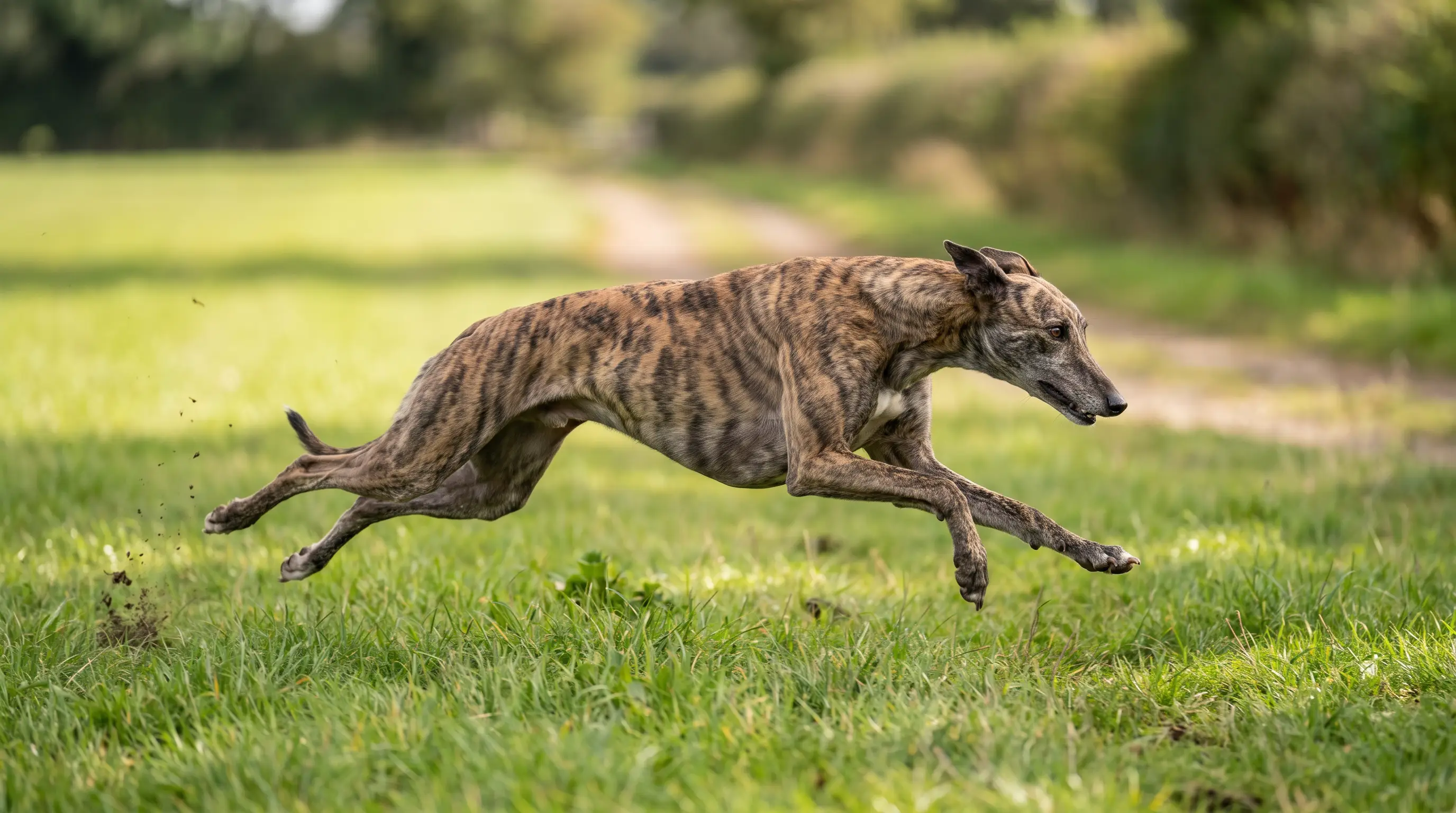
The Greyhound tops out at around 72 km/h (45 mph), and almost everything about its body exists to produce that number. It runs in a double-suspension gallop, a stride in which the dog is completely airborne twice per cycle — once with the legs bunched under it and once with them fully extended — so a huge share of the run is spent flying rather than touching down. A flexible spine coils and releases like a spring on every stride, an outsized heart and lungs feed the effort, and the muscle is loaded with fast-twitch fibre tuned for explosive sprinting.
The famous comparison is with the cheetah, and it is worth getting right. A cheetah is faster flat out, reaching perhaps 100 km/h, but only for a few hundred metres before it overheats and has to stop. A Greyhound holds its 70-odd km/h far longer, so over any real distance the dog wins. It is the fastest animal on the planet that can actually keep going — a sprinter with a distance runner's stamina bolted on.
The sighthounds behind it
Every breed near the top of the list is a sighthound — a dog built to chase down prey by sight across open ground, all long legs, deep chest and lean muscle. The Saluki runs at around 68 km/h (42 mph) and is the great endurance specialist; over long desert distances many people argue it is the truest "fastest dog" of all, because it can hold a punishing pace for miles rather than seconds. The Whippet, once called the poor man's racehorse, reaches about 56 km/h (35 mph) in a much smaller package.
The pattern runs right down the size range. The Afghan Hound hits roughly 64 km/h (40 mph) under all that coat, and even the Italian Greyhound, a toy dog you can pick up in one hand, is startlingly quick for its size. If a breed's job was to run something down with its eyes rather than its nose, it is fast, and it looks it standing still.
The fast dogs nobody expects
Speed is not a sighthound monopoly. The Dalmatian was bred to trot for miles beside a carriage and can still put on a genuine turn of pace, around 60 km/h (37 mph), with the stamina to back it up. Pointers such as the Vizsla and the Weimaraner cover ground at roughly 56 km/h (35 mph), because a gundog that quarters a field all day needs an engine too.
The bigger surprise is the small stuff. A Jack Russell can hit around 40 km/h (25 mph) on legs the length of your hand. And the herding breeds — the Border Collie and the German Shepherd at roughly 48 km/h (30 mph) — combine real speed with the agility and stop-turn control that pure sprinters lack, which is why they, not the Greyhounds, win the agility ring.
How fast is a Dobermann?
A Dobermann runs at around 51 km/h (32 mph), which makes it one of the quickest of the large guardian breeds — quick enough that its speed was part of the original job. It was developed in 19th-century Germany as a protection and police dog, and a guardian that can close distance fast is a more serious guardian. The lean, athletic build that reads as elegance is also, straightforwardly, a running body.
It is not a sighthound and never will be — a Greyhound would leave it standing in a straight sprint. But 51 km/h is faster than most people can process when it is coming towards them, and combined with the Dobermann's power and turning ability it is more useful in the real world than raw top speed. Fast enough to do the job it was built for is the honest way to put it.
How fast is fast, honestly
Treat every figure here as "about" and "up to", because that is what the evidence supports. The reliable numbers come from the track — racing Greyhounds are timed over measured distances, which is where the 70-plus km/h comes from — while most breed speeds are reasonable estimates rather than lab measurements. Individual dogs vary enormously with fitness, build, age and how much they actually want to run, and a couch-soft example of any breed will not touch these numbers.
One honest caution to end on. These are sprint figures for fit adult dogs on suitable ground, not an invitation to gallop your dog flat out on tarmac or to push a puppy whose growth plates are still open. If you want to see a fast dog do its thing, give it a safe surface and let it choose the pace. For the other end of the scale, we looked at how long the longest-lived dogs actually last, and at the smallest breeds in the world.
Common questions
What is the fastest dog breed?
The Greyhound is the fastest dog breed, reaching around 72 km/h (45 mph). That makes it the second-fastest land animal after the cheetah — and because it can hold its speed far longer than a cheetah can, the Greyhound is the fastest animal on Earth over any real distance. Its whole body, from the double-suspension gallop to the oversized heart, is built for the sprint.
How fast can a Greyhound run?
A racing Greyhound reaches about 72 km/h (45 mph), timed over measured track distances. It achieves this through a double-suspension gallop, in which the dog is fully airborne twice in every stride, powered by a flexible spring-like spine, a large heart and lungs, and muscle packed with fast-twitch fibre. Few other dogs come close to that top speed.
What is the fastest dog over long distances?
The Saluki is the great distance specialist, running at around 68 km/h (42 mph) but, crucially, holding a fast pace for miles rather than seconds. Over long distances many people consider it the truest 'fastest dog', because a Greyhound's blistering sprint is built for a short chase while the Saluki was bred to run down prey across open desert.
How fast is a Dobermann?
A Dobermann runs at around 51 km/h (32 mph), making it one of the fastest of the large guardian breeds. Speed was part of its original purpose: it was bred in 19th-century Germany as a protection and police dog, where the ability to close distance quickly mattered. It is not a sighthound and can't match a Greyhound, but it is very fast for a powerful working dog.
Are Greyhounds faster than cheetahs?
Not at top speed — a cheetah is quicker flat out, hitting perhaps 100 km/h. But a cheetah can only sustain that for a few hundred metres before it overheats and stops, whereas a Greyhound holds around 72 km/h for far longer. So over any distance beyond the cheetah's short burst, the Greyhound is faster, which makes it the fastest land animal for real distance.
What is the fastest small dog?
Among small breeds the Whippet is the standout, reaching about 56 km/h (35 mph) — remarkable speed in a dog light enough to curl up on your lap. The toy-sized Italian Greyhound is also very quick for its size. Even a Jack Russell Terrier can hit around 40 km/h on tiny legs, so small does not mean slow.
See also
More in Dogs
Are Schnauzers terriers? No — here's their real group
They've got the beard, the wiry coat and the attitude, but Schnauzers aren't terriers. Why the world's biggest registry files them somewhere else entirely.
What is a Kelpie? Australia's tireless farm dog
The Australian Kelpie is a medium herding dog built for endless work in brutal heat. What it is, how big it gets, whether it sheds, and who it actually suits.
Is a Cockapoo a breed? What designer crosses really are
A Cockapoo is a hugely popular dog — but not a breed any major registry recognises. Why a cross isn't a breed, what F1 and F1b actually mean, and why it matters.
The smallest dog breeds in the world
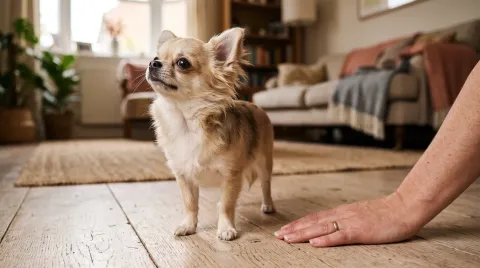
The Chihuahua is officially the smallest, at 1.5–3 kg. Here are the toy breeds just above it — and an honest warning about the 'teacup' label, which is marketing, not a breed.

Low-shedding dog breeds, ranked from our own data
We scored every breed for shedding, 1 to 5. Here are the ones that scored lowest — the curly coats worth the grooming bill, the genuinely low-maintenance short-hairs, and why none of them are hypoallergenic.
Which dog breeds are actually ancient?
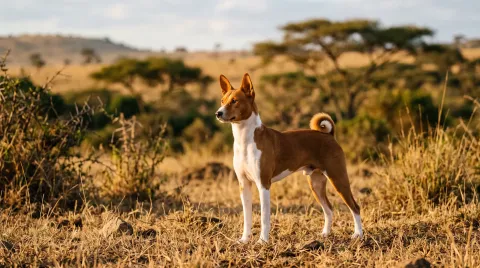
Genetics keeps naming the same handful of breeds as “ancient” — but that word means isolated from the Victorian breed factory, not unchanged since antiquity.