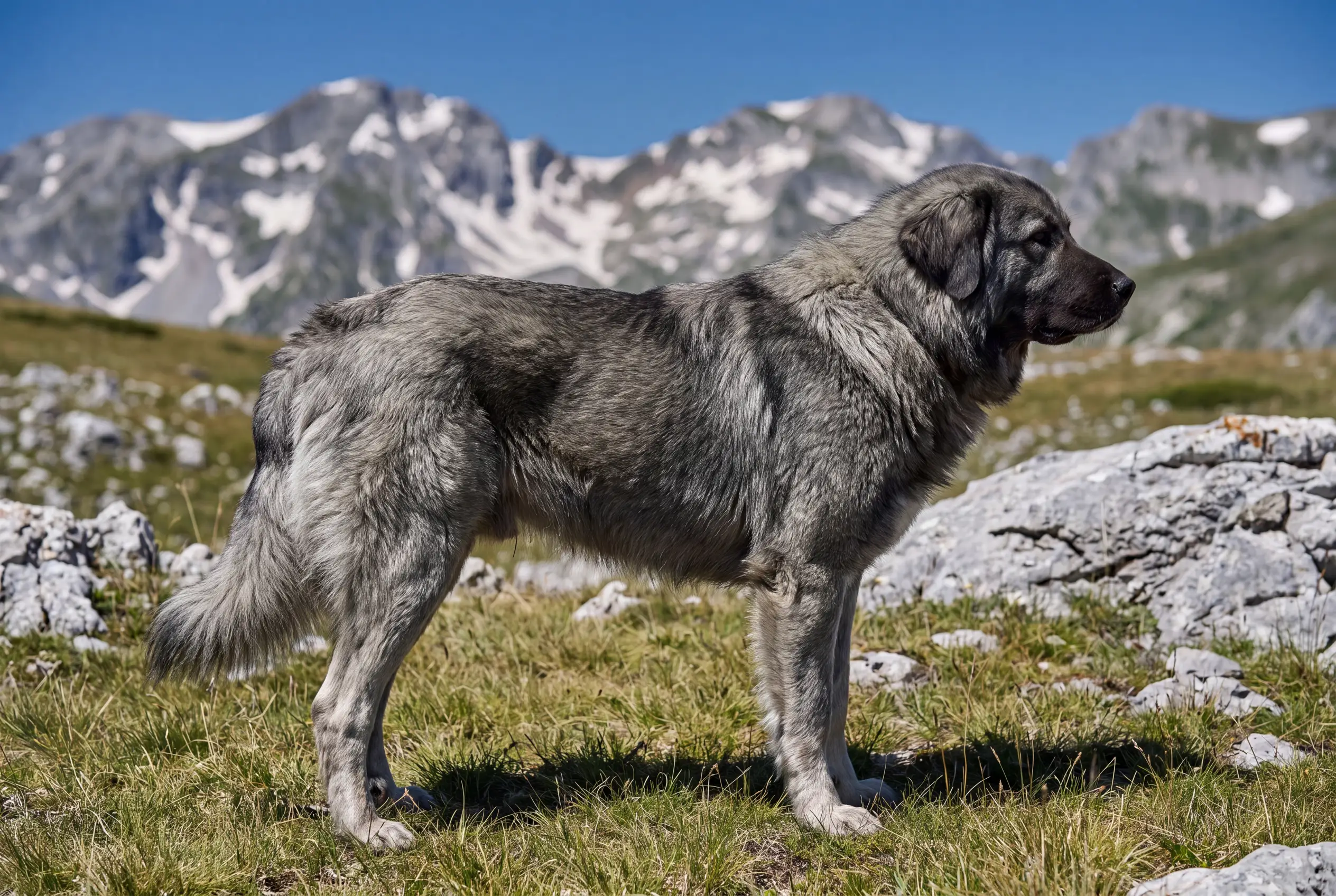
Šarplaninac
Summers on the mountain, winters on the plain, decisions all its own.
Vital stats
| Size | Large · 62 cm males, 58 cm females (average) |
| Weight | 35–45 kg males · 30–40 kg females |
| Life expectancy | 11–13 years |
| Energy | Moderate — stamina at a walk, no urge to sprint |
| Shedding | Heavy — long coat over an abundant undercoat |
| Coat | Long double coat, 10–12 cm at the withers · solid colour, iron grey preferred |
| Group | Working · Mountain Dog (FCI №41, Group 2) |
| Origin | Šar Planina, in the south-eastern Balkans |
| FCI group | 2 — Pinscher and Schnauzer, Molossoid and Swiss Mountain Dogs · FCI 41 |
Breed traits
Friendliness
Care
Mind
The Šarplaninac by the numbers
The Šarplaninac facts owners search for most — price, lifespan, weight, shedding and colours, in one place.
Less common, so expect a waitlist and some travel to a reputable breeder — which pushes the price up. Ongoing costs run high — more food, bigger doses at the vet, and pricier insurance. Its coat also needs a professional groom every few weeks — a real line in the budget.
We don't quote a single figure: the real price swings with breeder, region, bloodline and health testing — and a rescue costs a fraction of a breeder's litter. Adopting is almost always the cheapest route.
Temperament
The standard's own wording sets the bar in both directions: reliable, protective but not snappy, incorruptible and devoted to its master. Aggressive dogs and overly shy dogs are both disqualified, so the breed is written to be neither. Even the eye clause asks for a quiet but piercing gaze that should never show fear. Day to day that describes a dog which watches, weighs, and mostly does nothing. It settles where it can see the ways in and lets ordinary traffic pass without comment. What it will not do is check with you first. A guardian that spent centuries on a mountain out of sight of the shepherd made its own calls after dark, and that instinct did not survive by asking permission. Territory is the axis everything turns on: the same dog that ignores a stranger on a path will not accept one over a line it has decided is the boundary. Adult judgement takes two to three years to arrive, and the adolescent in the meantime is already strong enough to matter.
Habits & quirks
A dry mouth, by design
The Iberian mastiffs carry a loose throat and a double dewlap. This standard asks for the opposite: skin tight all over the body, no dewlaps, moderately thick lips, corners of the mouth clean without even a hint of a flew. What the neck does carry is hair, a marked frill at the nape that broadens the whole area. The practical result is a guardian of this size that does not leave water across the kitchen floor.
The coat is a measurement
Most standards describe a coat. This one measures it. The hair at the withers should be 10 to 12 cm and must not fall below 7 cm, with anything shorter listed as a disqualifying fault. Head, ears and the fronts of the legs stay short-haired, while the neck, rump, backs of the legs and tail carry the length, all of it over an undercoat the standard calls abundant, short, dense and fine.
Two addresses a year
The old working pattern was transhumance on a fixed circuit: up to the high pastures of Šar Planina for the summer, down to the warmer plains for the winter. Dogs that wintered in Thessaly were known there as Greek Shepherd Dogs, which is how one mountain breed picked up a second nationality in the literature.
Trots well, gallops badly
The standard is unusually frank about this. The stride is long and elastic and the usual gait is the trot; at a gallop the dog looks somewhat clumsy, though the jumps are long and cover plenty of ground. That is the movement of an animal built to put itself between a flock and a threat and to keep going all day, rather than to run anything down.
Care
| Exercise | Less than the size suggests, and different in kind. An hour or two of walking a day suits an adult, over ground it can survey rather than a pavement loop. The stamina is real and the urge to sprint is not, and a Šarplaninac given a boundary to patrol will do a fair amount of the work itself. Growth is the constraint early on: keep a youngster off forced distance, stairs and jumps well into its second year. |
| Grooming | The undercoat is the job. Two or three brushings a week keep 10 to 12 cm of guard hair and a dense undercoat from matting, especially behind the ears, in the nape frill, in the breeches and along the tail. Twice a year the undercoat lifts out in quantity and it becomes a daily task for several weeks. Do not clip it. The coat insulates in both directions, and the standard treats its length as a defining trait of the breed. |
| Training and boundaries | Reward-based, started early, and largely finished before the dog outweighs you. Teach lead manners, a settle and a calm greeting routine while it is still a puppy, and socialise widely through the first two years. Blind obedience is not on the menu: this is a breed selected to act alone at night, and it evaluates an instruction rather than simply executing it. Fencing matters more than any command, solid and tall and sunk properly, because a guardian that decides the boundary lies elsewhere will go and stand there. |
| Health | A hardy mountain landrace on the whole, with less structural trouble than the giant molossers alongside it. Ask for hip and elbow scores on both parents and an eye check. A chest this deep carries a gastric torsion risk, so split meals and keep exercise clear of them. Through spring and autumn check the skin under the coat: hot spots and parasites hide easily beneath that much hair. |
Life expectancy
This breed has a typical life expectancy of 11–13 years.
Similar breeds
Breeds with a similar build and background — worth a look if this one isn't quite the fit.
Breeds that look like this
Common questions
Does a Šarplaninac suit a home without livestock?
For most households, no. The guarding does not need sheep to switch on. With no flock to hold, the dog takes your family and your property line as the thing to hold instead, then works that job at its own discretion, which is the part people underestimate. Terraced housing, a shared garden, a footpath along the fence and a steady stream of unfamiliar visitors make the hardest possible setting for it. It can live well in a home that has land it can patrol, a fence it respects, an owner who will manage introductions for the dog's entire life rather than waiting for it to get used to people, and neighbours far enough off to sleep through a guardian bark at two in the morning. Plenty live as house dogs across the Balkans and do it well. Ask yourself whether you actually want a guardian working your address on its own judgement, because that is what arrives.
Why does the FCI call it a Yugoslavian Shepherd Dog?
Because the name was fixed while Yugoslavia existed and has not been changed since. The FCI registered the breed in 1939 as Illirski Ovčar, the Illyrian Shepherd Dog, and in 1957 its General Assembly accepted a motion from the Yugoslav Federation of Cynology to rename it Yugoslavian Shepherd Dog – Sharplanina. The standard currently in force dates from 24 November 1970 and still carries that title. After Yugoslavia broke up, the question of whose breed it is was raised repeatedly, and the FCI now lists North Macedonia and Serbia together as the country of origin; both claim the breed and the name has been formally contested. Šarplaninac, the everyday name across the region, simply means the dog of Šar Planina, and it is what most owners and breeders say. Expect to meet all of it in use: Šarplaninac, Sharplaninec, Illyrian Shepherd Dog, and the FCI's own title on the pedigree.
How big does one actually get?
Lighter on the scales than it looks in a photograph, because the coat is doing much of the work. The standard puts the average at 62 cm at the withers for males and 58 cm for females, with a floor of 56 cm and 54 cm below which a dog is not eligible for breeding. Weight runs 35 to 45 kg for males and 30 to 40 kg for females. That is a large dog rather than a giant one, well under the Spanish and Pyrenean mastiffs, whose standards start at 77 cm with no ceiling at all. What fills out the silhouette is 10 to 12 cm of hair at the withers, the frill at the nape and an abundant undercoat, over a frame the standard wants slightly longer than tall with a chest girth at least 20% greater than the height. Figures of 60 kg and more circulate online. Treat them with suspicion and weigh the dog.
Does the Šarplaninac shed a lot?
Yes — the Šarplaninac is a heavy shedder, dropping hair year-round or in big seasonal moults. Brush it several times a week and expect regular vacuuming; it isn't the coat for you if loose fur is a dealbreaker.
Is the Šarplaninac hypoallergenic?
Not really. No dog is truly hypoallergenic, and the Šarplaninac's shedding coat releases plenty of the dander that sets off allergies. If someone at home is allergic, this isn't the easiest breed to live with — spend time around one first.
Is the Šarplaninac good with children?
It depends. The Šarplaninac tends to be more reserved, so it suits older, calmer children better than boisterous toddlers. Early socialisation and careful, supervised introductions matter more with this breed.
Is the Šarplaninac easy to train?
They can be a challenge. The Šarplaninac is intelligent but independent, and would rather make its own decisions than take orders. Reward-based training and patience work best; expect recall in particular to take time.