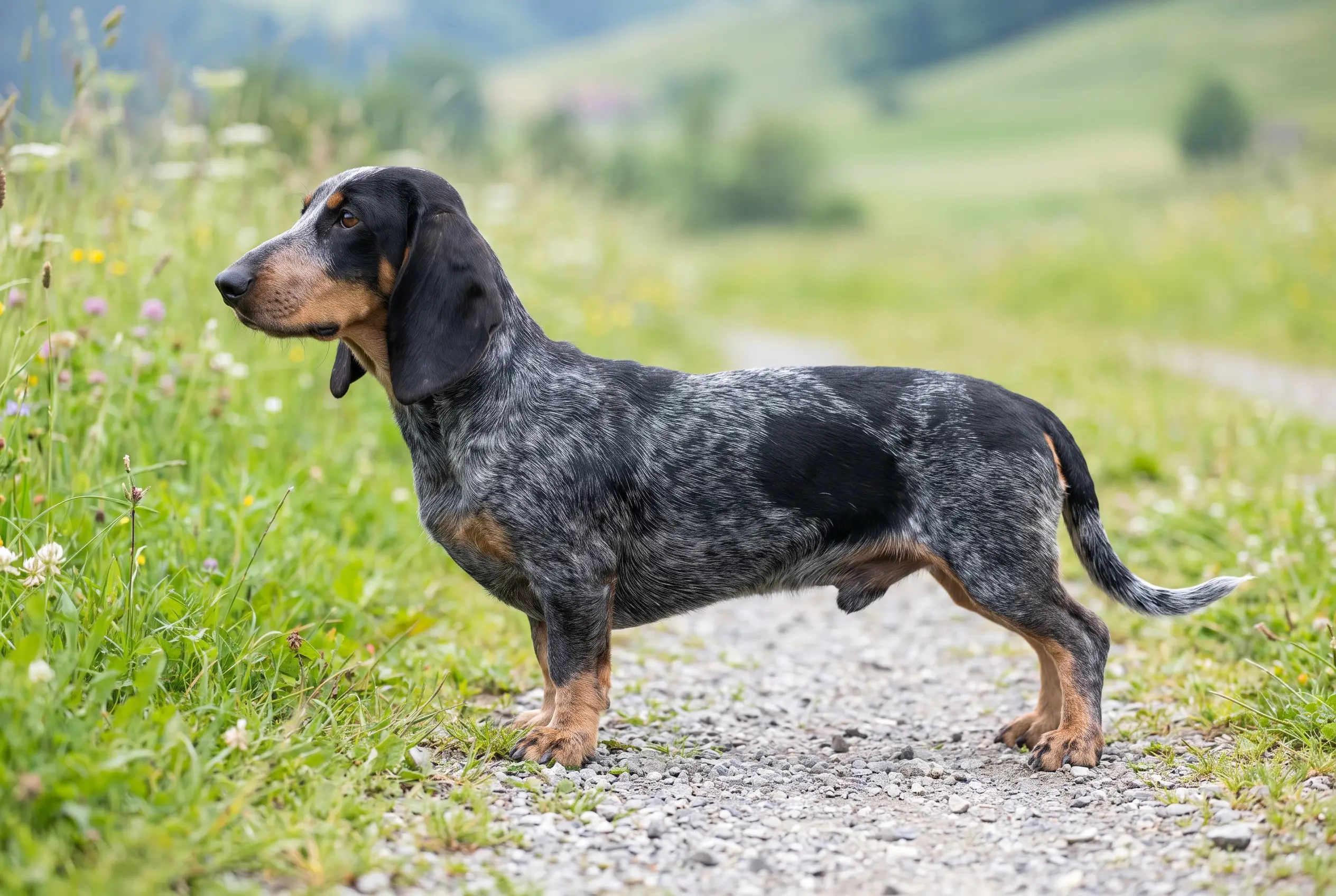
Schweizer Niederlaufhund
Four regional coats, one small Swiss hound, bred short-legged so it would never outrun a fenced hunting ground.
Vital stats
| Size | Small · 35–43 cm (males), 33–40 cm (females) — tolerance ±2 cm |
| Weight | 15–19 kg — an estimate; neither the standard nor breed literature publishes a figure |
| Life expectancy | 12–14 years — no breed-specific data found; typical for a small scenthound, not survey data |
| Energy | High — built to hunt alone, all day, over difficult terrain |
| Shedding | Low to moderate, depending on coat type |
| Coat | Smooth, rough or dense double, per variety · four colour patterns |
| Group | Hound · Small-sized Hounds (FCI №60, Group 6) |
| Origin | Switzerland |
| FCI group | 6 — Scent hounds and related breeds · FCI 60 |
Breed traits
Friendliness
Care
Mind
The Schweizer Niederlaufhund by the numbers
The Schweizer Niederlaufhund facts owners search for most — price, lifespan, weight, shedding and colours, in one place.
Less common, so expect a waitlist and some travel to a reputable breeder — which pushes the price up. Plan for steady ongoing costs — mid-range food, routine vet care and insurance.
We don't quote a single figure: the real price swings with breeder, region, bloodline and health testing — and a rescue costs a fraction of a breeder's litter. Adopting is almost always the cheapest route.
Temperament
The standard's own behaviour clause reads: "Passionate small Scenthound, with excellent nose, deft, untiring and keen scenthound with excellent nose. Steady on the trail and hunting with melodious cry. He reliably searches and drives the game with great determination, even on difficult terrain. He also excels in tracking wounded game. Friendly character, not nervous and never aggressive. Temperament calm to lively." ("With excellent nose" appears twice in the FCI's own English text — emphasis or a translation slip, quoted here exactly as published rather than smoothed over.) Strip out the repetition and the picture is a small hound that works a scent by voice, alone, without losing its nerve on rough ground, and comes home neither nervous nor sharp. "Calm to lively" is a real range rather than a single setting, and the standard's own fault list backs it up from both directions: it penalises "uncertain or slightly sharp temperament" as a fault and disqualifies outright aggression or overshyness.
Habits & quirks
Four cantons, four coats
The standard names each variety for the coat it carries: white and black with tan markings for the Bernese, black with tan markings for the Jura, blue speckled with a black mantle for the Lucerne, and white with an orange-red mantle for the Schwyz — plus any mixed combination of those. At a glance: the Bernese is the tricolour with real white ground, the Jura is the darkest and most solid-looking, the Lucerne reads grey-blue from a distance because of its speckling, and the Schwyz is the only one built on orange rather than black.
Bred down on purpose, not by accident
Its own standard's history section is blunt about why the breed exists: Swiss cantons started fencing off smaller hunting grounds, and the popular medium-sized Schweizer Laufhund ran too fast and too wide for them. Rather than retrain the bigger dog, breeders selected and crossed down to a shorter-legged scenthound built for the new, tighter ground — a deliberate downsizing, not a natural variant that happened to catch on.
Hunts alone, gives tongue
The standard's utilisation line is two short sentences: "Scenthound hunting the game by giving tongue. He hunts on his own." One dog working a scent solo, baying loudly and continuously so the hunter can follow by ear, is the job description in full — no pack coordination required — and the standard credits it with a melodious cry, "great determination, even on difficult terrain," and a particular gift for tracking wounded game.
A two-centimetre margin, defined to the letter
Height at the withers is set at 35–43 cm for males and 33–40 cm for females, with a stated tolerance of ±2 cm — and the disqualifying-fault clause is built from exactly that arithmetic: a male under 33 cm or over 45 cm, a female under 31 cm or over 42 cm, is disqualified outright. There's no soft edge to "small" here; the standard states its own limits down to the centimetre.
Care
| Exercise | This is a scenthound bred to work difficult terrain alone and all day, not a dog satisfied by a short lead-walk. Give it real daily distance with a scent to follow — hunting, tracking work or long off-lead walks on safe ground suit it far better than a loop around the block. |
| Grooming | Coat care depends on which of the three textures a dog carries: the smooth coat needs only an occasional brush, the rough coat (harsh, elastic, with a slight beard) wants a weekly session to clear dead hair, and the double coat's dense undercoat sheds more and asks for the most attention. Whatever the coat, check the very long, low-set, folded ears regularly — they trap moisture after a day working cover. |
| Training | It is bred to search and hunt on its own, out of sight and earshot of its handler, so recall has to be worked early and kept consistent — a dog built to hunt alone is also a dog that can wander off alone. The standard's own fault list flags "uncertain or slightly sharp temperament" as a defect, which in practice means careful socialisation matters as much as obedience work. |
| Health | The standard's closing note restricts breeding to dogs that are "functional and clinically healthy" with breed-typical conformation, and the low-set, very long ears are worth a routine check for infection. Neither the standard nor available breed literature documents a widely recognised breed-specific disorder, but the population outside Switzerland is small to the point of nonexistence, so pedigree depth is worth asking about wherever a litter turns up. |
Life expectancy
This breed has a typical life expectancy of 12–14 years — no breed-specific data found; typical for a small scenthound, not survey data.
Similar breeds
Breeds with a similar build and background — worth a look if this one isn't quite the fit.
Breeds that look like this
Common questions
Is the Schweizer Niederlaufhund just a small Schweizer Laufhund?
Closely related, but bred and registered as a separate breed. The Schweizer Laufhund (Swiss Hound, FCI №59) is the older, medium-sized original — 49–59 cm for males, 47–57 cm for females, with no tolerance for running over or under. Around 1900, Swiss hunters needed a hound suited to newly fenced, smaller hunting grounds, and breeders selected and crossed down from the Laufhund to produce the Niederlaufhund, standing 35–43 cm and 33–40 cm — a full size class shorter, with its own standard, FCI №60, since 1954. Both share the same four regional colour varieties and the same national hunting culture; leg length, and the ground each is built to work, is what sets them apart.
How do I tell the four varieties apart?
Mostly by colour. The Bernese is white with black patches or a black saddle, marked with tan over the eyes, on the cheeks and around the vent — a proper tricolour. The Jura is black with tan markings and little to no white, the darkest-looking of the four. The Lucerne is the "blue" one: a fine black-and-white speckling dense enough to read grey from a distance, with a black mantle. The Schwyz is the only variety built on orange rather than black: white with an orange-red mantle. The standard also allows mixed combinations of these four patterns, so not every dog lines up neatly with one variety.
How is this different from Germany's and Austria's short-legged hounds?
Switzerland, Germany and Austria all shortened a taller scenthound's legs to suit smaller hunting ground, but each solved it differently. Austria's Alpenländische Dachsbracke (FCI №254) is worked on a leash by a single hunter to track one specific wounded animal — Group 6, Section 2, the leash hounds — in essentially one colour scheme, dark deer red or black with tan Vieräugl markings. Germany's Westfälische Dachsbracke (FCI №100) hunts independently like this breed, sharing the same Section 1.3, but again settles on one national coat, red to yellow with a black saddle. Switzerland instead kept its full-sized parent breed's entire four-variety colour system — Bernese, Jura, Lucerne and Schwyz — folded into this one shorter-legged standard, rather than picking a single colour the way its neighbours did.
Does the Schweizer Niederlaufhund shed a lot?
Moderately. The Schweizer Niederlaufhund sheds a fair amount, steadily through the year with heavier seasonal patches. A weekly brush keeps most of the loose hair off your floors and clothes.
Is the Schweizer Niederlaufhund hypoallergenic?
Not really. No dog is truly hypoallergenic, and the Schweizer Niederlaufhund's shedding coat releases plenty of the dander that sets off allergies. If someone at home is allergic, this isn't the easiest breed to live with — spend time around one first.
Is the Schweizer Niederlaufhund good with children?
They can be. The Schweizer Niederlaufhund is reasonably sociable and can be good with children in the right home, especially when socialised early. Supervise around young kids and teach dog and child to respect each other.
Is the Schweizer Niederlaufhund easy to train?
Reasonably. The Schweizer Niederlaufhund is trainable with consistency and rewards, though it isn't the quickest study. Keep sessions short and positive, and be patient with the basics like recall.